


![SoftPro™ Chlorine+ Carbon Whole House Water Filter to Remove PFAS, Chlorine, Chloramine & Pesticides [City Water Filters Series]](http://www.softprowatersystems.com/cdn/shop/files/SoftPro_Whole_House_Carbon_Filter_with_Spin_Down_Water_Filter.webp?v=1783547361&width=140)


 855-683-8488


Plumbing Installation Order for Iron Filter and Water Softener: The Definitive Step-by-Step Guide

When installing an iron filter and water softener, we always install the iron filter first. Iron destroys softener resin beads, forcing constant regeneration cycles and driving up salt costs. By placing the iron filter upstream, we protect the softener and extend its lifespan notably. You'll also need a pipe cutter, pipe wrench, Teflon tape, and adjustable wrenches to get everything connected properly. Stick with us—there's a lot more to uncover about getting this right.
Key Takeaways
- Always install the iron filter before the water softener to prevent iron from coating and destroying the softener's resin beads.
- Use a quality pipe cutter for clean cuts, smooth all edges, and place a bucket beneath to catch residual water.
- Connect inlet and outlet hoses carefully, ensuring flow direction arrows align correctly to avoid costly installation mistakes.
- Position the brine tank beside the softener, secure the brine line, then slowly restore water pressure and inspect for leaks.
- Test water hardness every six months using a home kit or lab sample to maintain consistent soft water performance.
Tools You Need for Iron Filter and Water Softener Installation

Before we plunge into the installation process, let's make certain we've got the right tools on hand—because having the wrong ones can turn a straightforward job into a frustrating ordeal.
First, we'll need a quality pipe cutter for clean, precise cuts that guarantee leak-free connections. A sturdy pipe wrench handles securing those connections tightly, while Teflon tape guarantees every threaded joint stays watertight.
Don't overlook a simple bucket—it'll catch unexpected water spillage and protect your work area.
Beyond the essentials, keep adjustable wrenches, hose clamps, and screwdrivers within reach. These handle miscellaneous adjustments that inevitably arise mid-installation.
Gathering everything beforehand eliminates unnecessary interruptions, keeping our workflow efficient and controlled. The right tools don't just simplify this project—they determine whether our results are professional or problematic.
Why the Iron Filter Always Goes Before the Water Softener
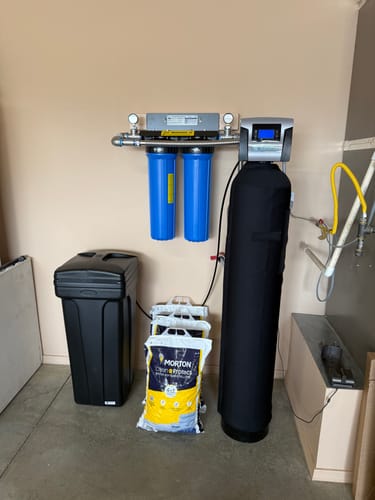
With our tools ready, let's talk about something that trips up a lot of DIYers—the order in which these two systems get installed.
Iron always goes first, and here's why that matters.
Iron is brutal on softener resin. It coats and fouls the resin beads, strangling their ability to remove hardness minerals. By filtering iron upstream, we're protecting that resin and extending the softener's lifespan considerably.
Iron destroys softener resin—coating and fouling the beads until they can't do their job.
There's also a performance angle. When iron clogs the softener, it forces more frequent regeneration cycles, driving up salt consumption and maintenance costs.
Installing the iron filter first eliminates that problem entirely.
Think of it this way—each system does its best work when it's not fighting battles meant for the other.
Sequence matters, and getting it right pays dividends for years.
How to Cut and Measure Pipes for a Proper Fit
Now that the sequence is sorted, it's time to get our hands dirty with the actual cutting and measuring. First, we'll identify the exact section of the main water line where the filter connects, leaving adequate space for every component.
Next, we match the pipe length to the filter's width—always double-checking measurements before committing to a cut. Precision here prevents costly mistakes.
We recommend using a quality pipe cutter for clean, straight cuts, then smoothing every edge afterward to guarantee a proper seal.
Before cutting anything, place a bucket underneath to catch residual water—skipping this step means unnecessary mess.
Finally, keep our workspace organized by immediately discarding cut pipe pieces. A cluttered work area invites accidents, and we're after mastery, not shortcuts.
How to Install Your Iron Filter and Water Softener in the Right Order
Once the pipes are cut and prepped, we're ready to tackle installation in the right sequence—because order matters more than most people realize.
Install the iron filter first, then the water softener downstream. Why? Iron particles destroy resin beads, so filtering them out first protects your softener's longevity.
Iron destroys resin beads—always install the iron filter before the softener to protect your investment.
Connect each unit's inlet and outlet hoses to the plumbing adapters, confirming flow direction arrows align correctly—reversed connections are a costly mistake.
Tighten every fitting firmly.
Next, position the brine tank beside the softener and secure the brine line, checking for kinks that restrict flow.
Verify the drain line routes properly.
Finally, restore water pressure slowly, inspect every connection for leaks, then program regeneration frequency and hardness settings.
Sequence done right means both systems perform at peak efficiency for years.
How to Test Water Hardness and Confirm Your System Is Working
After all that installation work, let's verify it's actually paying off. Grab an at-home testing kit or send a sample to a certified lab for deeper analysis.
You're measuring in grains per gallon (gpg)—soft water lands between 0-3 gpg, while anything above 12 gpg is very hard.
Within a few hours of installation, test your water and watch for richer soap suds and less scale buildup on fixtures. Those are your immediate performance signals.
From there, test every six months to guarantee your system's maintaining soft water consistently.
Also monitor your brine tank's salt levels and run occasional manual backwash cycles—these small habits protect your investment and keep your system performing at its peak long-term.
Frequently Asked Questions
What Goes First, Softener or Iron Filter?
We recommend installing the iron filter first. It'll remove harmful contaminants before water reaches your softener, protecting it from damage, extending its lifespan, and ensuring your entire system performs at peak efficiency.
What Are All the Steps to Installing a Water Softener?
We'll walk you through it: shut off water, drain lines, cut the main pipe, install a bypass valve, connect adapters and hoses, restore water supply, power on, then run a regeneration cycle.
What Is the Correct Order of Water Filters?
We recommend starting with a sediment filter, then an iron filter, followed by a water softener, an activated carbon filter, and finally a reverse osmosis system for the purest, most contaminant-free drinking water possible.
What Plumbing Is Needed for a Water Softener?
We'll need to cut the main water line, install plumbing adapters, connect flexible tubing with hose clamps and Teflon tape, and run both a brine line and a drain line to complete the installation.






