


![SoftPro™ Chlorine+ Carbon Whole House Water Filter to Remove PFAS, Chlorine, Chloramine & Pesticides [City Water Filters Series]](http://www.softprowatersystems.com/cdn/shop/files/SoftPro_Whole_House_Carbon_Filter_with_Spin_Down_Water_Filter.webp?v=1783547361&width=140)


 855-683-8488


Potassium Permanganate for Greensand Iron Filter Regeneration: The Complete Step-by-Step Guide

Potassium permanganate is the key to keeping your greensand filter working at full strength. It recoats the media with fresh manganese dioxide, converts dissolved iron and manganese into filterable particles, and restores the filter's oxidizing surface. To regenerate, you'll backwash the system, introduce potassium permanganate, let it soak, then rinse thoroughly. The entire process takes one to two hours. Stick with us, and we'll walk you through everything you need to know.
Key Takeaways
- Backwash the greensand filter thoroughly for 10–20 minutes to remove accumulated debris before introducing potassium permanganate.
- Apply potassium permanganate at 2–6 ounces per cubic foot, adjusting dosage based on measured iron concentration levels.
- Allow the potassium permanganate solution to soak within the filter media for 30–60 minutes to ensure effective oxidation.
- Rinse the system thoroughly for 5–15 minutes after soaking to flush all residual chemicals before returning to service.
- Schedule regeneration during off-peak hours, as the complete process, including backwash and rinse, takes 1–2 hours total.
What Does Potassium Permanganate Do to a Greensand Filter?

Potassium permanganate works as a powerful oxidizing agent in a greensand filter system, tackling iron, manganese, and hydrogen sulfide that would otherwise make your water unpleasant or unsafe.
Think of it as a reset button for your filter media.
During regeneration, it recoats the greensand with a fresh manganese dioxide layer, converting dissolved iron and manganese into solid particles your filter can actually trap and remove.
Without this recoating, your media gradually loses its capacity, and contaminants slip through unchecked.
We're talking about precise chemistry here. The permanganate fundamentally restores the greensand's oxidizing surface, keeping it aggressive against incoming contaminants.
When paired with proper backwashing, it guarantees your system stays sharp, delivering consistently clean water rather than slowly degrading performance between service calls.
What You Need Before Regenerating a Greensand Filter
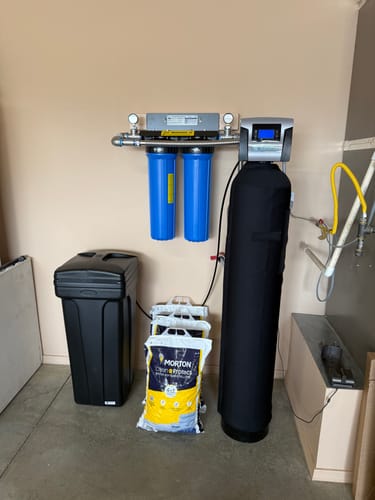
Before we touch anything, let's make sure we've got everything lined up—because a botched regeneration wastes time, chemicals, and potentially damages your media.
A botched regeneration wastes time, chemicals, and risks damaging your media—preparation isn't optional, it's everything.
First, secure high-quality potassium permanganate. Cheap or degraded product will undermine the entire process.
Next, test your water—your results dictate dosage, typically between 0.1 and 0.5 pounds per cubic foot of filter media. That range matters more than most people realize.
Confirm your filtration system is properly configured, including any chlorine side tank integration.
Then review your system's cycle step values—backwash timing, chemical application windows, and rinse duration all need dialing in beforehand.
Finally, make sure the system is completely idle with zero water flowing through the filter. Interruptions mid-regeneration create problems that are genuinely painful to troubleshoot.
Preparation here isn't optional—it's everything.
How to Regenerate Your Greensand Filter
With everything staged and ready, let's walk through the actual regeneration. First, backwash the filter thoroughly—this clears accumulated debris and primes the media for treatment. Skipping this step compromises everything that follows.
Next, introduce potassium permanganate at 2 to 6 ounces per cubic foot of media. Your iron levels dictate where you land in that range—higher iron demands higher dosage. Don't guess here; precision matters.
Once dosed, let the media soak for 30 to 60 minutes. That contact time is where the real work happens—oxidizing iron and manganese into filterable particles.
Finally, rinse thoroughly before returning the filter to service. Schedule this entire cycle around 2:00 a.m. to avoid disrupting household demand.
Regularly revisit your cycle step values as water quality shifts.
How Long Should Each Regeneration Cycle Run?
Each stage of the regeneration cycle has its own clock, and knowing those windows keeps your system running efficiently. The full regeneration cycle typically runs 30 to 60 minutes, though the complete process—including backwash and rinse—can stretch 1 to 2 hours.
Here's how we break it down:
- Potassium permanganate application: 10–20 minutes to fully oxidize iron and manganese
- Rapid rinse phase: 5–15 minutes to flush excess chemical
- Backwash cycle: 10–20 minutes to purge accumulated particulates from the greensand media
Because the total window hits up to two hours, we always schedule regeneration during off-peak usage times—overnight works perfectly.
Respecting these timeframes isn't optional; it's what separates a well-maintained filter from one that underperforms and shortens media life.
Signs Your Greensand Filter Isn't Removing Iron Anymore
A failing greensand filter doesn't stay quiet—it leaves clues.
You'll notice iron stains creeping back onto fixtures, laundry, and countertops—that orange-brown evidence that iron's slipping through unchecked. Your water might carry a metallic taste or odor, another unmistakable signal the media's losing its edge.
Run a post-filter water test. If iron levels exceed 0.3 mg/L, your filter's either exhausted or overdue for regeneration. Don't ignore reduced water pressure either—clogging iron buildup restricts flow and signals inefficient filtration.
Here's the telling sign most people miss: if you're backwashing frequently but seeing zero improvement in water quality, the media isn't recovering.
That's not a backwashing problem—that's exhausted greensand demanding immediate potassium permanganate regeneration or outright media replacement.
Frequently Asked Questions
How to Regenerate a Greensand Filter?
We'll start by preparing our potassium permanganate solution, then initiate the backwash cycle, apply the solution at 1-3 grams per gallon, rinse thoroughly, and monitor diagnostics to verify ideal iron and manganese removal performance.
How to Add Potassium Permanganate to Iron Filter Water Softener?
We'll start by dissolving 1-2 ounces of potassium permanganate per cubic foot of greensand into water, then add it to the brine tank, ensuring regeneration's scheduled overnight for seamless, disruption-free iron removal.
How Much Potassium Permanganate per Gallon?
We recommend using 0.5 to 2.0 pounds of potassium permanganate per 1,000 gallons, so that's roughly 0.0005 to 0.002 pounds per gallon. Higher iron concentrations demand we use the upper range for effective oxidation.
How to Apply Potassium Permanganate Solution?
We introduce the potassium permanganate solution during the backwash cycle, letting it thoroughly coat the greensand media. We maintain at least 30 minutes of contact time, then initiate a rapid rinse to flush excess permanganate before returning to service.






