


![SoftPro™ Chlorine+ Carbon Whole House Water Filter to Remove PFAS, Chlorine, Chloramine & Pesticides [City Water Filters Series]](http://www.softprowatersystems.com/cdn/shop/files/SoftPro_Whole_House_Carbon_Filter_with_Spin_Down_Water_Filter.webp?v=1783547361&width=140)


 855-683-8488


The Real Cost of Iron in Your Pipes — And How a Filter Changes Everything

Iron in your pipes quietly destroys your home's plumbing, appliances, and budget — often before you notice anything's wrong. Repair calls alone can cost over $300 each, and annual plumbing bills can climb to $1,000 or more. Appliances work harder, consuming 20–30% more energy. And the health risks? Serious and often overlooked. The right iron filter changes everything — and once you understand the full picture, you'll never look at your water the same way again.
Key Takeaways
- Iron deposits in pipes restrict water flow, triggering repair calls exceeding $300 each and pushing annual plumbing bills toward $1,000.
- Iron-contaminated water damages appliances, increasing repair costs past $1,500 while forcing them to consume 20–30% more energy.
- Iron levels above 0.3 mg/L cause gastrointestinal distress and fatigue, potentially masking serious conditions like liver damage.
- Neglected or cheap filters create bacterial breeding grounds, declining water quality, and unexpected repair costs exceeding $2,000.
- Quality iron filtration systems reduce long-term damage, with maintenance costs of $150–$300 annually far outweighing untreated iron expenses.
What Iron Actually Does to Your Pipes and Wallet

Iron in your pipes isn't just an aesthetic problem — it's a financial one that sneaks up on you.
Here's how it plays out: iron deposits quietly build inside your pipes, restricting flow and triggering repair calls that cost over $300 each time. Let that happen repeatedly, and you're looking at roughly $1,000 annually — just in plumbing bills.
Iron deposits don't just clog pipes — they drain your wallet, costing homeowners $1,000 or more annually in plumbing bills alone.
But it doesn't stop there. Iron-laden water attacks your appliances too, pushing repair costs past $1,500 as sediment degrades them prematurely.
Meanwhile, those struggling appliances consume more energy, inflating your utility bills by 20-30%.
What starts as a water quality issue becomes a compounding financial drain — one that quietly empties your wallet while you're focused on everything else.
The Hidden Costs Most Iron Filter Dealers Won't Mention
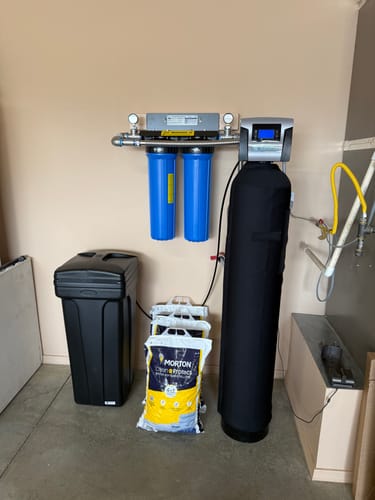
So now that we recognize what iron costs us in repairs and energy bills, let's talk about something dealers rarely bring up when they're pitching you a filtration system: the price tag doesn't end at the sale.
Here's what quietly drains your wallet after installation:
- Annual maintenance fees running $300–$800 that nobody mentions during the sales pitch
- Replacement media every 4–6 years costing $150–$400, buried in the fine print
- Hidden installation and permitting fees that contradict every advertised price you've seen
Neglect these costs, and cheap systems can run you $950 annually — plus repair bills exceeding $2,000.
Ironically, untreated iron causes plumbing damage surpassing $3,000. The smarter investment isn't avoiding a filter; it's choosing one with eyes wide open.
The Health Risks of Bad or Neglected Iron Filtration
When we ignore what's lurking in our pipes, the consequences go well beyond stained laundry and corroded fixtures — they show up in our bodies.
Iron above 0.3 mg/L triggers gastrointestinal distress, fatigue, nausea, and constipation. Worse, those symptoms can mask deeper issues — liver damage, heart disease — conditions that don't announce themselves loudly until real harm is done.
A neglected filter doesn't just stop working. It becomes a breeding ground for bacteria, putting vulnerable family members at even greater risk.
And iron rarely travels alone — where iron accumulates, heavy metals often follow.
We sometimes chase symptoms without questioning the water we drink daily. That's the danger of neglect. It's quiet, cumulative, and entirely preventable with consistent testing and proper filtration.
Why Cheap Iron Filters End Up Costing More
Saving money upfront on a cheap iron filter feels smart — until the bills start piling up. Bargain filters frequently underperform, letting iron levels creep past the 0.3 mg/L safety threshold — and that's when real trouble begins.
Here's what we're actually paying for with cheap systems:
- Annual maintenance: $300–$950 in recurring repairs and performance fixes
- Neglected system repairs: Costs exceeding $2,000 when maintenance gets skipped entirely
- Media and filter replacements: An unexpected $50–$500 added annually
That "deal" evaporates fast. What looked like savings becomes a cycle of patching, replacing, and paying — while your water quality suffers in the meantime.
Investing in quality filtration from the start isn't an expense; it's the smarter financial decision.
What to Look for Before You Buy an Iron Filter
Before dropping anywhere from $800 to $6,000 on an iron filter, we need to know exactly what we're paying for — because the sticker price is just the beginning.
First, confirm the system carries certification for contaminant removal. Without it, iron levels can exceed the 0.3 mg/L safety threshold — quietly, dangerously.
Next, match the system's capacity to your household's actual water usage and iron concentration. An undersized unit fails early; an oversized one bleeds money unnecessarily.
Then examine the technology. Multi-stage, automated systems consistently outperform budget alternatives in long-term savings on salt, water, and electricity.
Finally, budget honestly. Annual servicing runs $150–$300, media replacements every 3–5 years add $200–$800, and chemical refills cost $10–$30 monthly.
Hidden costs between $300–$950 annually change everything.
Frequently Asked Questions
What Is the Cheapest Way to Remove Iron From Well Water?
We've found budget filters are the cheapest upfront option, starting at $300, but they'll often cost you $300-$950 annually in maintenance—making a reliable $800+ system our smarter long-term investment.
What Are the Signs of Iron in Water Pipes?
We've seen it before — rusty stains on sinks, reddish-brown water, metallic-tasting drinks, clogged pipes, and reduced water pressure. These telltale signs mean iron's quietly wreaking havoc on your plumbing system.
Will a Whole-House Filter Remove Iron?
Yes, a whole-house filter can remove iron levels exceeding 0.3 mg/L. We're talking multi-stage filtration that tackles iron head-on, protecting your pipes before contaminated water ever reaches your faucets.
How Often Does an Iron Filter Regenerate?
Most iron filters we use regenerate every 3–7 days, though some trigger by water volume instead of time. Each cycle runs 30 minutes to several hours, so we'll want to schedule it overnight to avoid interruptions.






