


![SoftPro™ Chlorine+ Carbon Whole House Water Filter to Remove PFAS, Chlorine, Chloramine & Pesticides [City Water Filters Series]](http://www.softprowatersystems.com/cdn/shop/files/SoftPro_Whole_House_Carbon_Filter_with_Spin_Down_Water_Filter.webp?v=1783547361&width=140)


 855-683-8488


5 Signs Your Water Softener Resin Has Already Been Fouled by Iron Contamination in Your Well

If your water softener's resin has been fouled by iron contamination, you'll notice five key warning signs: rusty or brown water coming through despite softening, an oily or slick water texture, a metallic taste, dropping water pressure, and more frequent regeneration cycles. Iron coats the resin beads, stripping them of their ability to capture hardness minerals. We've outlined exactly what each symptom means and what you can do about it below.
Key Takeaways
- Rusty or brown water flowing from your taps despite an active water softener strongly indicates iron-fouled resin beads.
- A slick, oily water texture combined with a metallic taste signals severe iron coating on the resin.
- Falling water pressure below 40 psi suggests resin fouling is restricting normal system flow and performance.
- More frequent or extended regeneration cycles indicate the resin is struggling to remove hardness minerals effectively.
- Reddish-brown rust deposits found in faucet aerators or filters confirm iron contamination beyond acceptable EPA levels.
Rusty Water After Softening Points to Iron-Fouled Resin

When rusty or brown water flows from your tap despite having a water softener installed, we're looking at a telltale sign of iron-fouled resin. This discoloration tells us the resin beads have lost their capacity to intercept iron effectively, allowing contaminated water to pass through unchecked.
Here's what's actually happening: iron deposits accumulate on the resin beads over time, gradually coating the surfaces responsible for ion exchange.
Once fouled, the resin can't perform its core function—leaving you with water that's visually and chemically compromised.
Don't dismiss this warning sign. Water testing confirming iron levels above 0.3 mg/L post-softening validates what your eyes already suspect.
Addressing fouled resin promptly restores your system's efficiency and protects your household water quality from further deterioration.
Iron Coats the Resin Beads and Stops Your Softener From Working
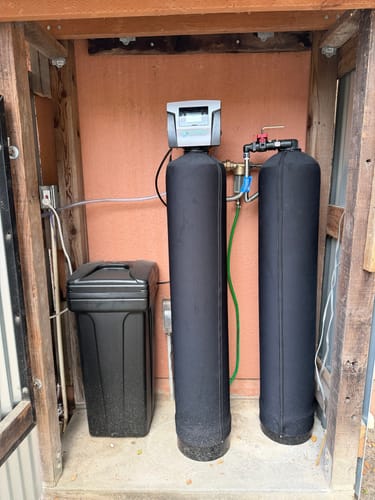
Understanding why rusty water appears after softening means we need to look at what's actually happening inside the resin tank. When iron enters your softener, it deposits as ferrous or ferric iron directly onto the resin beads. That coating is the problem.
Iron doesn't pass through your softener—it settles into it, coating the resin beads that keep your water clean.
Those beads can no longer attract and hold hardness minerals the way they're designed to, so softening efficiency collapses.
You'll notice the consequences quickly. Water develops a slick, almost oily feel. Scale keeps building on fixtures. Soaps won't lather properly. Your softener starts regenerating far more frequently, consuming extra salt while still underperforming.
What we're really seeing here isn't a softener malfunction—it's iron systematically disabling your resin bead by bead. Recognizing that distinction helps you target the actual source of failure.
Water Pressure Drops and Regeneration Cycles Increase as Resin Fails
As resin fouls with iron, two symptoms tend to show up together: dropping water pressure and more frequent regeneration cycles. When iron coats the resin bed, it restricts flow throughout your home—pressure consistently below 40 psi is a reliable signal that contamination has reached a critical level.
Watch your regeneration frequency closely. If your system's cycling more often than usual, it's struggling to clean iron-coated resin, meaning efficiency is already compromised. Extended regeneration times reinforce this—your softener's working harder and accomplishing less.
Keeping maintenance logs matters here. A documented rise in regeneration cycles gives you concrete evidence that iron buildup is accelerating, not stabilizing.
Catching these patterns early lets you intervene before the damage becomes irreversible and costly to correct.
Slick Water Texture and Metallic Taste Indicate Iron-Fouled Resin Beads
Have you noticed your water feeling slick or oily, almost like soap that never quite rinses off? That sensation, paired with a metallic taste, signals iron-fouled resin beads.
| Symptom | Cause | Action |
|---|---|---|
| Slick/oily texture | Iron coating resin beads | Test water immediately |
| Metallic taste | Compromised bead efficiency | Inspect resin bed |
| Both occurring together | Severe iron fouling | Restore system urgently |
When iron coats resin beads, they can't effectively pull hardness minerals from your water. We start noticing these warning signs compounding — slickness, taste changes, and even more frequent regeneration cycles. Regular water quality testing confirms iron levels and resin performance, giving us the precise data we need to act decisively before the system fails completely.
How to Test Your Water and Confirm Iron Fouling in the Resin Bed
Confirming iron fouling starts with a simple water testing kit — we measure iron levels against the EPA's recommended limit of 0.3 mg/L, and anything above that tells us the resin bed's in trouble.
Beyond the kit, physical clues sharpen our diagnosis fast.
Watch for these red flags:
- Reddish-brown tint or rust particles in your water confirm active iron contamination degrading resin performance.
- Rust deposits in aerators or filter housings provide direct physical evidence of iron fouling inside the system.
- Increased regeneration frequency signals declining resin efficiency — the bed's working harder because it's compromised.
Cross-referencing test results with these visual and operational indicators gives us a complete picture, so we're not guessing — we're diagnosing with precision.
Frequently Asked Questions
How to Tell if You Have Iron Bacteria in Your Well Water?
We can spot iron bacteria by checking for reddish-brown water, slimy deposits on fixtures, and a foul, rotten egg odor. Regular water testing confirms elevated iron levels, signaling bacterial contamination in our well.
How Can You Tell if Water Softener Resin Is Bad?
We can tell our resin's bad when we notice slick water texture, rust stains on fixtures, more frequent regeneration cycles, reddish-brown water, or iron levels testing above 0.3 mg/L.
Can a Water Softener Remove Iron From Well Water?
We can remove small amounts of iron with a water softener, but it's not designed for it. If iron exceeds 0.3 mg/L, we'll need a dedicated iron filter to protect our resin bed.
How to Clean Water Softener Resin With Iron Out?
We'll want to bypass the softener first, then add Iron Out directly to the brine tank, and run a full regeneration cycle. Following the manufacturer's dosage instructions guarantees we're dissolving iron deposits effectively from the resin beads.






