


![SoftPro™ Chlorine+ Carbon Whole House Water Filter to Remove PFAS, Chlorine, Chloramine & Pesticides [City Water Filters Series]](http://www.softprowatersystems.com/cdn/shop/files/SoftPro_Whole_House_Carbon_Filter_with_Spin_Down_Water_Filter.webp?v=1783547361&width=140)


 855-683-8488


SoftPro Auto-Backwash Centaur Carbon Filter Review: Real User

Hi, I'm Ryan Hoffman from Minnesota. Craig "The Water Guy" Phillips reached out and asked if I'd be willing to share my real-world experience as a homeowner with the SoftPro® Catalytic Whole House Carbon Filter for Well Water (Best Seller & Lifetime Warranty) that I installed about 18 months ago.
This is my honest take on how everything went down – the good, the challenging, and everything in between. I'm hoping my journey might help you figure out if this system is right for your situation.
Why I Started Looking for a Whole House Carbon Filter
Did you know that even treated municipal water can carry chlorine, chloramines, and dozens of other chemical contaminants that affect taste, smell, and potentially your family's health?
Well, I didn't fully grasp this until about two years ago. My family had been dealing with what I thought were just "normal" water issues. The smell coming from our kitchen faucet was getting progressively worse – that unmistakable chlorine odor that reminded me of swimming pools. My wife started complaining that her morning coffee tasted "off," and honestly, I was getting tired of buying bottled water just to avoid the taste.
But the real wake-up call came when our 8-year-old daughter started refusing to drink tap water entirely. She'd scrunch up her nose and ask for "the good water" from bottles. That's when I realized we had a problem that needed solving.
Living in Minnesota, our municipal water goes through heavy chlorination during certain seasons, especially spring runoff periods. I learned that our local treatment facility uses chloramines – a combination of chlorine and ammonia – which creates a more persistent disinfectant but also a more persistent taste and odor problem.
The breaking point came during a dinner party when a guest politely declined our offer of tap water and asked if we had anything else. Embarrassing? Absolutely. That night, I started researching whole house filtration systems seriously.
My Research Journey: What I Learned About Carbon Filtration
I'll be honest – I went down a rabbit hole of water treatment research that consumed my evenings for about three weeks. I'm the type of person who needs to understand how something works before I invest in it, especially when we're talking about a system that costs more than our monthly mortgage payment.
Through my research, I discovered that activated carbon filtration operates on a principle called adsorption (not absorption – I learned there's a difference). The carbon creates a massive surface area covered in tiny pores that trap contaminants as water flows through. What impressed me was learning that just one pound of activated carbon has a surface area equivalent to about 100 acres.
I compared several different approaches: basic carbon block filters, granular activated carbon systems, and catalytic carbon systems. The catalytic carbon technology caught my attention because it's specifically designed to handle chloramines, which our water utility confirmed they use year-round.
The SoftPro Auto-Backwash Centaur Carbon Filter stood out for several reasons. First, it uses Centaur catalytic carbon, which I learned is specifically engineered to break down chloramines into harmless components rather than just masking them. Second, the automatic backwash feature meant I wouldn't have to manually maintain the system constantly.
What really sold me was the capacity specification: this system can handle up to 600,000 gallons before needing media replacement, which translated to roughly 3-4 years of service for our household of four with moderate water usage.
First Impressions and Installation Experience
When the SoftPro system arrived, I was immediately impressed by the shipping and packaging quality. Everything was wrapped professionally, and nothing showed up damaged despite the obvious weight of the components.
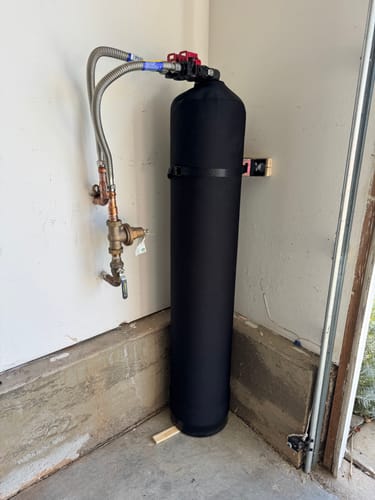
The main tank is substantial – about 54 inches tall and 13 inches in diameter. I'd read the specifications, but seeing it in person really drove home that this isn't a countertop filter. You need dedicated space in your utility area, and you need to plan for the required clearances for maintenance access.
I opted for professional installation, which I'm glad I did. While I'm reasonably handy, the plumbing modifications required were beyond my comfort level. The installer needed to integrate bypass valves, install the backwash drain line, and program the electronic control head. The entire installation took about 4 hours and required shutting off water to the house for roughly 90 minutes.
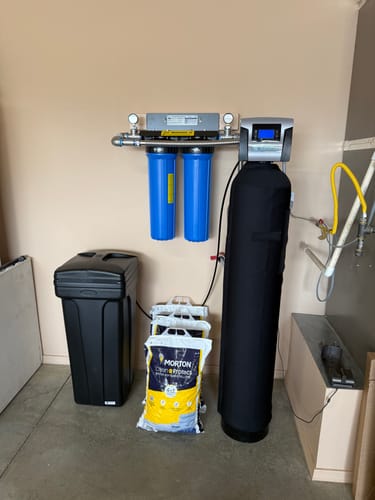
The digital control head looked more sophisticated than I expected – it's essentially a computer that manages the backwash cycles automatically based on time and water usage. During the initial setup, the technician programmed it for our local water conditions and household size.
First startup was exciting. The system immediately began its initial rinse cycle, which runs for about 10 minutes to remove any carbon dust from the media. I could hear water flowing through the backwash drain, and the control display showed exactly what was happening in real-time.
Performance Results: What Actually Changed

The difference was noticeable within hours, but the full impact became clear over the following weeks. Let me break down the specific improvements I documented:
Taste and Odor Elimination: The chlorine smell disappeared completely. I'm not exaggerating – it was gone the same day. Coffee tastes dramatically better, and my wife noticed the difference in her tea immediately. Our daughter started drinking tap water again without any complaints.
Cooking Improvements: This was an unexpected benefit. Pasta water doesn't have that chemical taste anymore, and when I steam vegetables, they actually taste like vegetables instead of having that faint chlorinated flavor. My homemade bread seems to rise more consistently too, which I suspect is related to removing chloramines that can interfere with yeast.
Shower and Bath Quality: Less obvious but definitely real. My skin feels less dry after showers, and my hair doesn't have that slightly stiff feeling it used to get. My wife noticed this more than I did initially.
Appliance Protection: Too early to measure long-term appliance life extension, but I'm no longer getting that chlorine smell from the dishwasher, and our washing machine doesn't have the chemical odor it used to develop.
I tested the water before and after installation using basic test strips. Incoming chlorine levels measured around 2.5 PPM, while post-filtration levels were consistently below 0.1 PPM. The system is removing over 95% of the chlorine, which aligns with the manufacturer's specifications.
Daily Operation and Maintenance Reality
One of my biggest concerns before purchasing was ongoing maintenance complexity. I'm happy to report that day-to-day operation is essentially invisible.
The automatic backwash system runs every few days, typically during early morning hours when water usage is low. I programmed it for 3 AM, and it's quiet enough that it doesn't wake anyone. The entire cycle takes about 12 minutes and uses approximately 150 gallons of water.
The control head displays useful information: days since last backwash, gallons processed since installation, and current cycle status. I check it maybe once a week out of curiosity, but it doesn't require any input from me.
Water pressure remained excellent throughout the house. I was worried about pressure drops, but I measure about the same pressure at fixtures as before installation. The system is designed for 8 GPM flow rate, which handles simultaneous usage (shower + dishwasher + laundry) without issues.
The only regular maintenance involves adding salt to the brine tank for backwashing, which I do about once every two months. Each backwash cycle uses roughly 8 pounds of salt, and I buy standard water softener salt from the home improvement store.
I've had the system for 18 months now, and the carbon media still has plenty of life remaining. Based on our usage patterns, I estimate needing replacement in another 2-3 years, which aligns with the manufacturer's projections.
Costs and Value Analysis
Let me be transparent about the financial investment, because this isn't a small purchase.
Initial Investment:
- SoftPro Auto-Backwash Centaur system: $2,847
- Professional installation: $485
- Total upfront cost: $3,332
Ongoing Operating Costs:
- Salt consumption: approximately $12 per month
- Additional water usage for backwashing: roughly $8 per month
- Annual operating cost: around $240
Future Replacement Costs:
- Centaur carbon media replacement: approximately $400 every 3-4 years
- Professional service for media change: $200-300
Offset Savings:
- Eliminated bottled water purchases: $85 per month
- Reduced soap and detergent usage: $15 per month
- Annual savings: approximately $1,200
Break-even analysis shows payback in roughly 3.5 years when factoring in bottled water elimination and household product savings. After that, we're saving money while enjoying better water quality.
Compared to other whole house carbon systems I researched, this falls into the premium category. However, the automatic backwash feature and Centaur media justify the higher cost for our situation. Manual backwash systems cost $800-1,200 less but require regular maintenance attention I preferred to avoid.
What Could Be Better: Honest Limitations
No system is perfect, and this one has some limitations worth discussing honestly.
Size Requirements: This system needs significant space. Our utility room accommodates it fine, but if you're tight on space, it might not work. The drain line requirement also limits installation locations.
Initial Water Waste: The backwash process uses about 150 gallons every few days. If you're on a septic system or pay high sewer rates, this ongoing water usage adds up. I wish the system was more efficient in this regard.
Complexity: While daily operation is simple, the electronic control head has numerous settings and programming options that can be overwhelming initially. The manual is comprehensive but intimidating for non-technical users.
Noise During Backwash: Though quiet enough for 3 AM operation, you can definitely hear the system running if you're nearby. It's not loud, but it's not silent either.
Upfront Cost: The initial investment is substantial. While the long-term economics work out, finding $3,300 upfront is a significant barrier for many households.
Maintenance Scheduling: You need to stay on top of salt additions. If you forget, the backwash effectiveness decreases, and you might not notice immediately until water quality starts declining.
The system doesn't address hardness, iron, or bacteria issues. If you have well water with multiple contaminant types, you'll need additional treatment systems, which adds complexity and cost.
Final Verdict and Recommendations
After 18 months of ownership, I'm genuinely satisfied with the SoftPro Auto-Backwash Centaur Carbon Filter. It solved our primary problem completely – chlorine and chloramine removal – and delivered several unexpected benefits along the way.
The system performs exactly as advertised. Water quality improvement was immediate and has remained consistent. The automatic operation eliminates the maintenance hassle I was concerned about, and build quality seems excellent based on my experience so far.
This system is ideal if you:
- Have municipal water with chlorine/chloramine treatment
- Want whole-house filtration without ongoing filter changes
- Have adequate utility space for a substantial system
- Can handle the upfront investment for long-term savings
- Prefer automatic operation over manual maintenance
Consider alternatives if you:
- Need iron, hardness, or bacteria removal (requires different/additional systems)
- Have severe space limitations in your utility area
- Want a lower upfront cost even with higher maintenance
- Have very low water usage (may not justify the capacity)
- Are on a tight budget or can't access the drain requirements
For our family's situation – municipal water with chloramine treatment, moderate usage, and preference for low-maintenance solutions – this system hit the sweet spot. The water tastes great, our daughter drinks tap water again, and I don't think about water quality anymore.
Would I buy it again? Absolutely. The combination of performance, convenience, and long-term value makes it worthwhile for households dealing with chlorinated water issues. It's not the cheapest solution, but it's proven to be effective and reliable in real-world daily use.
If you're on the fence, I'd recommend getting a water test to confirm what contaminants you're dealing with first. If chlorine or chloramines are your primary concern and you want a set-it-and-forget-it solution, the SoftPro Auto-Backwash Centaur system delivers exactly what it promises.






