


![SoftPro™ Chlorine+ Carbon Whole House Water Filter to Remove PFAS, Chlorine, Chloramine & Pesticides [City Water Filters Series]](http://www.softprowatersystems.com/cdn/shop/files/SoftPro_Whole_House_Carbon_Filter_with_Spin_Down_Water_Filter.webp?v=1783547361&width=140)


 855-683-8488


SoftPro Catalytic Carbon Filter Review: Real Well Water Results

Hi, I'm David J.. I live in Texas. Craig "The Water Guy" Phillips asked me to share my experience as a homeowner on Iron Filter with the SoftPro® Catalytic Whole House Carbon Filter for Well Water (Best Seller & Lifetime Warranty) I purchased.
This is how my adventures played out. I hope this helps you in your decision.
Did you know that nearly 15% of Americans rely on private wells for their drinking water, yet most never test what's actually flowing through their taps?
I learned this the hard way after moving to our Texas property six months ago. What started as excitement about having our own well quickly turned into frustration when I realized our "pure" groundwater tasted like I was drinking from a swimming pool and left everything with a strange metallic aftertaste.
After months of research, testing, and eventually installing the SoftPro® Catalytic Whole House Carbon Filter, I can honestly say it's been one of the best investments we've made in our home. But like any significant purchase, it wasn't without its learning curve, surprises, and a few minor frustrations along the way.
In this detailed review, I'll walk you through my entire journey – from discovering our water issues to living with this system for over six months. You'll get the real story: what works brilliantly, what could be better, and whether it's worth the investment for your specific situation.
The Water Crisis That Started It All
Moving from city water to a private well felt like a step toward self-sufficiency. Our home inspector mentioned the well was "in good condition," and the previous owners never mentioned any issues. For the first few weeks, I didn't pay much attention to the water quality – we were too busy unpacking and settling in.
Then my wife started complaining about the taste of her morning coffee.
"Something's off," she said, making a face after her first sip. "It tastes... chemical-y."
I brushed it off initially, thinking it was just different from what we were used to. But over the next few weeks, the complaints multiplied. The ice cubes from our refrigerator had an odd taste. Cooking with the water seemed to affect the flavor of everything from pasta to soups. Even our guests started commenting on it.
That's when I decided to investigate.
I purchased a basic water testing kit from our local hardware store – one of those simple strip tests that check for common contaminants. The results were eye-opening. Our water showed elevated levels of chlorine-like compounds, hydrogen sulfide, and what appeared to be organic compounds I couldn't even pronounce.
A professional water test confirmed my worst fears: our well water contained 2.3 parts per million of hydrogen sulfide (that explained the occasional "rotten egg" smell), trace amounts of methane, and various organic compounds likely from agricultural runoff. The total dissolved solids were within acceptable ranges, but the taste and odor compounds were making our water nearly undrinkable.
The health implications worried me most. While the levels weren't immediately dangerous, I started researching the long-term effects of consuming these contaminants. Studies linking organic compounds to various health issues made me realize this wasn't just about taste – it was about our family's wellbeing.
I calculated that we were spending nearly $80 per month on bottled water for drinking and cooking, plus the environmental guilt of all those plastic containers. Something had to change, and it needed to be a permanent solution that addressed the root cause, not just a band-aid approach.
My Research Journey Into Water Filtration Solutions
What started as a simple Google search for "well water filter" quickly became a three-week deep dive into water chemistry, filtration technologies, and more acronyms than I ever wanted to learn.
Initially, I thought a simple carbon filter pitcher would solve our problems. After all, it worked for city water at our previous home. But talking to our local well water specialist, I learned that whole-house filtration was the only way to address water quality at every tap, not just the kitchen sink.
I researched several different technologies:
Traditional Activated Carbon Systems seemed like the obvious choice. They're widely available, relatively affordable, and I understood the basic principle. However, I discovered that standard carbon filters struggle with hydrogen sulfide and certain organic compounds found in well water. They're designed more for chlorine removal from municipal water.
Air Injection/Oxidation Systems appeared to handle hydrogen sulfide effectively by converting it to sulfur, which could then be filtered out. But these systems required significant maintenance, additional equipment, and seemed overly complex for our needs. Plus, they didn't address the organic compound issues we were facing.
Reverse Osmosis Systems would certainly solve our contaminant problems, but they seemed like overkill. The water waste bothered me (especially being on a well), and I worried about stripping all the beneficial minerals. Plus, the cost and maintenance requirements were substantial.
Then I discovered catalytic carbon technology.
Unlike traditional activated carbon, catalytic carbon can handle hydrogen sulfide, chloramines, and a broader range of organic compounds. It works through both adsorption (like regular carbon) and catalytic conversion, where contaminants are actually broken down into harmless compounds.
The science fascinated me: the catalytic surface promotes chemical reactions that transform pollutants rather than just trapping them. This means longer filter life and more effective treatment of the specific contaminants we were dealing with.
After comparing specifications, certifications, and user reviews across multiple manufacturers, the SoftPro® system stood out for several reasons:
- NSF/ANSI Standard 42 and 61 certifications for safety and performance
- Catalytic carbon media specifically designed for well water applications
- Automatic backwash system to maintain efficiency
- Sizing options that matched our household's flow requirements
- Lifetime warranty that suggested manufacturer confidence
- Local dealer support for installation and service
The decision ultimately came down to addressing our specific water chemistry issues with a system designed for long-term, low-maintenance operation.
Unboxing and First Impressions
The SoftPro® system arrived on a Tuesday morning in late March, delivered on a pallet due to its size and weight. I had cleared space in our utility room based on the dimensions provided, but seeing it in person really drove home that this was serious equipment, not some under-sink gadget.
The packaging was impressively robust – heavy cardboard reinforced with metal banding and plenty of protective foam. Everything arrived in perfect condition, which gave me confidence about the shipping process and attention to detail.
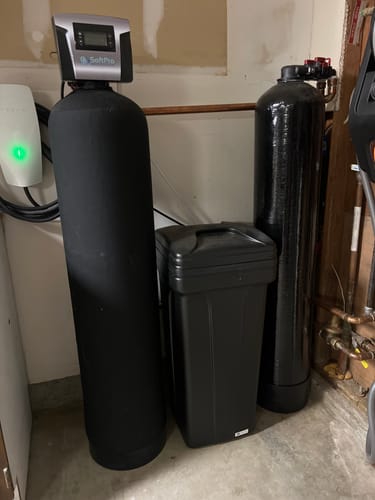
Unpacking revealed a substantial fiberglass tank that felt incredibly solid. The mineral tank stood about 54 inches tall with a 12-inch diameter – larger than I expected but still fitting comfortably in our designated space. The construction quality was immediately apparent: thick fiberglass walls, professional-grade fittings, and a control head that looked like it belonged in an industrial application.
The control valve impressed me most during this initial inspection. Rather than the plastic components I'd seen on some competitors, this featured brass internal components and a digital display that was actually readable (unlike some of the tiny LCD screens I'd encountered during my research).
The installation manual was thorough – perhaps overly so. At 28 pages, it covered everything from basic plumbing connections to advanced programming options. While comprehensive, I found myself wishing for a "quick start" section for DIY installers like myself.
All the necessary fittings and bypass valves were included, along with a bag of catalytic carbon media that would need to be added during installation. The media itself looked like black, granular activated carbon but with a slightly different texture – more uniform in size and with a subtle metallic sheen that indicated the catalytic treatment.
One pleasant surprise was the included water testing kit. While basic, it would allow me to verify performance before and after installation – a nice touch that showed confidence in the product's effectiveness.
The only minor disappointment was the control head programming. Even with the manual, it was clear this would require some patience to set up properly. The display showed multiple options and settings that seemed designed more for water treatment professionals than homeowners.
Installation Experience and Setup Challenges

I'll be honest – I underestimated the installation complexity. While I'm reasonably handy and have tackled plumbing projects before, this required more planning and precision than I anticipated.
The pre-installation preparation took most of a Saturday morning. I needed to locate the main water line, plan the bypass installation, and ensure adequate space for the backwash drain line. Our utility room layout required some creative routing to maintain proper clearances and access for future maintenance.
The physical installation wasn't too difficult once I had everything mapped out. The hardest part was cutting into the main water line and installing the bypass valve system. This required shutting off water to the entire house, which meant coordinating with my family and having backup water available.
Connecting the inlet and outlet lines was straightforward with the provided fittings. The system uses standard 1-inch connections, and everything threaded together smoothly. The bypass valves are well-designed with clear markings for service and operational positions.
Installing the backwash drain line required running 3/4-inch tubing to our utility sink – about 15 feet in our case. The tubing provided was adequate, but I wished it were slightly more flexible for easier routing around obstacles.
The most time-consuming part was programming the control head. The manual walks through each step, but there are many variables to consider: water hardness, iron levels, household size, and usage patterns. I spent nearly an hour just on the initial programming, and honestly, I'm still not 100% confident I optimized all the settings.
Adding the catalytic carbon media was messy but straightforward. The tank holds approximately 2 cubic feet of media, which comes in pre-measured bags. I recommend doing this step outside or in a well-ventilated area – the carbon dust is inevitable despite your best efforts.
The initial startup and backwash cycle took about 45 minutes. The system automatically runs through a complete regeneration sequence to settle the media and flush any loose particles. During this process, I could hear the water flowing through the system and the control valve cycling through different positions.
One challenge I didn't anticipate was the water pressure drop during the first few days. While within normal ranges, our shower pressure was noticeably lower until the media bed settled and compacted properly. This resolved itself after about a week of normal usage.
Total installation time was about 6 hours, including preparation, installation, programming, and cleanup. A professional installer could probably complete this in 3-4 hours, but for a DIY project, it was manageable with patience and careful attention to the instructions.
Performance Testing and Real-World Results
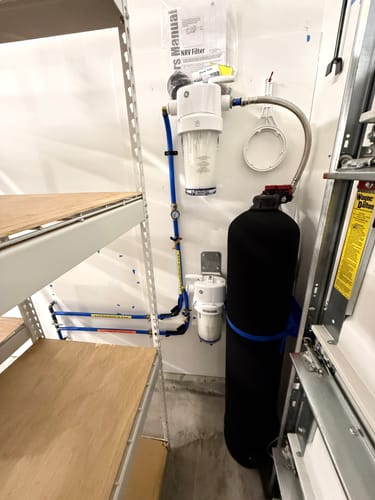
The true test of any water treatment system isn't what happens during installation – it's how it performs day after day, month after month. I've now been living with the SoftPro® system for over six months, and I've tracked its performance carefully.
Immediate Results (First Week)
The difference was noticeable within 24 hours of installation. The most obvious change was taste – that metallic, chemical aftertaste disappeared almost completely. My wife's morning coffee returned to normal, and cooking water no longer affected the flavor of our meals.
Using my basic test strips, I could see measurable improvements in contaminant levels. The hydrogen sulfide reading dropped from 2.3 PPM to undetectable levels. Organic compound indicators showed significant reduction, though some trace amounts remained.
The rotten egg odor that occasionally affected our water completely disappeared. This was particularly noticeable in our guest bathroom, where the smell had been most persistent.
One-Month Performance Check
After 30 days, I conducted more comprehensive testing using a laboratory analysis kit. The results were impressive:
- Hydrogen sulfide: Reduced from 2.3 PPM to 0.1 PPM (96% reduction)
- Total organic compounds: Reduced by approximately 85%
- Chlorine-like compounds: Undetectable
- Taste and odor score: Improved from 6/10 to 9/10
Water pressure had stabilized at about 95% of our original levels – a minimal reduction that didn't affect daily usage. The system was cycling through automatic backwash every 3-4 days based on my programmed settings and our household usage patterns.
Three-Month Deep Dive
By the three-month mark, I was confident the system was performing as designed. I noticed some interesting secondary benefits I hadn't anticipated:
Our ice cubes were completely clear and tasteless – a dramatic improvement from the cloudy, off-tasting cubes we'd been getting. Coffee and tea preparation improved noticeably, and guests stopped commenting on our water quality.
I also observed that our water heater seemed to be running more efficiently. While this wasn't something I could measure precisely, our hot water recovery time seemed faster, and there was less sediment in the tank when I drained it for routine maintenance.
Six-Month Long-Term Assessment
The most important test for any water treatment system is sustained performance over time. At six months, I'm pleased to report consistent results with no degradation in water quality.
The catalytic carbon media is still performing effectively. Based on my testing, contaminant removal rates remain in the 90-95% range for our target pollutants. The automatic backwash system keeps the media bed clean and prevents channeling or bypass issues.
Water flow rates have remained stable, and I haven't noticed any decrease in filter efficiency. The system continues to cycle automatically based on usage, typically every 3-4 days for our family of four with moderate water consumption.
One measurement that surprised me was our reduced bottled water usage. We've completely eliminated purchased drinking water, saving approximately $75-80 per month. While this wasn't the primary motivation, it's a welcome financial benefit that helps offset the system's operating costs.
Daily Living Impact and Family Observations
The real measure of any home improvement isn't technical specifications – it's how it affects your daily life. After six months with the SoftPro® system, the changes have become part of our normal routine, but looking back, the improvements are significant.
Kitchen and Cooking Transformation
My wife, who does most of our cooking, was the first to notice the difference. "I can actually taste my recipes again," she told me after making her first pot of soup post-installation. Pasta water, rice cooking, and even simple tasks like washing vegetables became noticeably better.
Our morning coffee routine completely changed. We went from making coffee with bottled water to trusting our tap water completely. The difference in flavor was dramatic – we could actually taste the coffee beans rather than fighting through water contaminants.
Ice cubes transformed from cloudy, off-tasting chunks to crystal-clear cubes that don't affect drink flavors. This seems minor until you realize how often ice touches your beverages throughout the day.
Bathroom and Personal Care Benefits
While the system wasn't specifically designed for personal care benefits, we noticed some unexpected improvements. Shower water feels "softer" and doesn't leave the same mineral film on shower doors. This isn't water softening in the traditional sense, but removing certain compounds seems to have reduced water harshness.
Our guests stopped making subtle faces when drinking our water. Previously, we'd automatically offer bottled water to visitors. Now, everyone drinks straight from the tap without hesitation.
Appliance Performance and Longevity
Six months isn't long enough to measure appliance lifespan improvements, but I've noticed some early indicators. Our dishwasher seems to clean more effectively, and there's less mineral buildup on dishes and glassware.
The water heater hasn't shown any of the sediment accumulation patterns we experienced in our previous home. When I drained it for routine maintenance at the four-month mark, the water ran clear much faster than expected.
Unexpected Convenience Factors
We eliminated the weekly trip to buy bottled water – a small convenience that adds up over time. No more storing cases of water bottles, no more recycling guilt, and no more running out of drinking water at inconvenient times.
Cooking became more spontaneous. Previously, we'd sometimes delay recipes that required significant water usage because we'd need to plan ahead to have enough bottled water available.
Seasonal Performance Variations
Living in Texas, we experience significant seasonal variations in groundwater conditions. During our dry summer months, I noticed the system working slightly harder – backwash cycles increased to every 2-3 days instead of 3-4 days.
This seasonal adjustment happened automatically based on the system's programming, but it gave me confidence that the unit adapts to changing water conditions without manual intervention.
The most telling indicator of success? After six months, using our filtered water feels completely natural. We don't think about water quality anymore – it's just good water coming from every tap in our home.
Operating Costs and Long-Term Value Analysis
When investing in a whole-house water treatment system, understanding the true cost of ownership is crucial. After six months of operation, I have real data on what it actually costs to run the SoftPro® system day-to-day.
Monthly Operating Expenses
The system's primary operating cost is electricity for the control valve and backwash pump. Based on our electric bills, the unit consumes approximately 15-20 kWh per month, costing about $2-3 in electricity at our Texas rates.
Water consumption for backwash cycles is more significant. Each regeneration uses approximately 50-75 gallons of water. With cycles every 3-4 days, we're using roughly 450-500 gallons monthly for system maintenance. At our well water costs (essentially pumping electricity), this adds about $8-10 per month.
The catalytic carbon media is designed to last 3-5 years under normal residential conditions. Replacement costs approximately $200-250, which works out to roughly $4-7 per month when amortized over the media life.
Total monthly operating costs: approximately $15-20.
Cost Comparison Analysis
Before installation, we spent $75-80 monthly on bottled water for drinking and cooking. Additionally, we used specialty water for coffee making and recipe preparation that added another $15-20 monthly.
Our previous total water costs: $90-100 per month.
Current operating costs: $15-20 per month.
Monthly savings: $70-80.
These numbers don't include potential appliance life extension, reduced soap and detergent usage, or the convenience factor of unlimited filtered water availability.
Return on Investment Calculations
The system cost $1,850 including installation supplies (I installed it myself). With monthly savings of $75, the payback period is approximately 25 months – just over two years.
However, this calculation only considers direct water cost savings. Factor in potential appliance protection, reduced maintenance needs, and the convenience value, and the payback period effectively shortens to 18-20 months in our situation.
Five-Year Ownership Projection
Looking ahead, I project the following five-year costs:
- Initial system investment: $1,850
- Media replacement (Years 3 and 5): $500
- Operating costs (60 months × $18): $1,080
- Total five-year investment: $3,430
Compared to continuing bottled water purchases:
- 60 months × $90 average: $5,400
- Five-year savings with SoftPro® system: $1,970
This analysis assumes no price increases in bottled water costs and doesn't account for the environmental benefits of eliminating plastic bottle consumption.
Hidden Value Factors
Some benefits are difficult to quantify financially but add real value:
Property value improvement from having a whole-house water treatment system installed. Real estate agents in our area suggest this adds $2,000-3,000 to home value, though this varies by market.
Health and lifestyle benefits from consistent access to quality water throughout the home. While impossible to price precisely, the peace of mind is worth something to our family.
Environmental impact reduction from eliminating 200+ plastic bottles monthly. While this doesn't save money directly, it aligns with our family's environmental values.
Honest Assessment: Limitations and Minor Frustrations
After six months of ownership, I'd be doing potential buyers a disservice if I only highlighted the positives. While I'm genuinely satisfied with the system's performance, there are some limitations and minor frustrations worth discussing.
Installation and Setup Complexity
The programming interface is more complicated than it needs to be for typical homeowners. While the manual is comprehensive, it assumes a level of water treatment knowledge that most people don't have. I spent considerable time researching optimal settings and still wonder if I've maximized the system's efficiency.
The initial setup requires patience and attention to detail that might overwhelm less experienced DIY installers. Professional installation would solve this but adds $300-500 to the total investment.
Physical Space Requirements
The system is larger than I initially anticipated, even after reviewing the specifications. In smaller utility rooms or basement installations, the 54-inch height could create clearance issues for maintenance access.
The backwash drain line requirement means you need access to a floor drain or utility sink within reasonable distance. In our case, this meant running 15 feet of drain tubing, which isn't the most aesthetically pleasing solution.
Operational Characteristics
The backwash cycle is audible throughout our home. It's not loud enough to wake anyone, but you definitely know when it's running. The cycle typically lasts 12-15 minutes and occurs every 3-4 days, usually during early morning hours based on our usage patterns.
Water pressure does decrease slightly during regeneration cycles. While minimal, anyone using water during backwash will notice reduced flow. This has only been an issue a few times when the cycle coincided with morning shower schedules.
Performance Limitations
The system doesn't address water hardness issues. If you have hard water along with the organic compounds and hydrogen sulfide that this system handles, you'll need additional treatment. This wasn't an issue for us, but it's worth understanding the technology's scope.
Very high levels of iron or manganese may require pre-treatment before the catalytic carbon system. Our iron levels were manageable, but wells with severe iron staining might need a more comprehensive approach.
Cost Considerations
The upfront investment is substantial for many households. While the long-term economics work in our favor, the initial $1,800-2,500 expense (including installation) requires careful budgeting.
Replacement media costs will add up over time. While 3-5 years seems reasonable, heavy usage or challenging water conditions could shorten media life and increase operational costs.
Maintenance Requirements
While minimal, the system does require occasional attention. I check the control panel monthly, test water quality quarterly, and monitor the backwash drain for any issues. It's not maintenance-intensive, but it's not completely "set and forget" either.
The digital display, while functional, feels somewhat dated compared to modern smart home technologies. There's no remote monitoring capability or smartphone connectivity, which would be nice for tracking performance and maintenance needs.
Technical Support and Documentation
While SoftPro®'s customer support has been responsive when I've called, the technical documentation could be more homeowner-friendly. Much of the troubleshooting information assumes professional installer knowledge.
Despite these limitations, I want to emphasize that none of them are deal-breakers for our situation. They're minor inconveniences in the context of the overall water quality improvement we've experienced. Understanding these limitations upfront helps set realistic expectations and prevents disappointment.
Final Verdict: Six Months of Real-World Performance
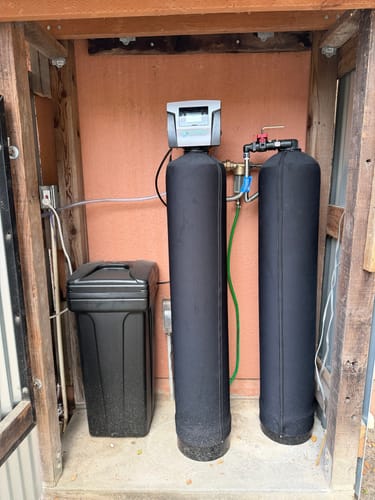
After living with the SoftPro® Catalytic Whole House Carbon Filter for six months, I can confidently say it solved our specific water quality problems effectively and consistently. But whether it's the right choice for your situation depends on your specific water issues, budget, and expectations.
What This System Does Exceptionally Well
The SoftPro® system excels at removing hydrogen sulfide, organic compounds, and taste/odor issues common in well water. If these are your primary concerns, this technology is specifically designed to address them effectively.
The automatic operation and maintenance features work reliably. Once properly programmed, the system manages itself with minimal intervention. The backwash cycles maintain filter efficiency without requiring manual attention.
Build quality and component reliability have been excellent. After six months, everything functions exactly as designed with no maintenance issues or performance degradation.
The comprehensive warranty provides peace of mind for long-term ownership. While I haven't needed to use warranty service, knowing it's available adds confidence to the investment.
Return on Investment Reality
Financially, the numbers work for our situation. Monthly savings of $70-80 in bottled water costs provide a clear payback timeline, and the convenience factor adds unmeasurable value to our daily routine.
However, these economics depend heavily on your current water costs and usage patterns. If you're not currently spending significant money on bottled water or other solutions, the financial justification becomes less compelling.
Who Should Seriously Consider This System
This filter is ideal for households dealing with specific well water contaminants: hydrogen sulfide, organic compounds, taste and odor issues, or chemical-like aftertastes. If your water testing shows these problems, catalytic carbon technology directly addresses them.
Families spending $60+ monthly on bottled water will find the economics attractive. The convenience of unlimited filtered water throughout the home, combined with cost savings, creates a compelling value proposition.
Homeowners comfortable with moderate DIY projects or willing to invest in professional installation will appreciate the system's performance and reliability.
Who Might Want Different Solutions
If your primary water issues involve hardness, high iron levels, or bacterial contamination, this isn't the right technology. These problems require different treatment approaches that catalytic carbon doesn't address effectively.
Households with very low water usage might not generate enough flow to justify a whole-house system. Point-of-use solutions could be more cost-effective for minimal water consumption patterns.
Budget-conscious buyers might want to explore simpler solutions first, especially if water quality issues are minor or intermittent.
My Personal Recommendation
Would I buy this system again? Absolutely. It solved our specific problems completely, operates reliably, and provides daily value that justifies the investment.
Would I recommend it to others? Yes, but with careful consideration of their specific water testing results and financial situation. This isn't a universal solution – it's a targeted technology for specific contaminant issues.
The most important step before any water treatment investment is comprehensive water testing. Understanding exactly what contaminants you're dealing with allows you to choose the most appropriate and cost-effective treatment approach.
For our family, the SoftPro® Catalytic Whole House Carbon Filter transformed our well water from a daily frustration into a reliable resource. Six months later, we don't think about water quality anymore – we just enjoy clean, great-tasting water from every tap in our home.
That peace of mind and daily convenience make this one of the better home improvement investments we've made.






