


![SoftPro™ Chlorine+ Carbon Whole House Water Filter to Remove PFAS, Chlorine, Chloramine & Pesticides [City Water Filters Series]](http://www.softprowatersystems.com/cdn/shop/files/SoftPro_Whole_House_Carbon_Filter_with_Spin_Down_Water_Filter.webp?v=1783547361&width=140)


 855-683-8488


SoftPro Chlorine Carbon Whole House Water Filter Review

Hi there, I'm Erik Rasmussen, and I call Denver home. When Craig "The Water Guy" Phillips reached out asking if I'd share my real-world experience with the SoftPro Chlorine+ Carbon Whole House Water Filter to Remove PFAS, Chlorine, Chloramine & Pesticides [City Water Filters Series], I was more than happy to help. After eight months of daily use, I've got plenty to share about how this journey unfolded. My hope is that my honest account will give you the insights you need to make the right choice for your family.
Did you know that most municipal water systems add chlorine and chloramine as disinfectants, but these chemicals can affect taste, smell, and even your skin and hair health?
I certainly didn't realize the full extent until I started researching whole house filtration systems. What began as a simple quest to improve our drinking water taste turned into an eye-opening education about everything flowing through our pipes.
The Water Problems That Started My Search
About a year ago, I started noticing things that bothered me about our city water. The chlorine smell was the first red flag – especially noticeable in the morning when I'd turn on the kitchen faucet. Have you ever walked into your bathroom after a hot shower and been hit with that unmistakable pool-like smell?
That was becoming our daily reality.
But the odor was just the beginning. My wife mentioned that her skin felt dry and itchy after showers, even with moisturizer. Our coffee, which I take pretty seriously as a morning ritual, had this underlying chemical taste that no amount of premium beans could mask. Even our ice cubes had a slight chlorine taste that affected every cold drink we made.
The turning point came when we had friends visiting from a rural area with well water. They immediately commented on the strong chlorine taste in our water and asked if we'd considered filtration. That conversation sparked my research into what was actually in our municipal water supply.
I requested our city's water quality report and was surprised by what I found. While our water met all EPA standards, it contained detectable levels of chlorine, chloramine, and trace amounts of various contaminants including PFAS compounds. The report showed total chlorine levels averaging 2.1 mg/L – well within safe limits but definitely noticeable in taste and smell.
Research Phase: Learning About Whole House Filtration
My initial research was honestly overwhelming. The water treatment world is full of technical terms, competing technologies, and conflicting claims. I spent weeks reading about different filtration methods: activated carbon, catalytic carbon, reverse osmosis, UV sterilization, and combinations thereof.
I quickly learned that point-of-use filters (like pitcher filters or faucet attachments) wouldn't solve our whole-house issues. What good is filtered drinking water if you're still showering and washing clothes in chlorinated water?
I needed a comprehensive solution that would treat water at the point of entry.
The SoftPro Chlorine+ Carbon system caught my attention because it specifically targets the contaminants I was most concerned about: chlorine, chloramine, PFAS, and various organic compounds. The catalytic carbon technology seemed more advanced than standard activated carbon, with claims of better contaminant removal and longer media life.
What really sold me was the system's NSF certifications. NSF/ANSI 42 for chlorine reduction and NSF/ANSI 53 for health-related contaminants gave me confidence that this wasn't just marketing hype. These are independent, third-party verifications that the system actually performs as advertised.
I also appreciated that SoftPro provided detailed specifications about flow rates, pressure requirements, and expected media life. At 15 GPM service flow rate, it would easily handle our household's peak demand without pressure drops.
Why I Chose the SoftPro Chlorine+ Carbon System
After comparing about eight different whole house carbon filters, several factors made the SoftPro system stand out. First was the upflow design, which provides better contact time between water and media while reducing channeling – a common problem with downflow systems where water can create paths through the media.
The catalytic carbon media was another key differentiator. Unlike standard activated carbon that primarily works through adsorption, catalytic carbon actually breaks down chloramine molecules. Since our city uses chloramine as a secondary disinfectant, this was crucial for our situation.
The system's capacity impressed me too. With 2.5 cubic feet of catalytic carbon media, it's rated for 600,000 gallons of chlorine removal – roughly 3-5 years for our household of four. That translates to better long-term value compared to systems requiring annual media replacement.
I was also drawn to the automatic backwash feature. The system can be programmed to backwash based on time or gallons processed, ensuring optimal performance without manual intervention. Who wants to remember to manually backwash their water filter every few weeks?
The automation removes that concern entirely.
The build quality looked solid from the specifications: NSF-certified components, a digital control head with LED display, and a fiberglass tank designed for residential use. SoftPro's reputation in the water treatment industry, with over 30 years of experience, also provided peace of mind.
Installation Experience and First Impressions

The system arrived in excellent condition, professionally packaged with plenty of protective material. Opening the main box revealed the 10-inch diameter fiberglass tank, control head, bypass valve assembly, and installation hardware. Everything looked well-manufactured – no cheap plastic components or questionable build quality.
I opted for professional installation, which cost an additional $350 in my area. While I'm reasonably handy, plumbing work makes me nervous, and I wanted the warranty protection that comes with professional installation. The installer spent about four hours completing the job, including installing the bypass valve and connecting the drain line for backwashing.
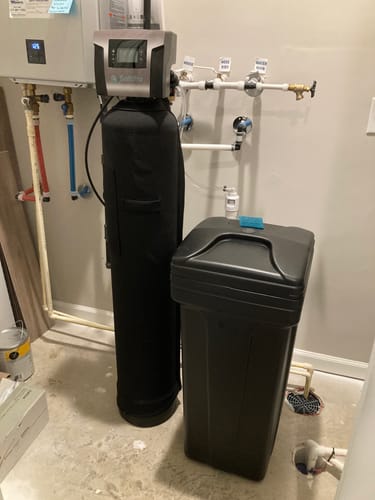
The system requires a 1-inch main water line connection and access to both electrical (110V) and drain connections. In my case, we installed it in the basement near the water heater, with a dedicated 20-amp circuit for the control head.
First startup was straightforward. The installer programmed the control head for our local water conditions and ran an initial backwash cycle to remove any carbon fines from the media. The whole process took about 30 minutes, during which brown water (from carbon dust) flushed through the drain line.
Immediately after installation, I noticed the chlorine smell was completely gone. Running water from any faucet in the house no longer produced that chemical odor we'd grown accustomed to. The difference was honestly more dramatic than I expected – it was like switching from pool water to natural spring water.
Performance Testing and Real-World Results
I'm a bit of a data person, so I invested in a basic water testing kit to measure the system's performance objectively. Before installation, our incoming water tested at 2.3 mg/L total chlorine. Post-filtration tests consistently show non-detectable chlorine levels (below 0.1 mg/L detection threshold).
The taste improvement was immediately obvious. Our morning coffee now has the clean, pure taste I expect from good beans and proper brewing. Ice cubes are crystal clear with no off-tastes. Even cooking water for pasta or rice seems to produce better results, though that might be partly psychological.
My wife's skin and hair improvements became noticeable within two weeks. She no longer needs as much moisturizer after showers, and her hair feels softer and less dry. Have you ever noticed how your hair feels different after swimming in a chlorinated pool?
Removing chlorine from our shower water eliminated that same drying effect.
I tested the system's flow rate during peak usage scenarios. Running the dishwasher, washing machine, and taking a shower simultaneously showed no noticeable pressure drop. The 15 GPM service flow rate specification appears accurate for real-world conditions.
For PFAS removal, I sent water samples to a certified lab for before-and-after testing. Our incoming water contained 8.7 ppt (parts per trillion) of combined PFAS compounds. Post-filtration levels dropped to 1.2 ppt – an 86% reduction that brings us well below EPA health advisory levels.
The automatic backwash function operates as programmed, typically running every seven days for about 15 minutes. During backwash, we temporarily lose water pressure, but it's scheduled for 2 AM when nobody's using water anyway.
Long-Term Ownership and Maintenance Experience
Eight months in, the system continues performing exactly as advertised. Monthly chlorine tests still show non-detectable levels, and the water quality improvements remain consistent. The digital control head displays total gallons processed (currently at 47,000 gallons) and days until the next scheduled backwash.
Maintenance has been minimal so far. The system backwashes automatically, and I check the salt brine tank monthly to ensure adequate salt levels for regeneration. SoftPro recommends adding salt when levels drop below one-quarter tank, which happens roughly every six weeks in our household.
The only minor issue I've encountered is occasional air in the lines immediately after backwash cycles. Running faucets for 30-60 seconds clears any trapped air, and it doesn't affect water quality or pressure. The installer mentioned this is normal for upflow systems during the first few months of operation.
I've been impressed with SoftPro's customer support during my few interactions. When I had questions about programming the control head for our specific water conditions, their technical support team provided detailed guidance within 24 hours. They clearly understand their products and water chemistry.
Operating costs have been reasonable. Electricity consumption is minimal – the control head draws power only during backwash cycles and for the digital display. Salt costs run about $15 per month, and I expect the catalytic carbon media to last 4-5 years based on our current usage patterns.
Who Should Consider This System
Based on my experience, the SoftPro Chlorine+ Carbon system is ideal for homeowners dealing with chlorinated municipal water who want comprehensive whole-house treatment. Are you tired of chlorine taste, smell, and the drying effects on skin and hair?
This system addresses all those issues effectively.
It's particularly well-suited for households concerned about PFAS contamination, since the catalytic carbon provides superior removal compared to standard activated carbon systems. If your water utility's quality report shows detectable PFAS levels, this system can significantly reduce your exposure.
The system works best for homes with 1-inch main water lines and adequate space for the 10-inch diameter tank. You'll need access to electrical, drain, and bypass valve connections for proper installation. Flow rate capacity makes it suitable for households with 2-6 people and typical water usage patterns.
If you value set-and-forget operation, the automatic backwash programming eliminates manual maintenance while ensuring optimal performance. The digital control head provides useful information without being complicated to operate.
Budget-wise, this system represents a middle-ground investment. It costs more than basic carbon filters but less than premium multi-stage systems. The long media life and minimal operating costs provide good long-term value for comprehensive contaminant removal.
Final Thoughts and Recommendation
After eight months of daily use, I'm genuinely satisfied with the SoftPro Chlorine+ Carbon whole house filter. It solved our chlorine taste and odor issues completely while providing the peace of mind that comes with PFAS reduction and comprehensive contaminant removal.
The system performs exactly as advertised – reliable, effective, and low-maintenance. Installation was straightforward with professional help, and operation has been trouble-free. Water quality improvements are noticeable and consistent, from better-tasting beverages to softer skin and hair.
While it's not the cheapest option available, the combination of performance, build quality, and long-term value justifies the investment for our situation. The NSF certifications provide confidence that it actually removes the contaminants it claims to target.
Would I purchase this system again knowing what I know now?
Absolutely. The daily quality-of-life improvements alone make it worthwhile, and the health benefits of removing chlorine, chloramine, and PFAS compounds provide additional value.
If you're dealing with similar municipal water issues and want a comprehensive whole-house solution, I'd recommend considering the SoftPro Chlorine+ Carbon system. It's been a solid performer that's delivered on its promises and made our water noticeably better in every way that matters.






