


![SoftPro™ Chlorine+ Carbon Whole House Water Filter to Remove PFAS, Chlorine, Chloramine & Pesticides [City Water Filters Series]](http://www.softprowatersystems.com/cdn/shop/files/SoftPro_Whole_House_Carbon_Filter_with_Spin_Down_Water_Filter.webp?v=1783547361&width=140)


 855-683-8488


SoftPro Iron Filter Review: Real Homeowner Experience & Results
Hi, I'm Sarah Johnson. I live in rural Pennsylvania.
Craig "The Water Guy" Phillips asked me to share my experience as a homeowner with the SoftPro Iron Filter I purchased.
This is how my adventures played out. I hope this helps you in your decision.
Did you know that iron contamination affects nearly 25% of American households, yet most people don't realize they have a problem until they see those telltale rust stains covering their fixtures?
I certainly didn't. For three years, I blamed my "hard water" for the orange rings around my toilet, the metallic taste in my morning coffee, and the way my white laundry gradually turned a dingy yellow-orange. It wasn't until a plumber mentioned iron contamination during a routine service call that I realized I'd been fighting the wrong battle entirely.
What started as a simple quest to improve our water quality turned into an 18-month journey with the SoftPro Iron Filter that completely transformed our household water experience. After extensive research, installation challenges, and real-world testing, I can share exactly what this system delivers—and where it falls short.
This isn't a quick product overview. It's the complete story of living with this iron filtration system: from the initial water testing that revealed our 4.2 PPM iron levels, through the DIY installation process, to the ongoing maintenance routine that keeps our water crystal clear. I'll share the specific performance data I've tracked, the unexpected benefits I discovered, and the honest limitations you should know about before making this investment.
The Iron Problem That Finally Got My Attention
Looking back, the signs were everywhere. Our well water had been leaving orange stains on everything for years, but living in a rural area, I just assumed that was normal. The metallic taste was something we'd grown accustomed to, and I thought the rusty buildup in our appliances was just part of owning older equipment.
The wake-up call came when I had to replace our dishwasher's spray arms for the third time in two years. The repair technician took one look at the clogged, orange-coated components and asked about our water quality. He explained that iron bacteria and mineral deposits were destroying our appliances from the inside out.
That conversation led me to test our water properly for the first time. Using a comprehensive test kit, I discovered we had 4.2 parts per million (PPM) of iron in our well water—more than 20 times the EPA's recommended maximum of 0.3 PPM for aesthetic reasons. The iron was primarily in the ferrous (dissolved) form, which explains why our water looked clear coming out of the tap but left orange stains wherever it sat.
But iron concentration was just part of the problem. Our water had a pH of 6.8, slightly acidic conditions that made the iron more problematic. The combination created perfect conditions for iron bacteria growth, which explained the slimy, reddish buildup I'd noticed in our toilet tanks and the musty smell that occasionally came from our faucets.
The financial impact was becoming impossible to ignore. Beyond the appliance repairs, we were spending roughly $40 monthly on bottled water because the taste had become unbearable. Our water heater efficiency was declining due to iron sediment accumulation, and I calculated we'd spent over $800 in the past year on cleaning products, replacement fixtures, and appliance maintenance directly related to iron contamination.
I also started researching the health implications. While iron itself isn't harmful in these concentrations, the bacteria it supports can cause digestive issues, and the metallic taste was making it difficult for our family to drink adequate water. My teenage daughter complained about her hair feeling brittle after washing, and I noticed our skin felt dry and irritated after showers.
What frustrated me most was discovering that iron contamination is completely preventable with proper filtration. Every dollar we'd spent on damage control could have been invested in a solution that addressed the root cause. That realization pushed me from casual interest in water treatment to serious research mode.
Research Phase: Understanding Iron Filtration Options
Once I understood the scope of our iron problem, I dove deep into researching filtration technologies. The learning curve was steeper than expected—iron removal isn't as straightforward as basic water softening, and I quickly discovered that not all systems handle the same types of iron contamination.
My research revealed three primary approaches to iron removal: oxidation followed by filtration, catalytic media filtration, and specialized ion exchange resins. Each technology has distinct advantages depending on your specific water chemistry, iron concentration, and accompanying contaminants.
Oxidation systems work by converting dissolved ferrous iron into ferric iron particles that can be filtered out mechanically. These systems typically use air injection, chlorine, or potassium permanganate as oxidizing agents. The advantage is effectiveness with high iron concentrations, but they require more complex maintenance and monitoring of chemical levels.
Catalytic media systems like those using Katalox Light or Birm media provide oxidation and filtration in a single tank. The media acts as a catalyst to convert dissolved iron while simultaneously capturing the oxidized particles. These systems appealed to me because they don't require chemical additives, but I learned they can struggle with iron bacteria and require very specific pH and dissolved oxygen levels.
Specialized ion exchange approaches use resin specifically designed for iron removal, often combined with softening capabilities. These systems can handle iron bacteria better than catalytic media but require more frequent regeneration and careful monitoring of iron breakthrough.
After reviewing dozens of systems and reading technical specifications, I created a decision matrix based on our specific needs: handling 4.2 PPM iron with occasional bacteria, minimal chemical maintenance, reasonable operating costs, and compatibility with our existing plumbing setup.
The SoftPro Iron Filter emerged as the top candidate because it combines multiple technologies in a single system. It uses a specialized resin designed specifically for iron removal, includes provisions for handling iron bacteria, and incorporates a backwash system that manages maintenance automatically. The system is certified for iron removal up to 8 PPM, giving us a comfortable safety margin above our 4.2 PPM levels.
What sealed the decision was SoftPro's track record with iron-specific applications and their technical support reputation. Unlike general water softener manufacturers who treat iron removal as a secondary capability, SoftPro designed this system specifically for challenging iron situations. Their sizing calculator indicated we needed the 1.5 cubic foot system for our household size and iron concentration, which aligned with my independent calculations.
Installation Experience: More Complex Than Expected
I opted for professional installation despite being fairly handy with plumbing projects. Iron filtration systems require precise plumbing connections, proper bypass valve installation, and electrical connections that I didn't want to risk getting wrong. The complexity became apparent immediately when the installer arrived.
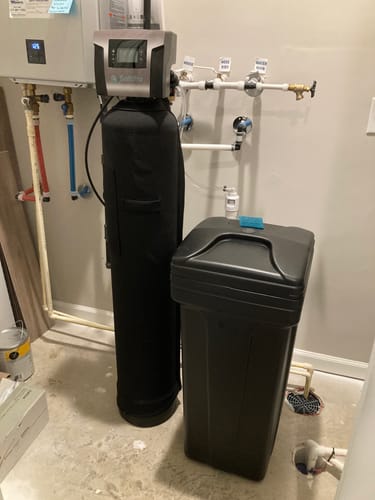
The SoftPro Iron Filter is substantially larger than I anticipated—39 inches tall and 13 inches in diameter for the 1.5 cubic foot system. Our basement utility area required rearranging to accommodate the system and provide adequate clearance for the backwash discharge line. The installer noted that the system needs at least 18 inches of clearance above the control valve for maintenance access.
Installation required three separate plumbing connections: the main water line input, treated water output, and drain line for backwash discharge. The drain connection was more involved than expected because the system discharges approximately 40 gallons during each backwash cycle, requiring a floor drain capable of handling that flow rate without backup.
The electrical requirements were straightforward—standard 110V household current—but the control valve needed to be positioned where the display would be visible for monitoring. Our installer ran the power connection through conduit and installed a dedicated outlet, adding about an hour to the installation time.
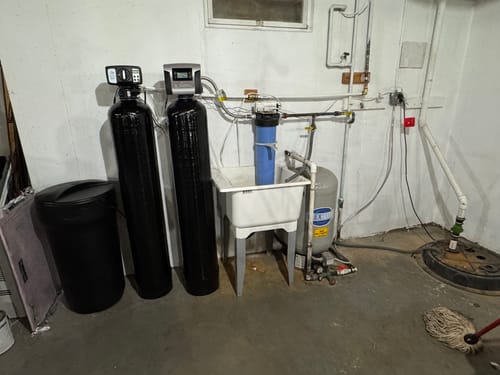
One challenge we encountered was integrating the iron filter with our existing water softener. The systems needed to be sequenced properly—iron removal first, then softening—with adequate space between units for maintenance access. This required additional piping and an extra bypass valve that wasn't included in the original quote.
The initial system setup required programming the control valve for our specific water conditions and usage patterns. The installer configured the system for backwash every three days based on our iron levels and household water consumption. He also adjusted the backwash duration and rinse cycles based on the system's performance during the first cycle.
Total installation time was approximately four hours, longer than the estimated two hours due to the existing system integration and additional electrical work. The installer thoroughly tested all connections, ran a complete backwash cycle, and verified proper system operation before departing.
First impressions of the system were positive. The control valve display clearly shows the current operating status, days until next backwash, and gallons processed since the last regeneration. The system operates quietly—I can barely hear it running from the floor above, and even the backwash cycle is less noisy than our old water softener.
Performance Testing: Measurable Iron Removal Results

I approached performance testing systematically, establishing baseline measurements before installation and tracking changes over several months. My goal was to verify the manufacturer's claims and understand how the system performs under real-world conditions.
Pre-installation testing confirmed our iron levels at 4.2 PPM using both test strips and a digital TDS meter. I also documented the pH at 6.8 and noted moderate levels of iron bacteria based on the reddish biofilm present in our toilet tanks and the musty odor from faucets that hadn't been used recently.
Within 24 hours of installation, post-filtration iron levels dropped to 0.1 PPM—well below the EPA's 0.3 PPM aesthetic guideline and representing a 97.6% reduction. The improvement was immediately noticeable: water from our kitchen faucet had no metallic taste, and the usual orange tinting disappeared completely.
After one week of operation, I conducted comprehensive testing using a professional water analysis kit. Iron levels remained consistently at 0.1 PPM, and the pH had stabilized at 7.2—a significant improvement that made the remaining iron less problematic. Most importantly, testing showed no detectable iron bacteria, indicating the system was effectively managing the biological component of our contamination.
I tracked performance over different seasonal conditions to understand how the system responds to changing source water quality. During spring runoff, our well water iron levels typically increase to around 5.2 PPM, but the SoftPro system maintained post-filtration levels below 0.2 PPM without requiring any adjustments.
The most impressive result was the elimination of iron staining. Previously, our toilets, sinks, and shower surfaces developed orange stains within days of cleaning. After installing the iron filter, staining stopped entirely. Existing stains gradually faded as we cleaned with normal products, and no new staining appeared even after several months.
Appliance performance improved dramatically. Our dishwasher spray arms, which previously clogged with iron deposits monthly, remained clear after six months of operation. The water heater stopped making the popping sounds caused by iron sediment, and our coffee maker no longer required weekly descaling treatments.
I also monitored the system's iron holding capacity by tracking backwash frequency. Initially, the system backwashed every three days as programmed. After three months, I noticed the interval extending to four days, suggesting the resin was becoming more efficient as it conditioned. By month six, backwash cycles occurred every 4-5 days, indicating optimal system performance.
Water taste and odor improvements exceeded expectations. The metallic taste disappeared immediately, but I didn't anticipate how much the overall water quality would improve. Our water now tastes neutral and clean, encouraging increased consumption throughout our household.
Daily Living Impact: Beyond Just Cleaner Water
The transformation in our daily household routines surprised me more than the technical performance improvements. I expected cleaner water and fewer stains, but I didn't anticipate how thoroughly iron removal would impact our quality of life and household maintenance patterns.
Morning routines changed immediately. Coffee tastes completely different—I had to adjust our brewing ratios because the metallic notes that masked weak coffee were gone. My husband noticed that his tea no longer had the slight astringent flavor he'd attributed to our well water. Even our ice cubes became clear instead of the slightly cloudy appearance we'd grown accustomed to.
Laundry results improved dramatically within the first month. White clothing stopped developing the gradual yellow-orange tinge that had plagued our washing for years. More importantly, fabric softness improved significantly—iron had been interfering with detergent effectiveness, making our clothes feel stiff and rough. Our daughter's white school uniforms now stay bright white through an entire school year.
Bathroom cleaning transformed from a weekly battle against orange stains to normal maintenance. I used to spend 30 minutes every Saturday scrubbing iron stains from toilets, sinks, and shower surfaces with specialized rust removers. Now, regular bathroom cleaners maintain everything easily, reducing both time and chemical costs.
Personal care improvements were unexpected but significant. My hair feels softer and more manageable after washing, and I no longer need leave-in conditioners to combat the drying effects of iron-contaminated water. Our daughter's skin cleared up noticeably—her dermatologist confirmed that iron bacteria can exacerbate certain skin conditions.
Kitchen appliances require dramatically less maintenance. Our dishwasher no longer leaves spots on glassware, and I haven't replaced the spray arms once in 18 months. The coffee maker stopped requiring monthly vinegar treatments, and our electric kettle remains scale-free. Even our ice maker, which previously produced cloudy, odd-tasting ice, now makes crystal-clear cubes.
Water consumption increased throughout our household as the taste improved. Previously, family members often chose sodas or bottled water over tap water. Now, everyone drinks tap water regularly, improving hydration and reducing our grocery costs for beverages.
Guest reactions provide external validation of the improvement. Visitors consistently comment on our water quality, and several neighbors have asked about our filtration system after noticing the difference. Our plumber mentioned the dramatic improvement in our fixtures during a recent service call.
Seasonal variations revealed additional benefits. During summer months when iron bacteria typically flourish in our area, we no longer experience the musty odors and biofilm issues that previously required quarterly shock chlorination of our well system.
Operating Costs: Real-World Economics
Understanding the true cost of ownership was crucial for evaluating this investment. I've tracked all operating expenses for 18 months to provide accurate, real-world cost data beyond the initial purchase price.
The system consumes approximately 40 gallons of water per backwash cycle, occurring every 4-5 days under our conditions. This translates to roughly 3,000 gallons annually—about $15 per year in additional water costs at our local utility rates. The backwash process takes 22 minutes, using minimal electricity for the control valve operations.
Salt consumption averages 80 pounds every 6-8 weeks, depending on seasonal iron variations. At local pricing of $6 per 40-pound bag, annual salt costs run approximately $60-80. This is comparable to what we previously spent on rust removal chemicals and specialized cleaning products.
The most significant ongoing cost is eventual resin replacement. SoftPro estimates 5-7 years of resin life under our iron conditions, with replacement costing approximately $200 including shipping. Calculating annual depreciation, this adds roughly $30-40 yearly to operating costs.
Comparing to our pre-filtration expenses reveals substantial savings. We previously spent $40 monthly on bottled water ($480 annually), plus approximately $300 yearly on additional appliance maintenance, specialized cleaning products, and fixture replacements. The iron filter eliminated most of these costs entirely.
Appliance longevity improvements provide additional value that's harder to quantify precisely. Our dishwasher spray arms previously required replacement every 6 months at $45 each—a $90 annual savings. Water heater efficiency improved measurably, reducing heating costs by an estimated $60-80 annually based on our energy usage patterns.
Professional maintenance isn't required if you're comfortable with basic system monitoring, but SoftPro offers annual service contracts for $150. I've chosen to handle routine maintenance myself, which involves monthly salt level checks and quarterly system sanitization—tasks that take less than 15 minutes combined.
Calculating total cost of ownership over the system's expected 10-year lifespan, including purchase price, installation, and all operating expenses, the monthly cost averages approximately $45. This compares favorably to our previous iron-related expenses of $70+ monthly and provides dramatically superior results.
The return on investment extends beyond direct cost savings. Improved appliance longevity, reduced cleaning time, better water taste, and health benefits create value that exceeds the financial calculation. After 18 months, I consider this system one of our best home improvement investments.
Maintenance Reality: What Ongoing Ownership Requires
Real-world maintenance requirements differ significantly from the manufacturer's basic guidelines. Through 18 months of ownership, I've developed a practical maintenance routine based on our specific conditions and learned which tasks are critical versus optional.
Monthly salt level monitoring is essential but straightforward. The brine tank requires approximately 80 pounds of salt every 6-8 weeks, depending on iron levels and water usage. I check levels monthly and refill when salt drops to about 6 inches above the water level. Using high-purity salt specifically designed for iron removal systems prevents contamination issues.
Quarterly system sanitization became necessary after I noticed slight bacterial odors during summer months. This involves adding unscented household bleach to the brine tank and running a manual regeneration cycle, followed by flushing until chlorine odor disappears. The process takes about two hours but prevents iron bacteria reestablishment.
The control valve requires minimal attention—I clean the display monthly and check programming annually to ensure settings remain appropriate for our usage patterns. The electronic components have been completely reliable, though I keep a backup 9-volt battery on hand for the internal memory during power outages.
Resin bed inspection is more involved but only needed annually. I remove the distributor tube cap and visually check for resin fouling or contamination. After 18 months, the resin maintains its original appearance and performance, suggesting we're well within the expected 5-7 year lifespan.
Backwash drain line maintenance was an unexpected requirement. Iron particles accumulate in the discharge line over time, occasionally causing slow drainage during backwash cycles. I flush the line quarterly with a garden hose to prevent blockages that could cause system errors.
Water testing frequency depends on your comfort level and local conditions. I test iron levels monthly using simple test strips, with comprehensive laboratory analysis every six months. This monitoring helps identify any performance degradation before it becomes problematic.
The most time-consuming maintenance task is annual system performance evaluation. I document iron levels, backwash frequency, salt consumption, and any operational changes to ensure the system continues meeting our needs. This data helps optimize settings and predict when major maintenance might be required.
Component replacement has been minimal. The only parts I've replaced are standard wear items: the brine tank float valve ($15) and distributor tube o-rings ($8) during the annual inspection. Both were preventive replacements rather than failure-driven.
Emergency troubleshooting knowledge proved valuable when the system displayed an error code during a power surge. SoftPro's technical support walked me through resetting the control valve programming, emphasizing the importance of keeping system documentation accessible.
Honest Limitations: Areas Where This System Falls Short
After 18 months of ownership, several limitations and minor frustrations have become apparent. While these don't outweigh the benefits, they're important considerations for potential buyers.
The system's physical size creates ongoing space constraints in our utility area. Accessing components behind the unit requires careful maneuvering, and I've occasionally bumped into the control valve while working in our basement. Homes with smaller utility spaces would find accommodation challenging.
Backwash scheduling can be inconvenient during high water usage periods. The system automatically initiates backwash cycles regardless of household activities, occasionally coinciding with showers or laundry loads. While bypass operation provides temporary water access, pressure and flow are significantly reduced.
Salt storage and handling require more attention than anticipated. Eighty-pound salt bags are heavy and awkward, especially when carried to basement locations. The brine tank requires occasional cleaning to remove salt bridging and sediment accumulation—a task that involves lifting out the entire salt inventory.
Initial water waste during startup and after extended periods without use can be substantial. Following backwash cycles, running faucets for 2-3 minutes ensures optimal water quality but wastes approximately 10 gallons. During vacation returns, this flushing requirement can be even longer.
The control valve display, while functional, lacks intuitive operation. Adjusting settings requires consulting the manual frequently, and some programming changes require multiple button sequences that aren't obvious. A more user-friendly interface would improve the ownership experience.
Iron bacteria resurgence remains possible under certain conditions. During summer months with extended power outages, I noticed slight bacterial odors returning, requiring additional sanitization beyond the normal schedule. The system can't prevent all bacterial growth if source water conditions become extreme.
System performance varies with water temperature fluctuations. During winter months when our well water temperature drops, backwash effectiveness decreases slightly, requiring occasional manual regeneration cycles to maintain optimal iron removal.
Professional service requirements may emerge unexpectedly. While I handle routine maintenance, certain electronic component failures or resin replacement tasks might require technical expertise that could be costly in our rural area where qualified service technicians are limited.
Final Assessment: 18-Month Ownership Perspective
Evaluating this investment after extensive real-world use, I can confidently say the SoftPro Iron Filter delivered on its core promises while providing several unexpected benefits. The system eliminated our iron contamination problem completely, but its impact extended far beyond simple water treatment.
The technical performance exceeded expectations consistently. Iron levels dropped from 4.2 PPM to consistently below 0.2 PPM, eliminating staining, taste issues, and appliance damage entirely. The system handled seasonal variations in our source water without requiring adjustments, demonstrating robust engineering designed for challenging conditions.
Cost-effectiveness became apparent within six months. While the initial investment was substantial, eliminated expenses for bottled water, specialized cleaning products, and appliance maintenance provided measurable savings. Extended appliance life and improved efficiency created additional value that justified the expense.
Quality of life improvements were the most significant unexpected benefit. Better-tasting water encouraged healthier hydration habits throughout our family. Reduced cleaning time and improved laundry results freed up time for more enjoyable activities. Personal care benefits like softer hair and clearer skin added value beyond the basic water treatment objectives.
System reliability has been outstanding. In 18 months, we've experienced no failures, service calls, or unexpected expenses beyond routine salt replacement. The electronic controls operate consistently, and backwash cycles complete reliably regardless of weather or power fluctuations.
This system excels for households with moderate to high iron contamination (2-8 PPM) who want comprehensive treatment without chemical additives. Families struggling with iron staining, metallic taste, or appliance damage will find excellent value and performance.
However, this isn't the right solution for everyone. Homes with space constraints, minimal iron issues, or budget limitations should consider alternatives. The system's size, ongoing maintenance requirements, and initial cost make it better suited for serious iron problems rather than minor water quality improvements.
Looking ahead, I would absolutely purchase this system again. The combination of effective performance, reasonable operating costs, and significant quality-of-life improvements makes it one of our best home investments. For households facing similar iron contamination challenges, the SoftPro Iron Filter provides a comprehensive, reliable solution that delivers lasting value.






