


![SoftPro Chlorine+ Carbon Whole House Water Filter to Remove PFAS, Chlorine, Chloramine & Pesticides [City Water Filters Series]](http://www.softprowatersystems.com/cdn/shop/files/SoftPro_Whole_House_Carbon_Filter_with_Spin_Down_Water_Filter.webp?v=1780515157&width=140)
![SoftPro Iron Filter - Iron Master AIO - Best Iron Filter for Well Water [Air Injected Water Filter / Katalox]](http://www.softprowatersystems.com/cdn/shop/files/SoftPro_AIO_Iron_Master_Iron_Filter_Main.webp?v=1772123747&width=140)


 855-683-8488


SoftPro Iron Master With Elite Water Softener Pairing: The Complete Setup and Configuration Guide

Pairing the SoftPro Iron Master with the Elite Water Softener gives you a powerful one-two punch against iron, rust stains, and hard water scale. The Iron Master tackles iron and contaminants first, so the Elite Softener can focus entirely on hardness — making both units work smarter, not harder. You'll install them upstream and downstream, connect drain lines, load salt, and program each unit based on your water test results. There's a lot more to unpack here.
Key Takeaways
- Install the Iron Master upstream of the Elite Softener to remove iron before water reaches the softening unit.
- Attach the bypass valve correctly, matching inlet and outlet, and secure connections using the system-specific red clips.
- Use 5/8" OD flexible tubing for drain lines on both units, securing each connection with a hose clamp.
- Load the Elite Softener with 2-3 bags of salt pellets and monitor brine tank levels regularly for refilling.
- Configure the Iron Master's control settings based on water test results and activate the built-in regeneration calculator for efficiency.
How the SoftPro Iron Master and Elite Softener Work Together

When it comes to tackling tough water problems, two systems are better than one. The SoftPro Iron Master and Elite Water Softener work as a team, each handling what it does best.
Here's how it plays out: water first passes through the Iron Master's specialized filtration media, stripping out iron and other contaminants before anything reaches the Elite. That pre-treatment step matters because it lets the softener focus entirely on hardness, boosting overall efficiency across the whole system.
The result? No more rust stains, no more scale buildup, and noticeably cleaner-tasting water flowing through every tap. Your plumbing and appliances stay protected, and the installation is straightforward enough that we can get everything up and running without unnecessary hassle.
Unpacking and Assembling the Iron Master and Elite Softener
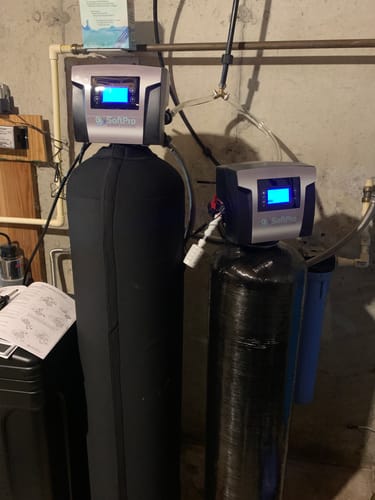
Before we plunge into connections and configuration, there are a few unpacking and assembly steps to get right from the start.
Handle the brine tank carefully to avoid resin spillage, then attach its legs using the push-and-twist mechanism. Snap the white cone securely into the control valve's bottom — that pre-lubricated O-ring matters, so confirm everything's seated before moving forward.
For the bypass valve, orientation is everything. Match inlet and outlet correctly, then lock it down with the included red clips. Don't substitute those clips — they're system-specific.
When connecting your Quick Connect hoses, verify compatibility with your setup and wrap all threaded connections with Teflon tape. Getting these foundational steps right eliminates headaches downstream and sets you up for a clean, leak-free installation.
Plumbing the Iron Master and Softener Into Your Water Line
With the units assembled and bypass valve oriented correctly, we're ready to tie everything into your water line — and getting this sequence right is what keeps the whole system running without headaches.
First, shut off the main water supply. Install the Iron Master upstream of the Elite Softener — sequence matters here. Use Quick Connect hoses, confirming compatibility and secure attachment at every fitting.
| Step | Component | Key Requirement |
|---|---|---|
| 1 | Main Supply | Shut off completely |
| 2 | Iron Master | Install before softener |
| 3 | Drain Line | 5/8" OD flexible tubing, hose clamp secured |
Once plumbed, slowly restore water pressure and inspect every connection carefully. Watch for leaks, then confirm clean flow from your faucets before moving forward.
Connecting the Drain Line, Power, and Salt for Both Units
Now that the plumbing's locked in, let's finish connecting the system so it's ready to actually do its job.
For the drain lines on both units, use flexible tubing with a 5/8" OD or 1/2" ID, and secure each connection with a hose clamp to prevent leaks.
Next, plug each transformer's quick connect cord into a nearby outlet—keep those connections secure and dry.
For salt, load the Elite Softener with regular pellets; two to three 40-pound bags will carry you through typical intervals.
If your Iron Master's fighting iron from a private well, use pellets with an iron-out cleaner built in—that's a game-changer.
Monitor both brine tanks consistently. When you're down to just a few pellets, it's time to refill.
Programming Your SoftPro Iron Master and Softener for Iron-Heavy Well Water
Once the hardware's in place, getting the programming dialed in is what transforms these two units into a system that actually fights iron-heavy well water on your terms.
Start with your water test results—those iron concentration numbers directly inform how you'll configure the Iron Master's control settings. Don't guess here; precision matters.
Next, activate the Iron Master's built-in regeneration calculator. It factors in your iron levels and household water usage to determine exactly when regeneration should trigger, keeping performance efficient rather than wasteful.
Pair that with your softener's settings, and both units work in coordinated rhythm.
We also recommend installing a pre-filter upstream to reduce sediment load before water reaches either system.
Monitor salt levels regularly and revisit your programming as water conditions change. Iron buildup doesn't announce itself—stay ahead of it.
Frequently Asked Questions
How Do I Set up My Water Softener for the First Time?
We'll start by unpacking all components, assembling the brine tank, connecting the bypass valve, and attaching the drain line. Then we'll gradually restore water supply, flush air from faucets, and program the softener settings.
How Many Gallons Should I Set My Water Softener to Regenerate?
We recommend setting your SoftPro to regenerate every 1,000–2,000 gallons. Calculate your household's daily usage—roughly 75 gallons per person—then adjust based on your water's hardness and iron levels for maximum efficiency.
What Setting Should I Set My Water Softener On?
We recommend setting your water softener's hardness level between 10 to 15 grains, adjusting regeneration frequency to match your household's usage, and enabling the iron removal setting at 2 to 5 ppm for ideal performance.
Should You Run Water When the Water Softener Is Running?
We recommend avoiding running water during regeneration. It disrupts the softening process, potentially delivering hard water to your taps. Schedule regeneration overnight to maximize efficiency and guarantee you're always getting fully softened water when it matters most.





