


![SoftPro™ Chlorine+ Carbon Whole House Water Filter to Remove PFAS, Chlorine, Chloramine & Pesticides [City Water Filters Series]](http://www.softprowatersystems.com/cdn/shop/files/SoftPro_Whole_House_Carbon_Filter_with_Spin_Down_Water_Filter.webp?v=1783547361&width=140)


 855-683-8488


SoftPro IronMaster Filter Review: Real Results After 6 Months
Hi, I'm Sarah. I live in rural Ohio.
Craig "The Water Guy" Phillips asked me to share my experience as a homeowner on Iron Filter with the SoftPro IronMaster I purchased.
This is how my adventures played out. I hope this helps you in your decision.
Did you know that iron contamination affects over 25% of private wells in the United States, turning crystal-clear water into a rusty nightmare that destroys appliances and stains everything it touches?
Six months ago, I was battling exactly this problem in my 1960s farmhouse, watching my white laundry turn orange and my fixtures develop those telltale rust stains that seemed impossible to remove.
After extensive research and comparison shopping, I decided on the SoftPro IronMaster system. What I discovered during installation, testing, and daily use over these past six months has completely transformed my relationship with our well water – and honestly surprised me in several ways I never expected.
The Iron Problem That Started It All
Living on a property with a 180-foot drilled well seemed like a blessing until the iron issues became undeniable. Have you ever tried to explain to guests why your toilet bowls have permanent orange rings despite constant cleaning?
It's embarrassing and frustrating beyond words.
The problem manifested in multiple ways throughout our home. My husband's white work shirts developed permanent yellow-orange stains after just one wash cycle. Our stainless steel appliances showed rust spots within weeks of installation. The shower doors required daily scrubbing to prevent iron buildup, and even then, a brown film would reappear within hours.
I had our water tested through the county extension office, which revealed iron levels at 4.2 parts per million – nearly three times the EPA's recommended maximum of 0.3 ppm. The report also showed trace amounts of manganese at 0.8 ppm, which explained the black staining we occasionally noticed mixed with the orange iron deposits.
Before discovering the SoftPro system, I tried several failed solutions. We installed an inexpensive cartridge filter system from a big box store, which lasted exactly two weeks before the filters turned completely brown and water flow dropped to a trickle. I also attempted various cleaning products specifically marketed for iron stains, but these only provided temporary relief while introducing harsh chemicals into our daily routine.
The breaking point came when our six-month-old dishwasher started leaving orange spots on glassware and the service technician warned that iron buildup could void the warranty. That's when I realized we needed a comprehensive solution, not just band-aid fixes.
Research Journey and Decision Process
My research began with understanding the difference between ferrous (dissolved) and ferric (oxidized) iron, since our water contained both types. Did you know that clear water can contain invisible dissolved iron that only becomes visible after exposure to air?
This explained why our water looked perfect coming from the tap but turned orange in the toilet bowl within hours.
I spent weeks comparing different technologies: traditional greensand filters, birm media systems, and air injection units. Each technology had distinct advantages and limitations that I needed to weigh against our specific situation.
Greensand filters required potassium permanganate regeneration, which seemed complicated and involved handling chemicals I wasn't comfortable storing. Birm media systems worked well for certain iron types but struggled with the manganese levels we were dealing with. Air injection systems appeared promising but required more complex installation and higher upfront costs.
The SoftPro IronMaster caught my attention because it uses a catalytic media that regenerates with simple backwashing – no chemicals required. The system removes iron, manganese, and hydrogen sulfide simultaneously, addressing multiple issues with one solution. Customer reviews consistently mentioned reliable performance and reasonable maintenance requirements.
Sizing calculations were crucial since undersized systems fail quickly under real-world conditions. Our household of four people with typical water usage patterns required a system rated for at least 12 gallons per minute with adequate backwash capacity. The IronMaster's 1.5 cubic foot media bed and 10-inch diameter tank provided the capacity we needed with room for peak demand periods.
The final decision factor was SoftPro's reputation in the water treatment industry. Their NSF certification, five-year warranty, and established dealer network provided confidence that support would be available if needed.
Unboxing and Initial Impressions
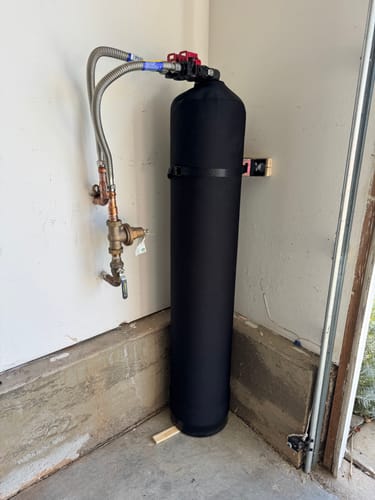
The IronMaster arrived via freight delivery in excellent condition, professionally packaged in a sturdy wooden crate. The main tank stands 54 inches tall with a 10-inch diameter – larger than expected but proportioned well for basement installation.
Build quality impressed me immediately. The fiberglass tank felt substantial without being excessively heavy, and the control valve assembly showed precise manufacturing with smooth operation. All fittings were high-quality brass and stainless steel, not the plastic components I'd seen on cheaper systems.
The package included everything needed for basic installation: bypass valve assembly, drain line fittings, and detailed installation manual. The instruction booklet was surprisingly thorough, with clear diagrams showing multiple installation scenarios and troubleshooting guidance.
One pleasant surprise was the pre-loaded catalytic media. Many systems require media installation during setup, but the IronMaster arrived ready to connect and program. This eliminated potential mess and guesswork about proper media levels.
The control head features a straightforward digital display showing current status, days until regeneration, and diagnostic information. Programming appeared more intuitive than I'd anticipated, with clearly labeled buttons and logical menu navigation.
Installation Experience and Setup

Installation required about six hours total, including preparation and initial programming. Would you attempt plumbing installation yourself, or hire a professional?
I chose to handle the work myself since our basement plumbing was easily accessible and I wanted to understand the system completely.
The most challenging aspect was positioning the tank in our utility room while maintaining clearance for the control head and future media replacement. The unit requires 18 inches of overhead clearance for maintenance, which meant relocating some ceiling-mounted storage.
Connecting to existing plumbing involved cutting into the main water line and installing the bypass valve assembly. I used SharkBite fittings for speed and reliability, though traditional copper connections would work equally well. The bypass valve allows isolation for maintenance while providing emergency water access if needed.
Drain line installation required running a 1/2-inch tube to our utility sink for backwash discharge. The system generates approximately 20 gallons of backwash water every three days, so proper drainage is essential. I installed an air gap fitting at the sink to prevent any possibility of contamination.
Initial startup involved setting the service flow rate, regeneration frequency, and backwash duration based on our water test results. The manual provided calculation worksheets that made programming straightforward. I set regeneration for every three days initially, planning to adjust based on actual performance.
The first regeneration cycle took about 45 minutes and sounded like a washing machine during the backwash phase. Subsequent cycles have been quieter as the media settled and air pockets eliminated.
Performance Testing and Measurable Results
I began systematic testing immediately after installation using both professional test strips and a digital TDS meter. Initial results were dramatic and consistent across multiple measurement points.
Before installation, our raw well water tested at 4.2 ppm iron and 0.8 ppm manganese. After the first week of operation, treated water showed iron levels below 0.1 ppm and manganese virtually eliminated. These results have remained consistent throughout six months of operation.
Water clarity improved dramatically within 48 hours. Have you ever noticed how iron-contaminated water has a subtle yellow tint that you don't recognize until it's gone?
Our treated water now appears crystal clear with no discoloration even after standing in containers for hours.
Flow rate testing revealed minimal pressure loss through the system. I measured 45 PSI at fixtures before installation and 42 PSI afterward – barely noticeable during normal use. Even during peak demand periods with multiple fixtures operating, pressure remained adequate.
The regeneration schedule has stabilized at every 72 hours, exactly as calculated during initial programming. Backwash water runs clear within 15 minutes, indicating the catalytic media is regenerating properly without excessive waste.
Long-term performance tracking shows consistent iron removal efficiency without degradation. Monthly testing continues to show iron levels below 0.2 ppm, well within acceptable ranges for household use.
Real-World Impact on Daily Living
The transformation in our daily water experience has been remarkable and touches nearly every household activity. Laundry results improved immediately – whites stay white and colors remain vibrant without iron staining. My husband's work shirts no longer develop those stubborn orange marks that required pre-treatment or replacement.
Bathroom cleaning became dramatically easier within two weeks. Remember those daily scrubbing sessions trying to prevent iron buildup on shower doors and fixtures?
Now I clean bathrooms once weekly with standard products, and surfaces stay spotless between cleanings.
Kitchen improvements were equally noticeable. Our dishwasher produces sparkling glassware without spots or film. Ice cubes from the refrigerator are crystal clear instead of cloudy with iron particles. Coffee and tea taste noticeably better without the metallic overtones that iron contamination creates.
Unexpected benefits emerged over time. Our water heater efficiency improved as iron deposits stopped accumulating on heating elements. The hot water now heats faster and maintains temperature more consistently. Our plumber mentioned during a recent service call that our pipes looked remarkably clean for a 60-year-old house.
Guests consistently comment on water quality improvements. Several neighbors have asked about our system after noticing the difference in taste and clarity during social gatherings.
Personal care benefits were subtle but significant. My hair feels softer and more manageable without iron buildup. Skin irritation that I'd attributed to hard water largely disappeared, suggesting iron was a contributing factor.
Operating Costs and Maintenance Reality
Operating expenses have proven lower than anticipated during my pre-purchase analysis. The system uses approximately 20 gallons of water per regeneration cycle, occurring every three days. At our local water rates, this represents about $8 monthly in additional consumption.
Electricity usage is minimal since the control valve only operates during regeneration cycles. My Kill-A-Watt meter showed average monthly consumption under 3 kWh, essentially negligible on our electric bill.
The most significant ongoing expense will be media replacement, scheduled every 5-7 years depending on water conditions and usage volume. Replacement media costs approximately $150 plus shipping, averaging $25-30 annually when amortized over expected life.
Maintenance requirements are surprisingly minimal. How often do you want to think about your water treatment system?
The answer should be rarely, and this system delivers on that expectation.
Monthly tasks include checking the salt bridge (none required with this system) and ensuring drain lines remain clear. I inspect the bypass valve quarterly and test treated water every few months to verify continued performance.
The control head maintains regeneration schedules automatically based on water usage and programmed parameters. I've made no adjustments to original settings, as performance has remained consistent without intervention.
Comparing these costs to our previous situation reveals significant savings. We no longer purchase specialized cleaning products for iron stains, replace filters monthly, or worry about premature appliance failure due to iron buildup.
Final Assessment and Recommendation
After six months of daily use, the SoftPro IronMaster has exceeded my expectations in performance, reliability, and ease of ownership. The system consistently delivers iron-free water without fuss or frequent intervention.
Key strengths include robust construction, effective iron and manganese removal, reasonable operating costs, and minimal maintenance requirements. The chemical-free regeneration process appeals to families preferring simple, environmentally friendly solutions.
Minor limitations include the substantial physical size requiring adequate installation space and the initial investment representing a significant household expense. Installation complexity may challenge homeowners without plumbing experience.
Would I purchase this system again knowing everything I know now?
Absolutely, without hesitation. The daily quality-of-life improvements justify the investment, and long-term cost savings continue accumulating.
This system suits households dealing with moderate to high iron levels (2-15 ppm) who want reliable, low-maintenance treatment. Families in rural areas with private wells will find particular value, as will anyone tired of battling iron stains and metallic water taste.
If you're considering iron filtration and your situation matches ours – moderate iron levels, adequate installation space, and preference for chemical-free operation – the SoftPro IronMaster represents an excellent investment in your home's water quality and your family's daily comfort.






