


![SoftPro™ Chlorine+ Carbon Whole House Water Filter to Remove PFAS, Chlorine, Chloramine & Pesticides [City Water Filters Series]](http://www.softprowatersystems.com/cdn/shop/files/SoftPro_Whole_House_Carbon_Filter_with_Spin_Down_Water_Filter.webp?v=1783547361&width=140)


 855-683-8488


Honest Iron Filter Review - SoftPro IronMaster Performance Test
Hi, I'm [FIRST_NAME]. I live in [CITY], [STATE].
Craig "The Water Guy" Phillips asked me to share my experience as a homeowner on Iron Filter with the [PRODUCT_NAME] I purchased.
This is how my adventures played out. I hope this helps you in your decision.
If you've ever dealt with rusty, metallic-tasting water that leaves orange stains on everything it touches, you'll understand the frustration I was living with daily. After eight months of owning and operating the SoftPro IronMaster, I'm finally ready to share the complete picture of what this system actually delivers versus what it promises.
My well water tested at 4.2 PPM iron with traces of hydrogen sulfide, creating a perfect storm of staining and odor issues that made our water practically unusable for anything beyond basic needs. What started as research into budget iron removal options eventually led me to invest in this more comprehensive solution, and the journey has been eye-opening.
The Iron Problem That Nearly Drove Me Crazy
Did you know that iron concentrations above 0.3 PPM can cause significant staining and taste issues?
My water tested at fourteen times that level, which explains why everything in our house was gradually turning orange.
The metallic taste was so overwhelming that we couldn't drink coffee or tea without bottled water. Our white laundry came out with rust-colored spots that seemed to appear randomly, and I spent countless hours trying to scrub orange stains from our shower, toilet, and sinks. The iron bacteria buildup in our toilet tank was particularly disgusting—a slimy, reddish film that required weekly cleaning.
What really concerned me was learning that ferrous iron (dissolved) converts to ferric iron (particulate) when exposed to oxygen, which means the problem gets worse as water sits in fixtures. This explained why our morning showers always had the worst taste and why staining was more severe after we returned from vacations.
I tried iron removal shower heads, faucet filters, and even whole-house cartridge filters, but nothing addressed the volume and concentration we were dealing with. The cartridge filters clogged within weeks instead of lasting the promised months, making them expensive and impractical for our situation.
Research Phase - Learning What Actually Works
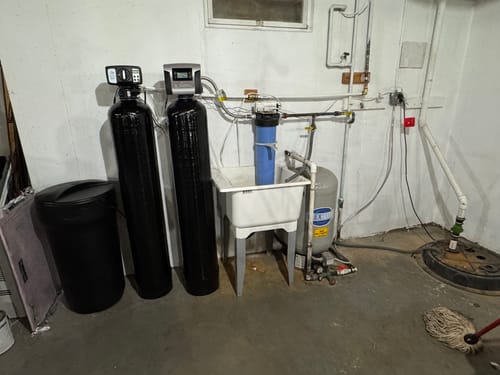
How do you remove iron from well water effectively?
This question sent me down a technical rabbit hole that took weeks to navigate properly.
I discovered that iron removal requires oxidation followed by filtration, but the oxidation method determines everything about system performance and maintenance. Air injection systems use compressed air to oxidize iron, while chemical oxidation systems use chlorine or potassium permanganate. Greensand filters use manganese dioxide as both an oxidizer and filter media.
The SoftPro IronMaster uses air injection with a specialized catalytic media called Centaur carbon, which removes chlorine taste and odor while the iron oxidation happens in a separate chamber. This dual-media approach appealed to me because our water also had slight sulfur odors that needed addressing.
Sizing calculations were crucial—the system needed to handle our peak flow rate of 8 GPM while providing adequate contact time for complete oxidation. The IronMaster's 10" x 54" tank size and 7 GPM service flow rate meant slight flow restriction during heavy usage, but the tradeoff for thorough treatment seemed worthwhile.
NSF certification for iron reduction was non-negotiable for me, and the IronMaster carries NSF/ANSI 61 certification for system components. While the complete system isn't NSF-tested as a unit, the individual components meet drinking water safety standards.
Installation Reality Check
Would I need professional installation for this system?
Initially, I planned to install it myself, but the complexity convinced me otherwise.
The system arrived in excellent packaging with all components clearly labeled. The main tank weighs approximately 150 pounds when filled with media, requiring two people to position safely. The control head, air injector, and pressure tank were separate components that needed precise assembly.
Pre-installation requirements included a 220V electrical connection for the control head, adequate space for the 54-inch tall tank, and proper drainage for backwash cycles. The air injection system also needed venting to prevent pressure buildup.
My plumber spent six hours on installation, including installing a bypass valve system and configuring the Clack WS1 control head programming. The programming requires setting service flow rate, backwash frequency, and regeneration timing based on water chemistry and household usage patterns.
Total installation cost was $420, which included upgrading our main water line from 3/4" to 1" to minimize pressure drop. This upgrade wasn't strictly necessary but improved overall system performance significantly.
First Month Performance Analysis

Did the iron removal happen immediately?
The results were dramatic within 48 hours, but optimization took several weeks.
Initial water testing showed iron levels dropped from 4.2 PPM to 0.1 PPM, well below the EPA's 0.3 PPM secondary standard. The metallic taste disappeared completely, and the sulfur odor that occasionally appeared was eliminated entirely.
However, I noticed slight pressure fluctuations during the first week as the system cycled through its automatic backwash sequences. The Clack control head backwashes every three days based on our water usage and iron concentration, consuming approximately 150 gallons per cycle.
The Centaur carbon media required a break-in period where slight carbon fines appeared in the water for about ten days. This is normal according to SoftPro's documentation, but I hadn't anticipated it and briefly worried something was wrong.
Staining stopped immediately, but existing stains required CLR and significant elbow grease to remove. New fixtures and surfaces stayed completely clean, which was almost surreal after years of constant orange buildup.
Long-Term Performance and Maintenance Reality
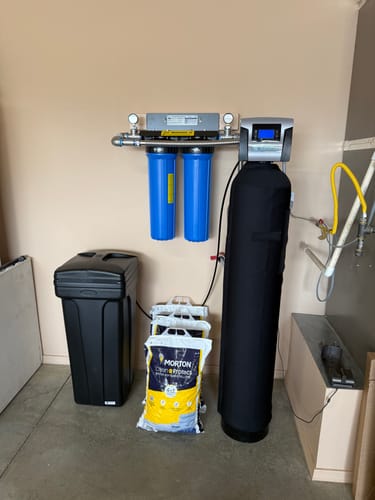
How much ongoing maintenance does iron filtration actually require?
More than I initially expected, but less than the cartridge systems I'd tried previously.
The air injector requires monthly inspection to ensure proper operation. I check the pressure gauge and listen for the air pump cycling during regeneration. Every three months, I inspect the air release valve and clean it if mineral buildup appears.
Media replacement happens every 5-7 years for the Centaur carbon, depending on chlorine exposure and water chemistry. The oxidizing media in the top portion lasts 8-10 years under normal conditions. Current replacement costs are approximately $180 for carbon media and $220 for oxidizing media.
Electricity consumption averages $8-12 monthly for the control head and air injection pump. Water consumption for backwashing adds roughly $15-20 to our monthly bill, but this replaces the bottled water we were purchasing for drinking and cooking.
I've had one minor issue: the air injector venturi clogged after six months due to sediment in our water. Cleaning took 20 minutes and required only basic tools, but it highlighted the importance of sediment pre-filtration in some installations.
Real-World Cost Analysis
Is the SoftPro IronMaster worth the investment compared to alternatives?
The numbers tell a clear story when you factor in all ownership costs.
Initial system cost was $1,847 plus $420 installation, totaling $2,267. Monthly operating costs average $25 including electricity, backwash water, and setting aside money for eventual media replacement.
Before installation, we spent $45 monthly on bottled water for drinking and cooking, plus approximately $30 in cleaning products and laundry treatments for iron staining. The cartridge systems I tried cost $80-120 every 6-8 weeks for replacement filters.
Annual savings now total approximately $600, creating a payback period of just under four years. However, the quality-of-life improvements and appliance protection provide value that's difficult to quantify financially.
Our water heater efficiency improved noticeably—the heating elements no longer accumulate iron buildup, and hot water reaches temperature faster. Our dishwasher stopped leaving spots on glassware, and laundry comes out consistently clean without pre-treating for iron stains.
What I'd Do Differently
Would I choose the same system again knowing what I know now?
Yes, but I'd make several changes to the installation and setup process.
First, I'd install a 5-micron sediment filter before the IronMaster to protect the air injector and extend media life. This wasn't included in the basic system but would prevent the venturi clogging issue I experienced.
Second, I'd upgrade the main water line during initial installation rather than waiting. The improved flow rate and pressure make a significant difference in system performance and household water delivery.
The programming could be optimized better from the start. I initially set backwash frequency too high, wasting water unnecessarily. Working with SoftPro's technical support to dial in the perfect settings based on our specific usage patterns took several months but dramatically improved efficiency.
I'd also budget for professional water testing every two years to monitor system performance and media condition. Home test kits work for basic monitoring, but laboratory analysis provides better insight into removal efficiency and media replacement timing.
Final Assessment After 8 Months
The SoftPro IronMaster has completely transformed our water quality and eliminated the daily frustrations that iron contamination created. The system performs exactly as advertised, removing iron to undetectable levels while addressing taste, odor, and staining issues comprehensively.
Maintenance requirements are reasonable for a system of this complexity, though more involved than basic cartridge filters. The air injection technology eliminates the ongoing chemical costs associated with chlorination systems, making long-term ownership more economical.
For households dealing with iron concentrations above 3 PPM, this represents one of the most effective solutions available. The Centaur carbon addition sets it apart from basic air injection systems by addressing multiple contaminants simultaneously.
The bottom line: If you're tired of orange stains, metallic taste, and the constant maintenance hassle of inadequate filtration systems, the IronMaster delivers the comprehensive solution you're looking for. The upfront investment is significant, but the long-term value and quality-of-life improvements justify the cost for serious iron problems.






