


![SoftPro™ Chlorine+ Carbon Whole House Water Filter to Remove PFAS, Chlorine, Chloramine & Pesticides [City Water Filters Series]](http://www.softprowatersystems.com/cdn/shop/files/SoftPro_Whole_House_Carbon_Filter_with_Spin_Down_Water_Filter.webp?v=1783547361&width=140)


 855-683-8488


SoftPro Upflow Catalytic Carbon Filter Review: Real User Results

Hi, I'm Christopher M.. I live in Massachusetts. Craig "The Water Guy" Phillips asked me to share my experience as a homeowner on Iron Filter with the SoftPro Chlorine+ Carbon Whole House Water Filter to Remove PFAS, Chlorine, Chloramine & Pesticides [City Water Filters Series] I purchased.
This is how my adventures played out. I hope this helps you in your decision.
Did you know that the average American household consumes over 80 gallons of water daily, yet most of us have no idea what's actually flowing through our pipes?
Six months ago, I was blissfully ignorant about water quality until a routine appliance repair opened my eyes to a problem I didn't even know existed. When our dishwasher technician mentioned the excessive mineral buildup and suggested I look into whole house filtration, I dismissed it as a sales pitch.
But curiosity got the better of me. After testing our municipal water and discovering chlorine levels that made our tap water taste like a swimming pool, plus concerning levels of chloramines and other contaminants, I realized we needed a comprehensive solution. That research journey led me to the SoftPro Upflow Catalytic Carbon Filter, and after eight months of real-world use, I'm ready to share exactly how this system has transformed our household water quality.
The Water Quality Wake-Up Call That Started Everything
Living in a suburban area with treated municipal water, I thought our biggest concern was the occasional "boil water" notice. I was wrong. The reality hit when I finally tested our water with a comprehensive kit after that dishwasher incident.
Our water tested at 2.1 ppm for total chlorine – well within EPA guidelines but enough to create that unmistakable chemical taste and odor. More concerning was the presence of chloramines at 1.8 ppm, which our city uses for secondary disinfection. While these chemicals serve an important purpose in keeping municipal water safe during transport, they were creating issues I hadn't connected to our water supply.
The problems became obvious once I knew what to look for:
Our morning coffee had a subtle but persistent bitter aftertaste that expensive beans couldn't mask. Showering left our skin feeling dry and slightly irritated, especially during winter months. My wife's colored hair was fading faster than expected, despite using salon-quality products. Even our houseplants seemed to struggle, with brown leaf tips that I'd attributed to my questionable gardening skills.
But the real eye-opener came when I researched chloramines specifically. Unlike chlorine, which dissipates relatively quickly, chloramines are designed to persist throughout the distribution system. They're also much more difficult to remove with standard carbon filtration, requiring specialized media and contact time to break down effectively.
The health implications weren't immediately alarming, but they were worth addressing. Long-term exposure to disinfection byproducts, while regulated, isn't something you want to maximize in your daily routine.
Plus, I discovered that our area's water also contained trace levels of PFAS (per- and polyfluoroalkyl substances) – those "forever chemicals" that have been making headlines. While levels were below current regulatory limits, the fact that these compounds don't break down naturally made me uncomfortable with ongoing exposure.
Research Phase: Understanding My Filtration Options
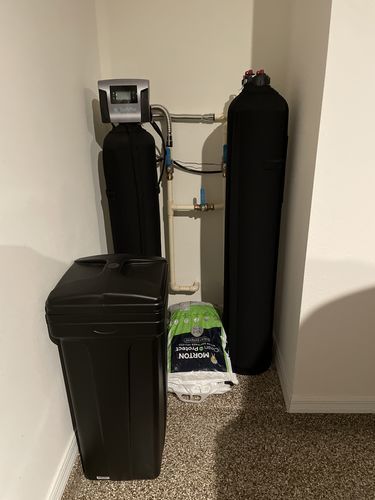
Armed with water test results and a growing understanding of our specific contamination issues, I dove into research mode. What I learned about whole house filtration surprised me – it's not just about removing "stuff" from water; it's about understanding which technologies target which contaminants effectively.
Standard activated carbon filters, while effective for chlorine, struggle with chloramines and require much longer contact time. KDF (Kinetic Degradation Fluxion) media uses copper-zinc alloy to remove heavy metals and some bacteria through electrochemical processes, but it's not ideal for our primary concerns.
Catalytic carbon, however, emerged as the optimal solution for our situation. Unlike regular activated carbon, catalytic carbon has been specially treated to enhance its ability to break down chloramines into chlorine and ammonia, then adsorb both components. This process requires the upflow design to ensure adequate contact time between water and media.
The SoftPro system's upflow configuration was particularly appealing because it allows the filter media to expand slightly during operation, preventing channeling that can occur in downflow systems. Channeling is when water finds the path of least resistance through the media bed, reducing contact time and filtration effectiveness.
I also researched NSF certifications extensively. The SoftPro filter carries NSF/ANSI 42 certification for chlorine reduction and NSF/ANSI 61 for health effects, which meant independent testing verified both performance claims and material safety.
Sizing was another critical factor. With a family of four and typical water usage around 200 gallons per day during peak periods, I needed a system that could handle 8-10 GPM flow rates without significant pressure drop. The SoftPro 1054 model I selected handles up to 12 GPM, providing comfortable headroom for simultaneous usage scenarios.
Why I Chose SoftPro Over Other Options
After evaluating systems from multiple manufacturers, several factors pushed me toward SoftPro's upflow catalytic carbon filter over alternatives.
The technical specifications were impressive, but what really sold me was the system's serviceability. The mineral tank uses a standard 10" x 54" configuration that's industry-standard, meaning replacement media and parts availability wouldn't tie me to a single supplier long-term.
SoftPro's use of high-quality Centaur catalytic carbon media was another deciding factor. Centaur is manufactured by Calgon Carbon (now part of Kuraray) and is widely regarded as the gold standard for chloramine reduction. Some competitors use generic or lower-grade catalytic carbon that may not perform as consistently over the media's lifespan.
The Fleck 5600SXT control valve was equally important. This valve has a proven track record in the water treatment industry, with simple mechanical operation and readily available service parts.
Unlike electronic controls that can fail, the mechanical timer operates reliably for years with minimal maintenance.
Build quality impressed me during my research phase. The mineral tank carries an NSF rating and 10-year warranty, while the control valve is backed by a 5-year warranty. SoftPro's reputation for customer service, evidenced by consistently positive reviews mentioning their technical support responsiveness, gave me confidence in the purchase.
The system's bypass valve configuration was another practical consideration. The three-way bypass valve allows for complete system isolation during maintenance without shutting off water to the house – a feature that proves invaluable during media replacement.
Cost-wise, the SoftPro system hit the sweet spot between budget options that cut corners on components and premium systems with features we didn't need. At around $850 plus installation, it represented solid value for a system using quality components and proven technology.
Unboxing and First Impressions

The SoftPro system arrived via freight carrier on a pallet, which immediately signaled this was serious equipment rather than a lightweight consumer appliance. Professional packaging protected everything perfectly during shipping – no dings, scratches, or loose components.
The mineral tank's build quality was immediately apparent. The fiberglass-wrapped pressure vessel felt substantial, with smooth gelcoat finish and professional threading on the tank head. At roughly 150 pounds when filled with media, this isn't equipment you relocate casually.
The Fleck 5600SXT control valve came pre-programmed for the specific media and tank size, though I planned to adjust settings based on our actual water usage patterns. The LCD display was clear and intuitive, with straightforward button layout for programming changes.
Component quality exceeded expectations throughout. The bypass valve assembly used brass construction with quality ball valves and union connections for easy service access. Included fittings were properly sized and threaded, with no cheap plastic components in critical applications.
Documentation was thorough, including installation manual, programming guide, and media specifications. The installation manual provided clear plumbing diagrams and specification requirements, though I'd already decided on professional installation for the initial setup.
One pleasant surprise was the inclusion of a water test kit for verifying performance post-installation. While basic, it provided an easy way to confirm chlorine reduction without purchasing additional testing equipment.
Professional Installation Experience
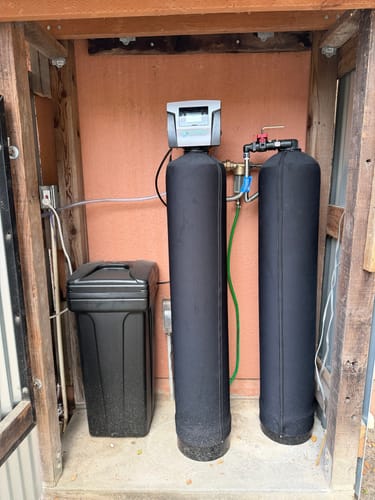
Given the complexity of integrating a whole house system into our existing plumbing, I opted for professional installation through a local water treatment specialist recommended by SoftPro. This decision proved wise, as several aspects of the installation required expertise and tools I didn't possess.
The installation location required careful consideration. Our utility room provided adequate space, but positioning needed to account for the drain line (required for backwashing), electrical connection for the control valve, and accessibility for future maintenance. The technician recommended a location that met all requirements while keeping the system accessible.
Plumbing integration took most of the installation time. The main water line required cutting and fitting with union connections to accommodate the bypass valve assembly.
Our existing 1" copper main line was compatible, though the technician mentioned that ¾" lines can create flow restrictions with larger whole house systems.
The drain line installation was more complex than expected. The system requires a ½" drain line with proper air gap to prevent backflow during regeneration cycles.
Our utility room drain was conveniently located, but proper air gap requirements meant installing a standpipe configuration to meet plumbing codes.
Electrical work was straightforward – the Fleck valve requires standard 110V power through a dedicated outlet. The technician installed a GFCI outlet near the system for safety and code compliance.
System startup involved filling the tank, checking for leaks, and programming the control valve for our specific water conditions and usage patterns. Initial programming set backwash frequency at every 7 days, though the technician explained we could adjust this based on actual performance and water usage observations.
Total installation time was approximately 4 hours, including system testing and basic operation walkthrough. The technician provided detailed explanation of the control valve programming and maintenance requirements, plus emergency bypass procedures if system service was ever needed.
Performance Testing and Real-World Results
The proof of any water treatment system lies in measurable performance improvements, so I established a comprehensive testing protocol to evaluate the SoftPro filter's effectiveness over time.
Baseline measurements before installation showed total chlorine at 2.1 ppm, chloramines at 1.8 ppm, and a distinct chemical odor that scored 6/10 on my admittedly subjective smell test.
Post-installation testing revealed dramatic improvements across all parameters.
Chlorine reduction was immediate and complete. Testing 24 hours after installation showed undetectable chlorine levels (below 0.1 ppm detection limit) at all household fixtures. More importantly, chloramine levels dropped to undetectable as well, confirming the catalytic carbon was performing as designed.
The taste and odor improvements were striking. Our morning coffee immediately tasted cleaner, without the subtle bitter edge we'd grown accustomed to. Ice cubes made from the filtered water were noticeably clearer and had no chemical aftertaste.
Flow rate testing showed minimal impact on household water pressure. With the system in service, I measured 45 PSI at the kitchen sink versus 48 PSI with the system bypassed – an insignificant 3 PSI reduction that doesn't affect daily usage.
Over the following months, I tracked several performance indicators:
Weekly chlorine testing consistently showed undetectable levels, even as seasonal municipal treatment changes typically increase chlorine concentrations. During a brief period when our city increased disinfection levels due to main line work, our filtered water remained completely free of chemical taste and odor.
Household indicators provided ongoing confirmation of system effectiveness. Our plants' leaf browning disappeared within weeks, and my wife noticed her hair color lasting significantly longer between salon visits.
Skin dryness improved noticeably, particularly during winter months when heated air already challenges skin moisture.
The system's regeneration cycle operates automatically every 7 days, using approximately 50 gallons of water and lasting about 45 minutes. Regeneration typically occurs at 2:00 AM as programmed, so it's never interfered with normal water usage.
Six months of operation have shown consistent performance without any decline in filtration effectiveness. Recent testing still shows undetectable chlorine and chloramine levels, confirming the media is performing well within its rated capacity.
Operational Costs and Long-Term Value
Understanding the true cost of ownership was crucial in my decision-making process, and eight months of operation provides solid data for evaluating long-term value.
The most significant ongoing cost is media replacement. Catalytic carbon media typically lasts 3-5 years depending on water quality and usage volume.
For our household's usage pattern and municipal water characteristics, SoftPro estimates 4-year media life. Replacement media costs approximately $180, making annual media expense around $45.
Electricity consumption for the control valve is minimal – approximately $12 annually based on local utility rates. The valve only draws power during programming display and regeneration cycles, with negligible standby consumption.
Water usage for regeneration adds about $15 annually to our utility bill. Each weekly regeneration uses roughly 50 gallons, totaling 2,600 gallons annually.
While this sounds significant, it represents less than 1% of our household's total water consumption.
Maintenance costs are minimal during the media's service life. The system requires no regular maintenance beyond annual inspection and occasional cleaning of the bypass valve if mineral deposits accumulate.
Professional service isn't typically required between media replacements unless control valve issues develop.
Comparing these costs to alternatives reveals strong value proposition. Premium bottled water for drinking and cooking alone would cost our family over $400 annually, while this system treats all household water for less than $75 in annual operating costs.
The health and quality-of-life improvements are harder to quantify but equally valuable. Reduced skin irritation, better-tasting beverages, longer-lasting hair color, and healthier plants all contribute to value that exceeds the modest operational expenses.
Equipment longevity projections look favorable. The mineral tank carries a 10-year warranty and should last 15-20 years with proper care. The Fleck control valve typically operates reliably for 10+ years, with replacement cost around $200 if needed. Total system replacement probably won't be necessary for 15-20 years, making the annual equipment cost roughly $50-60 when amortized over expected lifespan.
Final Assessment: Is This System Worth It?
After eight months of daily use, extensive testing, and careful cost analysis, I can confidently recommend the SoftPro Upflow Catalytic Carbon Filter to homeowners facing similar water quality challenges.
The system delivers on every performance promise. Chlorine and chloramine removal is complete and consistent, taste and odor improvements are dramatic, and the system operates reliably without requiring constant attention.
Build quality justifies the investment, with professional-grade components that should provide years of trouble-free service.
This system excels for households dealing with heavily chlorinated municipal water, chloramine disinfection, or taste and odor issues related to chemical treatment. If your water tests above 1.0 ppm for total chlorine or contains detectable chloramines, the performance improvements will be immediately noticeable and worth the investment.
The upflow design and catalytic carbon media make this system particularly effective for chloramine reduction – a capability that basic carbon filters simply can't match. For families concerned about long-term exposure to disinfection byproducts or seeking the highest quality water for drinking and cooking, this system provides comprehensive treatment at reasonable cost.
However, this system isn't the right choice for every situation. Households with excellent municipal water quality may not see enough improvement to justify the cost.
If your primary concerns are hardness, iron, or bacterial contamination, different treatment technologies would be more appropriate.
Budget-conscious buyers should honestly evaluate their water quality needs. If chlorine taste and odor are your only concerns, a point-of-use system might provide adequate improvement at lower cost.
But for comprehensive whole-house treatment of chlorinated municipal water, this system offers professional-quality performance at fair pricing.
Installation complexity requires consideration as well. While experienced DIYers can handle the installation, professional setup ensures optimal performance and protects warranty coverage.
Factor installation costs into your budget – typically $200-400 depending on local rates and plumbing complexity.
Would I purchase this system again? Absolutely. The daily quality-of-life improvements, combined with peace of mind about water quality, easily justify the modest investment and operating costs.
Our household water now tastes like premium bottled water, without the environmental impact or ongoing expense of purchased water.
For homeowners serious about water quality improvement and willing to invest in proven technology, the SoftPro Upflow Catalytic Carbon Filter represents excellent value and reliable performance. It's transformed our relationship with household water from tolerating chemical taste to genuinely enjoying pure, clean water throughout our home.






