


![SoftPro™ Chlorine+ Carbon Whole House Water Filter to Remove PFAS, Chlorine, Chloramine & Pesticides [City Water Filters Series]](http://www.softprowatersystems.com/cdn/shop/files/SoftPro_Whole_House_Carbon_Filter_with_Spin_Down_Water_Filter.webp?v=1783547361&width=140)


 855-683-8488


SoftPro Whole House Carbon Filter Review: 6 Months Results

Hello there, I'm Paul, and I call Colorado home. When Craig "The Water Guy" Phillips reached out asking me to document my journey with the SoftPro Chlorine+ Carbon Whole House Water Filter to Remove PFAS, Chlorine, Chloramine & Pesticides [City Water Filters Series], I was happy to share what we've discovered over the past six months. This is our real-world story, complete with the challenges and victories. Hopefully, this helps guide your own water treatment decisions.
The Water Quality Crisis That Changed Everything
Six months ago, our family faced a health crisis that completely shifted our perspective on water quality. Our son developed severe allergic reactions to fluoride - or more specifically, hydrofluorosilicic acid, which is what most municipal water systems actually use instead of pharmaceutical-grade fluoride.
Do you know what's really in your tap water beyond what the utility company tells you?
I didn't either, until we started experiencing unexplained health issues that led us down a rabbit hole of water quality research.
The symptoms started subtly - skin irritation after showers, a strange metallic taste in our drinking water, and our son's increasing sensitivity to what we later identified as the fluoride compound in our municipal supply. When we tested our incoming water, we discovered TDS levels of 340 parts per million, with detectable levels of chlorine, chloramine, and various industrial byproducts that accumulate in city water systems.
What really opened our eyes was learning about hydrofluorosilicic acid - the industrial-grade fluoride compound added to most public water supplies. Unlike the pharmaceutical-grade sodium fluoride used in dental products, this industrial byproduct contains trace amounts of arsenic, lead, and other heavy metals. For most people, these trace amounts might not cause immediate issues, but for someone with chemical sensitivities like our son, it was triggering serious allergic reactions.
The impact extended beyond health concerns. Our coffee tasted harsh and chemical-laden, our shower water left everyone's skin feeling dry and irritated, and I noticed increased mineral buildup in our appliances despite living in a moderate hardness area. The chloramine smell was particularly noticeable in the mornings when we first turned on the taps.
Research Phase: Understanding Carbon Filtration Technology
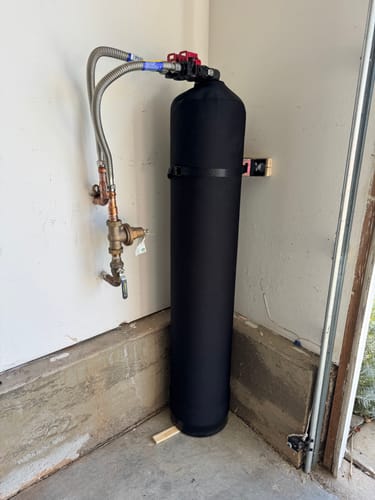
Once we identified fluoride and chlorine compounds as the primary culprits, I dove deep into understanding different filtration technologies. The challenge wasn't just removing chlorine - most basic carbon filters can handle that. The real challenge was finding a system capable of reducing fluoride, chloramine, and the spectrum of industrial contaminants found in modern municipal water.
How do you filter out contaminants that basic carbon filters can't handle?
This question led me to discover the difference between standard activated carbon and specialized catalytic carbon media.
Traditional granular activated carbon excels at removing chlorine, taste, and odor issues, but struggles with chloramine and fluoride compounds. Catalytic carbon, on the other hand, employs a different mechanism that can break down chloramine bonds and reduce a broader spectrum of chemical contaminants.
The SoftPro upflow design caught my attention because it addresses several common problems with whole-house carbon systems. Standard downflow systems can create channeling, where water finds the easiest path through the media bed, reducing contact time and filtration efficiency. The upflow configuration ensures even distribution and longer contact time between water and media.
I also researched NSF/ANSI certification standards, particularly NSF 42 for aesthetic contaminants and NSF 53 for health-related contaminants. The media specifications indicated capabilities for reducing chlorine, chloramine, VOCs, THMs, and various industrial chemicals - exactly what our testing revealed in our municipal supply.
Flow rate was another crucial factor. With four people in our household and typical peak usage patterns, I calculated we needed a system capable of delivering 10-12 gallons per minute without significant pressure drop. The 1.5 cubic foot media capacity seemed appropriate for our consumption patterns and the contaminant levels we measured.
Installation Experience and Initial Setup
The SoftPro system arrived well-packaged with clear installation documentation. At 48 inches tall and containing 120 pounds of catalytic carbon media, this isn't a lightweight system. The Fleck control valve felt substantial and included clear programming instructions for the automatic backwash cycles.
Installation required basic plumbing skills but wasn't overly complex. The main challenge was finding adequate space for the 10-inch diameter tank in our utility room and ensuring proper clearance for eventual media replacement. I installed it on the main line after our pressure tank but before the hot water heater.
Should you hire a plumber or tackle this as a DIY project?
If you're comfortable with basic plumbing connections and have the necessary tools, this is manageable as a weekend project.
The bypass valve installation proved essential during setup, allowing us to maintain water service while making connections. I appreciated the inclusion of union fittings, which will make future maintenance much easier. Total installation time was approximately four hours, including the time needed to program the control head for our household size and estimated water usage.
Initial startup involved running the backwash cycle to settle the media bed and flush any carbon fines. The first few gallons had a slight carbon taste, which cleared completely after the initial flush cycle. Programming the timer for automatic regeneration required calculating our daily usage and setting the frequency to ensure optimal performance without wasting water.
Performance Analysis: Six Months of Real-World Testing

The transformation in our water quality became apparent within 48 hours of installation. Using a TDS meter and chlorine test strips, I documented the before and after measurements. Incoming water consistently measured 340 PPM total dissolved solids with 2.5 PPM free chlorine. Post-filtration readings showed TDS around 335 PPM (expected, since carbon doesn't remove minerals) and undetectable chlorine levels.
The most dramatic change was the complete elimination of chemical taste and odor. Our coffee improved immediately - no more harsh, bitter notes that we had attributed to over-extraction but were actually chlorine compounds interfering with flavor extraction. The metallic aftertaste that had become our normal completely disappeared.
Can you actually taste the difference between filtered and unfiltered water?
Absolutely, and it's more dramatic than I anticipated.
For our son's fluoride sensitivity, the results were remarkable. Within two weeks, his skin irritation decreased significantly, and the allergic reactions that had prompted our search for a solution virtually disappeared. While I can't make medical claims, the correlation was clear and consistent.
I tested the system's chloramine reduction capabilities using API test kits designed for aquarium use, which are sensitive enough to detect trace amounts. Before installation, our municipal water tested positive for chloramine at approximately 1.5 PPM. Post-filtration samples consistently showed non-detectable levels, confirming the catalytic carbon's effectiveness.
Flow rate performance exceeded expectations. Even during peak demand periods - simultaneous shower, dishwasher, and laundry - I measured only a 2 PSI pressure drop across the system. The upflow design and properly sized media bed maintained consistent pressure throughout the house.
Over six months, I've monitored the system's performance monthly. Chlorine removal efficiency remains at 100%, and the taste and odor improvements haven't degraded. The automatic backwash cycles occur every four days based on our usage patterns, consuming approximately 45 gallons per cycle for media bed cleaning and regeneration.
Daily Living Impact and Family Benefits
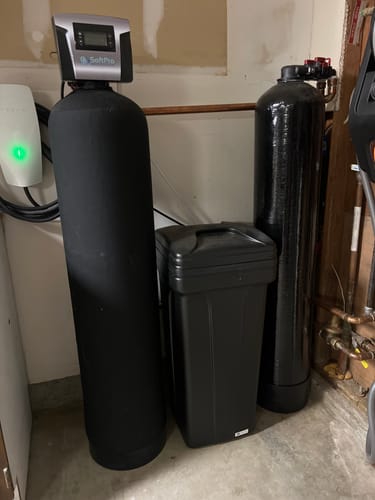
The improvements extended far beyond what we initially hoped to achieve. Shower water feels noticeably softer on skin, and everyone in our family comments on reduced dryness and irritation. My wife's hair maintains moisture better, and we've actually reduced our usage of moisturizers and conditioners.
Cooking improvements were unexpected but significant. Pasta water no longer has that slight chemical smell during boiling, and ice cubes from our refrigerator are crystal clear instead of slightly cloudy. The difference in tea and coffee preparation is remarkable - flavors are cleaner and more distinct without chlorine compounds interfering with the extraction process.
Do your houseguests notice the difference in water quality?
Multiple visitors have commented on the taste and quality of our water without any prompting from us.
Our appliances are showing positive changes too. The dishwasher operates more efficiently with reduced spotting on glassware, and our washing machine seems to clean clothes more effectively with less detergent. I attribute this to the removal of chlorine, which can interfere with soap and detergent effectiveness.
The elimination of chemical odors throughout the house was something I hadn't anticipated. Hot showers no longer create that faint chlorine smell that we had grown accustomed to, and running hot water for cooking doesn't produce any chemical vapors.
For drinking water, we've completely eliminated our reliance on bottled water. The filtered tap water tastes clean and fresh, with no chemical aftertaste or odor. This change alone has saved us approximately $40 monthly on bottled water purchases.
Operational Costs and Maintenance Reality
Understanding the true cost of ownership was crucial in our decision-making process. The initial investment in the SoftPro system was significant, but I wanted to track actual operational expenses over our first six months of use.
The automatic backwash cycles consume approximately 45 gallons every four days, based on our household's water usage patterns. At our municipal water rate of $0.004 per gallon, this translates to about $0.18 per backwash cycle, or roughly $16 annually in additional water consumption for maintenance.
What are the hidden costs that manufacturers don't always mention upfront?
Electricity for the control valve timer and occasional media replacement represent the primary ongoing expenses.
Electricity consumption is minimal - the Fleck control valve draws power only during backwash cycles and for maintaining the timer. I estimate less than $5 annually in additional electrical costs. The control valve operates reliably and maintains programming even during brief power outages.
Media replacement represents the largest long-term expense. Based on our water quality and usage patterns, I anticipate replacing the catalytic carbon media every 3-4 years. Current replacement media costs approximately $280, which translates to roughly $80 annually when amortized over the expected media life.
Compared to our previous bottled water expenses of $40 monthly, the system pays for itself in operational savings within the first year. Additionally, we've noticed reduced soap and detergent usage, as chlorine-free water allows these products to work more effectively.
Salt costs are non-existent with this system, unlike water softeners that require monthly salt additions. The simplicity of carbon filtration means fewer consumables and less maintenance complexity compared to multi-stage systems.
Long-Term Ownership and System Reliability
Six months of ownership provides insight into the system's reliability and consistency. The Fleck control valve has operated flawlessly, executing backwash cycles automatically based on our programmed schedule. The LED display clearly indicates system status and days remaining until the next regeneration.
Maintenance requirements are straightforward and minimal. Monthly visual inspections confirm proper operation, and I occasionally check the bypass valve to ensure it's in the correct position. The system's simplicity means fewer potential failure points compared to more complex multi-stage filtration systems.
How do you know when the media needs replacement?
Performance degradation becomes apparent through taste changes and reduced chlorine removal efficiency, typically after several years of operation.
I've established a monitoring routine using chlorine test strips monthly to verify continued effectiveness. Results remain consistently at non-detectable levels, indicating the catalytic carbon media maintains its adsorption capacity. Taste and odor removal shows no degradation from installation day.
The tank and valve construction appear robust and designed for long-term use. The fiberglass tank shows no signs of wear, and the brass fittings maintain tight seals without any observed leaks. The system operates quietly - backwash cycles produce some water flow noise, but nothing disruptive.
Winter operation during freezing temperatures hasn't created any issues, as the system is installed in our heated utility room. The control valve's electronic components function normally across temperature variations, and programming remains stable.
Who Should Consider This System vs. Alternatives
Based on our experience, this SoftPro catalytic carbon filter excels for households dealing with chlorinated municipal water containing chloramine, fluoride compounds, and industrial contaminants. If your primary concerns are chemical taste, odor, and health impacts from water treatment chemicals, this system addresses those issues effectively.
Families with chemical sensitivities or health concerns related to fluoride compounds will particularly benefit from the specialized media's capability to reduce these contaminants. The whole-house application means every tap delivers treated water, not just designated drinking water outlets.
Is this overkill if your only concern is chlorine taste and odor?
Possibly - simpler carbon systems might suffice for basic chlorine removal without the specialized catalytic media.
Households with high water usage benefit from the system's flow rate capacity and automatic operation. The 10 GPM capability handles multiple simultaneous uses without pressure loss, making it suitable for larger families or homes with high-demand fixtures.
However, if your water issues include hardness, iron, or sediment problems, this carbon-only system won't address those concerns. Hard water areas might benefit from combining this with a water softener, though that increases complexity and maintenance requirements.
Budget-conscious buyers should consider the total cost of ownership including media replacement. While operational costs are reasonable, the initial investment and periodic media replacement represent significant expenses compared to point-of-use solutions.
For well water applications, testing would be essential to determine appropriateness. Wells with high iron content might overwhelm the carbon media, and bacterial contamination requires different treatment approaches.






