


![SoftPro Chlorine+ Carbon Whole House Water Filter to Remove PFAS, Chlorine, Chloramine & Pesticides [City Water Filters Series]](http://www.softprowatersystems.com/cdn/shop/files/SoftPro_Whole_House_Carbon_Filter_with_Spin_Down_Water_Filter.webp?v=1780515157&width=140)
![SoftPro Iron Filter - Iron Master AIO - Best Iron Filter for Well Water [Air Injected Water Filter / Katalox]](http://www.softprowatersystems.com/cdn/shop/files/SoftPro_AIO_Iron_Master_Iron_Filter_Main.webp?v=1772123747&width=140)


 855-683-8488


Whole House Catalytic Bone Char Carbon Filter Review

Hi, I'm Ken J. I live in California.
Craig "The Water Guy" Phillips asked me to share my experience as a homeowner on the SoftPro Fluoride & Chlorine+ SUPER Filter (Whole House Catalytic + Bone Char Carbon Filter) I purchased.
This is how my adventures played out. I hope this helps you in your decision.
The Water Quality Nightmare That Started It All
Living in California, I thought I had decent municipal water. Boy, was I wrong. The turning point came last March when I filled a clear glass pitcher and noticed it had a slight yellowish tint. Have you ever questioned what's really flowing through your taps?
The taste was becoming increasingly metallic, and my morning coffee – once a highlight of my day – started tasting like it was brewed with pool water. My wife complained about her hair feeling dry and brittle after showers, and our white laundry was developing a dingy appearance despite using premium detergents.
I decided to get our water tested professionally. The results were eye-opening: chlorine levels at 3.2 ppm, fluoride at 1.1 ppm, and traces of iron that explained the discoloration. The lab technician mentioned that while these levels weren't dangerous, they were certainly affecting our water's taste, smell, and overall quality.
We had tried basic pitcher filters and even a countertop unit, but these solutions only addressed drinking water. The real problem was that contaminated water was flowing through our entire house – affecting our showers, laundry, dishwasher, and every appliance connected to our water supply.
Research Phase: Understanding What We Actually Needed
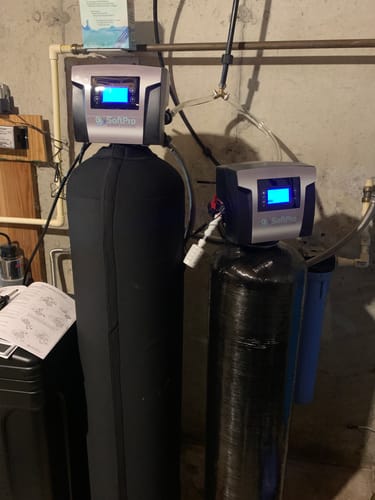
My deep dive into water filtration technology lasted about three weeks. I quickly learned that not all whole house filters are created equal. The key was finding a system that could handle multiple contaminants simultaneously without creating pressure drops or requiring constant maintenance.
I discovered that catalytic carbon was superior to regular activated carbon for chlorine removal because it doesn't require backwashing and has a longer lifespan. The bone char component specifically targets fluoride – something most carbon filters can't effectively remove.
The SoftPro system caught my attention because it combined both technologies in a single upflow design. The upflow configuration prevents channeling and ensures maximum contact time between water and the filtration media. This meant better contaminant removal without the pressure loss common in downflow systems.
After comparing flow rates, I determined the system could handle our household's peak demand of 12 GPM without causing pressure issues. The 10-year media life span also appealed to me compared to other systems requiring annual replacements.
Unboxing and Initial Assessment
The system arrived in well packaged boxes Inside, both of the 10" x 54" fiberglass tank had a substantial feel and was protected with a black neoprene jacket, weighing approximately 70 pounds each
The Water Softener digital control head looked sophisticated with its clear display showing regeneration cycles, gallons processed, and system status. All the necessary fittings, bypass valve, and installation hardware were included, along with detailed documentation that actually made sense.
The Catalytic carbon Filter with Bone char carbon was already loaded with the carbon. All I had to do is unscrew the protect cap from the top of the tank and screw the in and out valve in its place,
Installation Experience and Setup Process

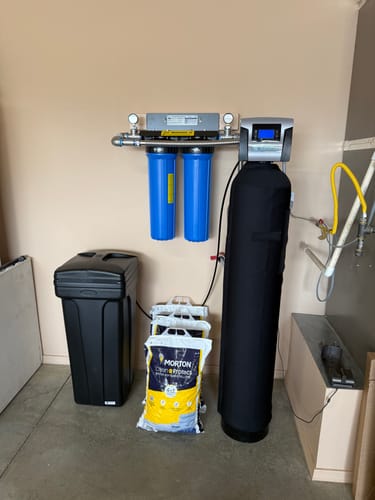
We installed the Carbon filter and the water softener it after my water meter but before the water heater, ensuring all incoming water would be filtered. The bypass valve installation was crucial – it allows us to isolate the system for maintenance without shutting off water to the entire house.
Initial startup involved slowly filling the carbon tank to prevent media displacement and letting the carbon soak for a day, then we ran water from the hose bib we installed between the carbon filter and the water softener, opened the bypass valve on the carbon filter leaving the water softener in bypass mode, we ran water slowly from the hose bib and checked it every few minutes by filling a container until the water was clear and no carbon particles were present. We then did programming on the water softener control head for our specific water conditions.
Real-World Performance and Daily Impact
Did you know that most people don't realize how poor their water quality is until they experience truly clean water?
The transformation was immediate and dramatic. That first glass of water from our kitchen tap was revelation – crisp, clean, with no chemical aftertaste whatsoever. My wife noticed the difference in her shower that same evening, commenting that her skin didn't feel tight and dry afterward.
Within a week, our coffee maker stopped leaving mineral deposits, and the water spots on our glassware virtually disappeared. Our dishwasher started performing better because the detergent could work effectively without fighting chlorine and other contaminants.
I measured the chlorine levels post-filtration using test strips and consistently got readings below 0.1 ppm – a 97% reduction from our baseline of 3.2 ppm. The fluoride reduction was equally impressive, dropping from 1.1 ppm to 0.3 ppm.
Perhaps most importantly, the system maintains consistent water pressure throughout our home. Even during peak usage periods – morning showers while the dishwasher runs – we haven't experienced any noticeable pressure drops.
Maintenance Requirements and Long-Term Ownership
Six months into ownership, maintenance has been refreshingly minimal. The upflow design is largely self-cleaning, preventing the channeling issues that plague traditional downflow systems. The digital control head tracks usage.
Monthly maintenance consists of checking the display readings and ensuring the bypass valve operates smoothly. I also test our water quarterly using home test kits to verify the system continues performing effectively.
The backwash cycle occurs automatically based on water usage rather than a timer, which means the system only regenerates when necessary. This typically happens every 2-3 weeks in our household of four people.
Operational costs are minimal – primarily electricity for the control head, which uses about the same power as a digital alarm clock. There are no salt purchases, replacement cartridges, or frequent service calls required.
Investment Analysis and Value Proposition
The system cost $2,847 plus some plumbing supplies and around 5 hours of our time to install it and set it up. So much less than the quotes we received from local dealers and the quality of these systems is top notch.
Our previous bottled water expenses averaged $85 monthly for drinking water alone. The system eliminated this cost entirely while providing filtered water for every use in our home. Additionally, our reduced soap and detergent usage save approximately $25 monthly.
I calculated that the system pays for itself in about 2.5 years through direct savings, not including the value of appliance protection and improved water quality for bathing and cleaning.
The 10-year media life means no expensive annual replacements. When replacement is eventually needed, the media cost is approximately $400 – still less than many systems charge for annual cartridge replacements.
Final Assessment and Recommendations
After eight months of ownership, this system has exceeded my expectations in every category. The water quality improvement is substantial and consistent, the maintenance requirements are minimal, and the long-term economics make sense.
Would I make the same purchase decision again?
Absolutely. The combination of catalytic carbon and bone char effectively addresses our specific water quality issues without the ongoing costs and maintenance headaches of other systems.
This system is ideal for homeowners dealing with chlorine, fluoride, and taste/odor issues who want a set-it-and-forget-it solution. The upfront investment is significant, but the 10-year media life and minimal operational costs make it economical over time.
For California residents dealing with heavily treated municipal water, I can confidently recommend this system based on my real-world experience. The water quality improvement has been transformative for our entire household.



