


![SoftPro Chlorine+ Carbon Whole House Water Filter to Remove PFAS, Chlorine, Chloramine & Pesticides [City Water Filters Series]](http://www.softprowatersystems.com/cdn/shop/files/SoftPro_Whole_House_Carbon_Filter_with_Spin_Down_Water_Filter.webp?v=1780515157&width=140)
![SoftPro Iron Filter - Iron Master AIO - Best Iron Filter for Well Water [Air Injected Water Filter / Katalox]](http://www.softprowatersystems.com/cdn/shop/files/SoftPro_AIO_Iron_Master_Iron_Filter_Main.webp?v=1772123747&width=140)


 855-683-8488


Step-by-Step Well Pump Flow Rate Calculation for Accurate Water Filter Selection

To calculate your well pump's flow rate, you'll need a 5-gallon bucket and a stopwatch. Make sure no water's running inside, then open a faucet to trigger the pump. Collect water, time how long it takes, then use this formula: (Gallons ÷ Seconds) × 60. That gives you your GPM. Anything below 6 GPM may require a storage solution before installing a filter. Keep exploring to find exactly which system fits your results.
Key Takeaways
- Gather a 5-gallon bucket and stopwatch, ensuring no water runs inside the house before beginning your flow rate measurement.
- Open a faucet to activate the pump, collect water in the bucket, and time how long until the pump restarts.
- Calculate GPM by dividing gallons collected by seconds elapsed, then multiplying by 60 for your final result.
- Match your measured GPM to your filter's rated flow rate, targeting 6–12 GPM for standard household water treatment systems.
- Flow rates consistently below 6 GPM may require a storage solution and professional evaluation before installing any filtration system.
What Is Well Pump Flow Rate and Why Does It Determine Your Filter Size?

Well pump flow rate is simply how many gallons per minute (GPM) your pump pulls from the well — and getting this number right affects everything downstream, especially your filter selection.
Your well pump's GPM isn't just a spec — it's the foundation every downstream filtration decision depends on.
If you're running an iron filter, for example, it needs sufficient GPM to backwash effectively. Size it wrong, and you're left with a system that underperforms or fails prematurely.
Here's why this matters: filters aren't one-size-fits-all. They're engineered around specific flow rate thresholds. Too low, and the filtration media won't regenerate properly. Too high, and you risk bypassing the treatment process entirely.
Knowing your exact GPM puts you in control. You'll match the right filter to your actual system — not guesswork — and that precision is what separates a reliable water treatment setup from a costly mistake.
How to Measure Your Well Pump Flow Rate at Home
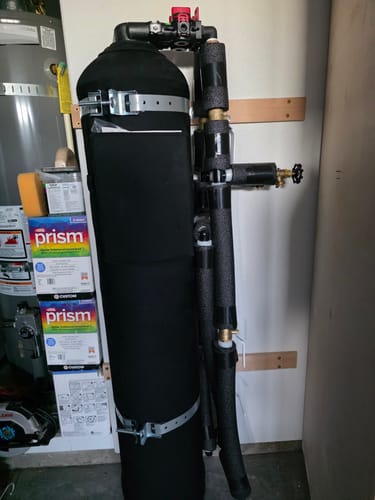
Measuring your well pump flow rate at home doesn't require a plumber or specialized equipment — just a bucket, a stopwatch, and a few minutes.
Here's exactly how we do it:
- Confirm no water is running inside the house, then open a nearby faucet to trigger the pump.
- Close the faucet and let the pump fully pressurize the tank until it shuts off.
- Open the faucet again, collect discharged water in a 5-gallon bucket, and start your stopwatch.
- Stop timing when the pump restarts, then record your gallons collected and seconds elapsed.
- Apply this formula: (Gallons ÷ Seconds) × 60 = GPM
Target 6–12 GPM for a healthy household system — that number directly determines which filter can keep up.
How to Calculate GPM and Interpret Your Results
Once you've collected your water and stopped the clock, the math is invigoratingly simple: divide your gallons by seconds, then multiply by 60. That's your GPM. For instance, filling a 5-gallon bucket in 45 seconds gives you (5 ÷ 45) × 60 = 6.6 GPM.
Now, what does that number actually mean? It tells you whether your well can support specific water treatment systems, which have minimum flow requirements to function properly.
Too low, and you'll need a storage-based solution rather than a point-of-entry filter.
We recommend running this calculation annually. Well performance shifts over time, and catching a declining flow rate early lets you adapt your filtration strategy before it becomes a costly problem.
Which Water Filters Match Your Well Pump Flow Rate
Now that you've got your GPM number, how do you translate it into the right filter choice? Matching your flow rate to your filter prevents pressure drops and treatment failures.
We recommend targeting these essentials when evaluating options:
- Confirm the filter's maximum rated flow rate exceeds your measured GPM
- Target 6–12 GPM for standard household performance
- Check iron filters specifically—their backwash rate must exceed their service flow rate
- Review manufacturer specs carefully before purchasing
- Monitor your pump's flow rate regularly to catch performance shifts early
Here's the key insight: a filter rated below your pump's output won't treat water effectively—it'll simply struggle to keep up.
Match the specs precisely, and you'll protect both your water quality and your system's pressure.
What a Low Well Pump Flow Rate Means for Your Filter System
If your well pump's flow rate consistently falls below 6 GPM, it's a red flag worth taking seriously.
Iron filters, for instance, demand higher backwash flow rates to function effectively—fall short, and contaminants stay in your water. Low flow rates also strain your entire system, driving up maintenance costs and compromising home water pressure.
Here's what we recommend before installing any filter: get a professional evaluation.
A consistently low flow rate often signals clogged filters or a damaged pump—problems that'll undermine even the best filtration system if left unaddressed.
Measuring your flow rate regularly isn't optional; it's essential.
Those measurements let us fine-tune filter specifications, ensuring your water treatment system operates at peak efficiency rather than fighting against inadequate supply.
Frequently Asked Questions
How Do You Calculate the Flow Rate of a Well Pump?
We'll calculate your well pump's flow rate by filling a 5-gallon bucket, timing the seconds, then multiplying (gallons ÷ seconds) × 60. Make certain no other water's running for accurate GPM results.
How to Calculate Flow Rate Through a Filter?
We'll measure the volume of water passing through the filter, then divide it by time: Flow Rate (GPM) = Gallons ÷ Minutes. Always measure at the filter's inlet to account for pressure drop across the media.
Is a 30/50 or 40-60 Pressure Switch Better?
Neither's universally better—it depends on your needs. We'd recommend a 40/60 switch if you're running multiple fixtures simultaneously, as it delivers more consistent pressure. Choose 30/50 for lower-demand systems to reduce pump wear.
How to Select a Pump for a Desired Flow Rate?
To select a pump for your desired flow rate, we'll consult manufacturer pump curves, match your GPM needs to head pressure specs, and target the Best Efficiency Point for ideal performance and longevity.



