


![SoftPro™ Chlorine+ Carbon Whole House Water Filter to Remove PFAS, Chlorine, Chloramine & Pesticides [City Water Filters Series]](http://www.softprowatersystems.com/cdn/shop/files/SoftPro_Whole_House_Carbon_Filter_with_Spin_Down_Water_Filter.webp?v=1783547361&width=140)


 855-683-8488


Step-by-Step Whole House Iron Filter Installation Guide for Experienced DIY Homeowners

Installing a whole house iron filter starts with gathering key components like the filter tank, bypass valve, filter media, and gravel, plus tools like pipe cutters and Teflon tape. We'll shut off the main water supply, cut into the main line, and install the bypass valve before loading the tank with gravel and media. Then we'll test for leaks and run our first backwash cycle. Stick with us, and we'll walk through every detail that makes this upgrade last.
Key Takeaways
- Shut off the main water supply, mark precise cutting points, and immediately install the bypass valve after cutting the pipe.
- Prepare all components beforehand, including filter media, gravel, flexible connectors, and tools like pipe cutters, wrenches, and Teflon tape.
- Center the distributor tube, add a 2–3 inch gravel base, then gradually load filter media evenly per manufacturer specifications.
- Slowly reopen the main valve, inspect every connection for leaks, and tighten or re-tape any weeping joints before proceeding.
- Run an initial 15–20 minute backwash cycle, test iron levels post-backwash, and maintain a log for ongoing maintenance tracking.
Gather Your Tools and Materials Before Starting

Before we plunge into the installation, let's make certain we've got everything we need on hand. Scrambling for missing parts mid-installation kills momentum and invites costly mistakes.
You'll need the whole house iron filter system, bypass valve kit, flexible connectors, filter media, gravel, and mounting hardware. On the tool side, grab pipe cutters, wrenches, screwdrivers, and Teflon tape—these guarantee tight, leak-free connections every time.
Gather your filter system, bypass valve, flexible connectors, media, gravel, and tools before touching a single pipe.
Organize your workspace deliberately. Experienced DIYers know that a cluttered area creates confusion and slows progress. Lay everything out systematically before touching a single pipe.
Before starting, verify that all fittings and connectors match your existing plumbing specifications—compatibility issues mid-project are genuinely frustrating.
Finally, suit up with gloves and safety glasses. Protecting yourself isn't optional; it's smart practice.
Shut Off the Water and Cut Into the Main Line
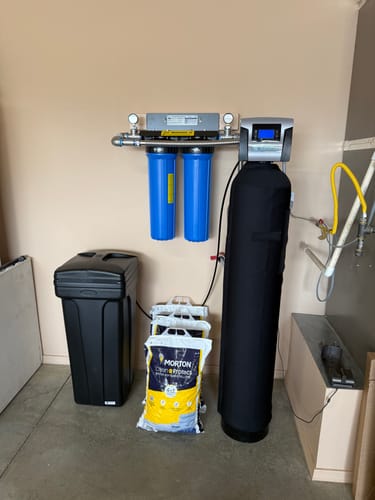
With our tools laid out and ready to go, it's time to take the first real step toward cleaner water—shutting off the main water supply. This prevents leaks and water damage while we work.
Next, mark the exact cutting points on your main line. Copper or PVC—it matters, because each material demands a specific tool. Use a pipe cutter for copper and a saw for PVC, keeping every cut clean and straight. A sloppy cut creates fitting problems downstream.
Once the pipe's open, immediately install the bypass valve. Don't wait. It maintains water flow and gives us easy maintenance access later.
Finally, wrap all threaded connections with Teflon tape before re-pressurizing—that thin layer is what stands between us and a frustrating leak.
Install the Filter Tank and Load the Media
Now that the bypass valve is in and the line is prepped, we're ready to set the filter tank and load it with media—the core of the whole system.
Start by centering the distributor tube inside the tank and sealing its top so media doesn't contaminate it during loading.
Next, pour in a 2–3 inch gravel base. This foundation supports the media and guarantees proper flow dynamics.
A 2–3 inch gravel base isn't optional—it's what keeps your media supported and your flow dynamics dialed in.
Then gradually add your filter media per the manufacturer's specs, distributing it evenly—uneven loading kills iron removal efficiency fast.
Once the media's in, verify every bracket, fitting, and internal component is seated and aligned correctly. A misaligned fitting now means a leak later.
With the tank loaded and secured, we're ready to tackle plumbing connections and system testing.
Test for Leaks and Run the First Backwash Cycle
Crack open the main supply valve slowly and watch the system come to life—but keep your eyes sharp on every connection and fitting as water begins flowing through. Any weeping joints get a quick fix: tighten the threading and wrap Teflon tape where needed.
Don't rush this step—catching leaks now saves headaches later.
Once we're confident everything's sealed tight, we'll initiate the first backwash cycle and let it run 15-20 minutes. Watch the drain line closely. Murky water clearing to crystal transparency tells us the media is doing exactly what it should.
After the cycle completes, test your water's iron content immediately. Confirm those contaminants are dropping, and we'll know our filtration system is primed and ready for reliable, long-term performance.
Clean, Backwash, and Test Your Iron Filter Long-Term
Everything we've done to this point only pays off if we commit to a consistent long-term maintenance routine. Neglect it, and we'll watch performance degrade fast.
| Task | Frequency | Purpose |
|---|---|---|
| Backwash filter | Every 2–3 days | Prevent clogging, maintain flow |
| Test iron levels | Every 6–12 months | Confirm filtration effectiveness |
| Clean filter media | Every 6–8 years | Remove accumulated impurities |
Watch the pressure gauge closely. A notable drop signals it's time to backwash or replace media before efficiency tanks.
Keep a detailed maintenance log tracking every backwash cycle, water test result, and media replacement. Patterns emerge over time, and those patterns tell us exactly when trouble's brewing before it becomes a costly problem.
Frequently Asked Questions
Can I Install a Whole House Filtration System Myself?
Yes, you can! If you're an experienced DIY homeowner, we'll walk you through selecting the right filter size, cutting your water line, and securing leak-proof connections for a system that performs flawlessly.
How to Install a Whole House Iron Filter?
We'll start by shutting off your main water supply, cutting the line, and installing a bypass valve. Next, we'll layer gravel and filter media, restore pressure gradually, then run a 15-20 minute backwash cycle.
What Is the Best Whole House Iron Filter for Well Water?
We've found that systems using Katalox Light media, like the Fleck 2510AIO, deliver the best results for well water, removing up to 15 ppm of iron automatically—no chemicals needed, just reliable, consistent whole-house protection.
How Long Does a Whole House Iron Filter Last?
With proper maintenance, your whole house iron filter's tank lasts 40-50 years, the Fleck valve 10-15 years, and the filter media 6-8 years before needing replacement. Consistent backwashing keeps everything running efficiently.






