


![SoftPro™ Chlorine+ Carbon Whole House Water Filter to Remove PFAS, Chlorine, Chloramine & Pesticides [City Water Filters Series]](http://www.softprowatersystems.com/cdn/shop/files/SoftPro_Whole_House_Carbon_Filter_with_Spin_Down_Water_Filter.webp?v=1783547361&width=140)


 855-683-8488


5 Telltale Signs Your Iron Filter Is Undersized for Your Well Water Flow Rate

If your iron filter's undersized, you'll notice it fast. Your flow rate tanks the moment water hits the filter, your pressure tank drains quicker than it should, and rust stains keep coming back no matter what. You'll also see the filter regenerating constantly, and bypassing it instantly restores your pressure. These five signs point directly to a sizing problem — and understanding each one helps you fix it for good.
Key Takeaways
- An immediate drop in flow rate from 60+ liters per minute to 20-25 liters per minute signals an undersized iron filter.
- Rapid pressure tank drainage indicates the iron filter is creating a bottleneck that prevents proper tank recovery.
- Recurring rust stains and metallic taste suggest iron is bypassing an overwhelmed, undersized filter.
- Regenerating more than twice weekly means the filter exhausts its media too quickly for your household's iron load.
- Bypassing the filter and restoring full flow rate confirms the filter, not pipes or pump, is the problem.
Your Flow Rate Drops the Moment Water Hits the Iron Filter

When your iron filter is undersized, the flow rate drop is immediate and hard to ignore—what was once 60+ liters per minute can plummet to around 20-25 liters per minute the moment water passes through.
That's not a subtle dip; that's your system struggling under demand it simply wasn't designed to handle.
That's not a subtle dip—it's your system buckling under demand it was never built to handle.
Here's how you can confirm the culprit: bypass the filter entirely. If your flow returns to normal, the filter's the problem—not your pump, not your pipes.
An undersized unit rated for 25 liters per minute will buckle during peak usage, leaving multiple fixtures starved simultaneously.
Understanding this pressure relationship is the first step toward diagnosing the real issue and sizing your next filter correctly.
Your Pressure Tank Drains Fast Because the Iron Filter Can't Keep Up
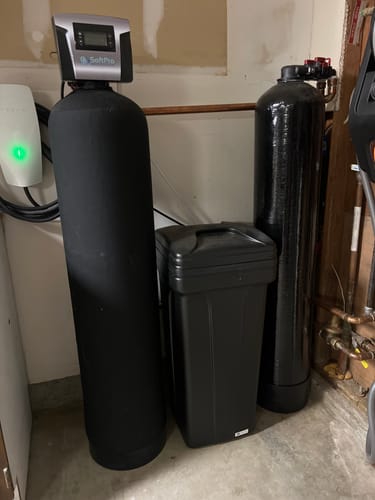
If your pressure tank is draining faster than usual, an undersized iron filter is likely strangling the flow before the tank can recover.
When the filter can't keep pace with demand, it creates a bottleneck that forces the tank to compensate—and it drains rapidly as a result.
Here's what we often see: flow rates plummeting from 60+ liters per minute down to 20 after a poorly sized filter gets installed.
During peak demand, that gap becomes a serious problem.
Try bypassing the filter temporarily. If pressure stabilizes, you've confirmed the filter's the culprit.
That's your signal to resize or replace it.
Monitoring flow rates consistently isn't optional—it's how we protect the pressure tank and guarantee reliable water delivery when it matters most.
Rust Stains Keep Returning Despite Having an Active Filter
Rust stains creeping back onto your sinks and toilets despite running an active filter tells us the system's losing the battle against your iron load.
When iron levels exceed 0.3 ppm and stains keep returning, your filter's simply undersized for your household's demand. An undersized unit regenerates too frequently, signaling it's overwhelmed before it can fully recover its capacity.
Notice a metallic taste alongside those stains? That's ferrous iron bypassing filtration entirely. The filter's not failing because it's broken—it's failing because it was never matched correctly to your flow rate.
We recommend testing your water supply regularly to track iron levels.
Once you know your actual load, you can right-size your system and stop chasing rust stains for good.
Your Iron Filter Regenerates Far Too Often Each Week
How often is your iron filter kicking into regeneration mode? If it's cycling more than twice weekly, you've likely got a sizing problem worth addressing immediately.
An undersized filter exhausts its media faster than it can recover, leaving iron removal compromised between cycles.
Here's what that pattern actually signals:
- Capacity mismatch — Your household's water usage and iron concentration exceed what your filter can handle between regenerations.
- Media exhaustion risk — Frequent cycles degrade filter media prematurely, reducing its contaminant-removal effectiveness.
- Rising operational costs — More regenerations mean higher water and salt consumption, compounding your expenses weekly.
We recommend tracking regeneration frequency alongside your water usage data.
That combination reveals whether your filter's capacity genuinely matches your well's iron load.
Bypassing the Filter Instantly Brings Your Water Pressure Back
There's one telling test you can run right now: bypass your iron filter and watch what happens to your water pressure. If flow jumps from 20 liters per minute back to 60+, your filter's undersized—full stop.
| Condition | Flow Rate |
|---|---|
| Filter Active | ~20 L/min |
| Filter Bypassed | 60+ L/min |
| Ideal Filtered Flow | 60+ L/min |
That pressure drop isn't a pipe problem or a pump issue—it's your filter choking under peak demand. An undersized unit creates excessive pressure drop that most homeowners never trace back to the filter until they run this simple bypass test. Once you see that pressure surge return instantly, you'll know exactly where to focus your sizing upgrade.
Frequently Asked Questions
What Are the Symptoms of Too Much Iron in Well Water?
We'll notice rust stains on fixtures, a metallic taste in drinking water, yellowish or orange discoloration, cloudy water with visible sediment, and water tests consistently revealing iron concentrations exceeding the recommended 0.3 ppm threshold.
What Are Common Problems With Iron Filters?
We've seen iron filters struggle with undersized capacity, clogged media, frequent regeneration cycles, and reduced water pressure. If your filter can't handle your flow rate, you'll notice rust stains and metallic-tasting water persisting after filtration.
What Is the Best Filter to Remove Iron From Well Water?
We recommend oxidizing filters using air injection, hydrogen peroxide, or potassium permanganate paired with greensand or Birm media. They're most effective at precipitating and capturing iron, ensuring consistently clean water tailored to your flow rate and iron concentration.
How Often Should an Iron Filter Run?
We'd recommend your iron filter run every few days, not daily. Frequent regeneration signals an undersized system struggling to keep up with your household's iron levels and peak water flow demands.






