


![SoftPro™ Chlorine+ Carbon Whole House Water Filter to Remove PFAS, Chlorine, Chloramine & Pesticides [City Water Filters Series]](http://www.softprowatersystems.com/cdn/shop/files/SoftPro_Whole_House_Carbon_Filter_with_Spin_Down_Water_Filter.webp?v=1783547361&width=140)


 855-683-8488


UV Ultraviolet Treatment for Iron Bacteria in Well Water: How It Works and Why It's Essential

If your well water's leaving rust-colored slime in your pipes, iron bacteria are likely the culprit. UV ultraviolet treatment works by blasting bacteria with UV-C light at 254 nm, destroying their DNA so they can't reproduce — neutralizing up to 99.99% of microorganisms in real time. It's chemical-free, it's effective, and it's essential for well owners facing contamination risks. Stick with us, and we'll break down everything you need to know.
Key Takeaways
- UV-C light at 254 nm destroys iron bacteria DNA, preventing reproduction and neutralizing up to 99.99% of microorganisms in well water.
- Since 33% of wells show bacterial contamination, UV treatment is essential for maintaining safe, clean drinking water.
- Unlike chlorination, UV treatment leaves zero chemical residues, preserving natural water taste while delivering immediate, continuous disinfection.
- UV treatment alone is insufficient; pairing it with sediment filters and activated carbon ensures comprehensive well water protection.
- Annual well water testing helps identify iron bacteria presence, determining whether UV treatment installation is necessary for your system.
What Is Iron Bacteria and Why Is It a Problem?

Iron bacteria are tiny microorganisms that thrive in iron-rich groundwater, and if you've ever noticed a rust-colored slime coating your pipes or fixtures, they're likely the culprit.
Beyond the visual horror, these bacteria compromise your water's taste and odor, making it genuinely unpleasant to use daily.
Here's what makes them particularly insidious: their presence signals a deeper problem. Elevated iron levels and potentially other contaminants are likely lurking in your water supply.
While iron bacteria themselves won't make you sick, they create conditions where harmful pathogens can flourish — turning a nuisance into a genuine health risk.
Left unaddressed, they'll clog your plumbing, reduce your treatment system's efficiency, and generate costly repairs.
We're talking about a problem that compounds quickly without proper intervention.
How UV Light Kills Iron Bacteria in Your Well
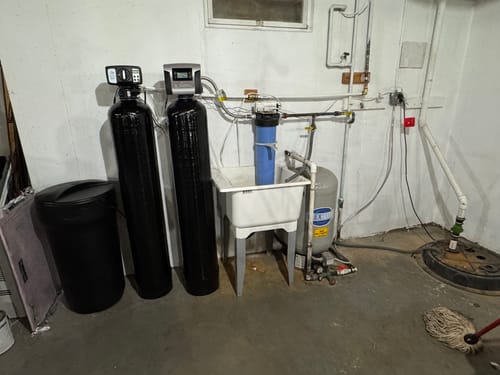
UV light works by penetrating iron bacteria's cellular structure and destroying their DNA, leaving them unable to reproduce or cause further harm. Specifically, UV-C light at 254 nm targets cellular functions with surgical precision, neutralizing up to 99.99% of microorganisms as water passes through the lamp.
| UV-C Wavelength | Target | Effectiveness |
|---|---|---|
| 254 nm | DNA disruption | Up to 99.99% neutralization |
| Continuous exposure | Cellular functions | Real-time disinfection |
| Combined filtration | Particle absorption | Optimized UV penetration |
Here's what makes this powerful: it's chemical-free and instantaneous. However, iron bacteria create particles that absorb UV light, reducing efficacy. That's why we always recommend pairing UV treatment with sediment filtration — together, they're unstoppable.
Do You Need UV Treatment for Your Well Water?
How do you know if your well actually needs UV treatment? Start with testing. About 33% of wells nationwide show bacterial contamination, so the odds aren't in your favor.
Here's what should push you toward installing UV:
- Your tests detect coliform, E. coli, or iron bacteria present in your water.
- You have a shallow or older well, which health authorities flag as higher-risk.
- Your well has a documented history of contamination.
If any of these apply, UV treatment isn't optional—it's essential. It neutralizes up to 99.99% of harmful microorganisms.
However, remember that UV doesn't remove sediment or chemicals, so pair it with proper filtration for complete protection. We recommend annual testing to stay ahead of problems.
Why UV Treatment Beats Chlorination for Iron Bacteria
When it comes to fighting iron bacteria, we've found that UV treatment consistently outperforms chlorination—and the reasons are hard to ignore.
UV light directly disrupts bacterial DNA, neutralizing microorganisms that chlorine sometimes can't touch. Chlorination introduces chemical byproducts that alter taste and require careful monitoring to maintain effective residual levels—levels that diminish over time.
UV treatment delivers immediate results with zero chemical residues, meaning your water stays clean without waiting periods or taste compromises. It operates continuously, providing real-time protection rather than depending on fluctuating chemical concentrations.
There's also an environmental advantage: UV systems consume less energy than chlorine production and handling require.
Maintenance is straightforward—replace the lamp, clean the sleeve, and you're protected. Chlorination demands constant chemical adjustments. UV simply wins.
What UV Treatment Can't Do on Its Own
Though UV treatment is remarkably effective at neutralizing harmful microorganisms, it can't do everything—and understanding its limits keeps us from making costly mistakes.
Iron bacteria demand a multi-layered strategy because UV simply wasn't designed to handle certain challenges:
Iron bacteria require a multi-layered defense — UV alone simply wasn't built to tackle every challenge they present.
- It doesn't remove iron or sediment — High concentrations block UV light penetration, crippling disinfection efficiency before it even starts.
- It ignores chemical contaminants — UV neutralizes living organisms, not dissolved minerals or chemical pollutants compromising your water quality.
- It doesn't eliminate the iron bacteria source — UV neutralizes bacteria present in water but leaves the underlying iron problem completely untreated.
Pairing UV with sediment filters and activated carbon creates the all-encompassing defense system your well water actually needs.
Frequently Asked Questions
What Is the Downside of UV Disinfection Water?
We've found UV disinfection doesn't remove iron or chemicals, struggles with turbid water, and requires consistent power. Neglect lamp maintenance, and you're risking compromised protection against resistant microorganisms like spores and cysts.
How Often Should I Change the UV Light for Well Water?
We recommend replacing your UV lamp annually. Over time, its output declines, reducing effectiveness against harmful microorganisms. Don't wait until it fails—staying ahead of this simple maintenance step keeps your well water consistently safe.
How Much Does It Cost to Install an UV Light for Well Water?
We're looking at $800 to $2,500 for installation, depending on system capacity and complexity. Factor in $100 to $300 annually for maintenance—lamp replacements and sleeve cleaning—making it a smart, affordable long-term investment.
How Does the UV Light Work on Well Water?
We use UV-C light at 254 nm to damage bacterial DNA as water flows past the lamp, neutralizing up to 99.99% of pathogens instantly—no chemicals, no residues, just clean, safe water.






