


![SoftPro™ Chlorine+ Carbon Whole House Water Filter to Remove PFAS, Chlorine, Chloramine & Pesticides [City Water Filters Series]](http://www.softprowatersystems.com/cdn/shop/files/SoftPro_Whole_House_Carbon_Filter_with_Spin_Down_Water_Filter.webp?v=1783547361&width=140)


 855-683-8488


Well Pump Flow Rate vs. Peak Household Demand: How to Use Both Numbers for Iron Filter Sizing

Sizing an iron filter correctly means using two numbers together, not separately. Your well pump's flow rate tells us the maximum water supply available, while your peak household demand reveals what you actually need during busy periods like morning routines. When these numbers align with your iron concentration levels, you can choose a filter that handles real-world usage without premature saturation. Keep exploring, and we'll show you exactly how to match every variable for a perfectly sized system.
Key Takeaways
- Well pump flow rate determines the filter size needed, while peak household demand ensures the system meets high-usage periods effectively.
- Calculate peak demand by adding fixture flow rates; a 3-4 bedroom home typically requires 10-12 GPM.
- Your well pump must deliver at least 5-10 GPM to support effective backwashing and prevent iron buildup.
- Higher iron concentrations (15-20 ppm) can reduce usable flow rates, requiring larger or hybrid filtration systems.
- Match your filter size to both peak demand and daily usage (50-100 gallons per person) to prevent premature saturation.
What Your Well Pump Flow Rate Actually Tells You About Iron Filtration

Well pump flow rate isn't just a number—it's the foundation of your entire iron filtration system. Think of it as your system's heartbeat. When we're aware your pump delivers 10-12 GPM, we immediately understand what filter size can realistically keep pace with your household's iron removal demands.
Here's what that number actually reveals: your filter must handle both steady daily usage and those high-demand morning rushes when everyone's showering simultaneously.
If your filter can't match your pump's output, iron slips through untreated, and you're left with stained fixtures and compromised water quality.
We use flow rate to guarantee your filter's backwash cycle—requiring 5-10 GPM minimum—stays powerful enough to flush captured iron and keep the media performing at its peak.
How to Calculate Peak Household Demand for Your Iron Filter
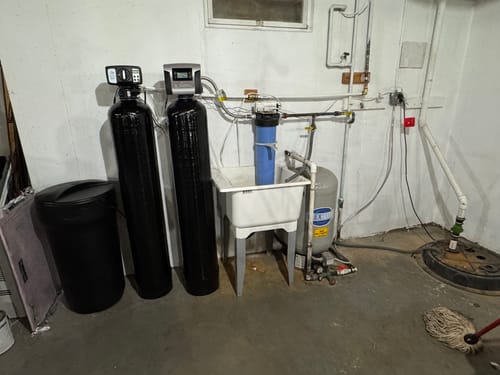
Now that we recognize how your pump's flow rate shapes your filter selection, let's put that knowledge to work by calculating exactly how much water your household actually demands at peak times.
Add up your fixtures' individual flow rates—kitchen faucets run 2-3 GPM, showers 2-5 GPM, washing machines 4-5 GPM. Running simultaneously during morning routines, these numbers stack fast. Most 3-4 bedroom homes target 10-12 GPM peak demand.
Kitchen faucets, showers, and washing machines running together can push peak household demand to 10-12 GPM fast.
Don't guess—keep a week-long usage log to catch real variations you'd otherwise miss. Morning and evening routines reveal your true worst-case scenarios.
Once you've got solid numbers, cross-reference them with professional calculators or water treatment specialists to match the right iron filter capacity. Under-sizing here is an expensive mistake you'll feel every single day.
Why Iron Concentration Changes the Flow Rate Math
Once you've nailed down your peak demand numbers, iron concentration throws a wrench into the equation that most people don't see coming.
Here's why: a filter sized for 7-10 ppm iron behaves very differently when concentrations spike to 15-20 ppm. Higher iron loads saturate filter media faster, effectively shrinking your usable flow rate during peak demand. Suddenly, that system you sized for 8 GPM struggles to keep pace.
Worse, iron levels fluctuate seasonally, so what tests fine in spring may overwhelm your system by summer.
At elevated concentrations, you'll often need hybrid filtration systems that balance both removal capacity and flow rate simultaneously. Backwashing requirements also intensify—your pump must reliably deliver 5-10 GPM to flush accumulated iron and restore performance.
Concentration changes everything.
How to Match Flow Rate and Peak Demand to Iron Filter Size
Sizing an iron filter correctly means we need to work through a simple but critical sequence: calculate peak demand first, then match it to filter capacity.
For a 3-4 bedroom home, that peak typically hits 10-12 GPM during morning or evening rush. We also need our well pump delivering at least 5-10 GPM to support effective backwashing—skip this step and the filter never fully regenerates.
Daily usage matters too. At 50-100 gallons per person, we can't afford a filter that saturates before the day ends.
Once we've mapped those numbers, we match them to a filter rated for our actual demand. Then we test regularly, because flow rates shift and iron levels change. Precision here protects the whole system long-term.
Backwash Flow Rate: The Third Number That Determines Filter Performance
Most people focus on two numbers when sizing an iron filter—peak demand and daily usage—but there's a third number that quietly determines whether the whole system actually works: backwash flow rate.
Your filter needs 5–10 GPM to lift and redistribute media during backwashing cycles, which typically run every 2–3 days depending on your iron concentration. If your well pump can't deliver that flow rate, the media never fully cleans, iron builds up, and your filtration efficiency drops.
We've seen systems fail not because the filter was undersized for household demand, but because nobody checked whether the pump could support backwashing. Mismatched backwash capability quietly drives up maintenance costs while reducing performance.
Size for all three numbers, not just two.
Frequently Asked Questions
How Many Gpm Is a 4 Bedroom House?
For a 4-bedroom house, you'll need 10-12 GPM for standard demand. But when multiple fixtures run simultaneously, we recommend planning for 12-15 GPM to handle peak usage comfortably and size your iron filter correctly.
How to Calculate Flow Rate Through a Filter?
To calculate flow rate through a filter, we'll measure total water volume filtered, then divide it by the time taken. The result gives us gallons per minute (GPM), our key filter-sizing metric.
How Many GPM for a 3 Bathroom House?
For a 3-bathroom house, you'll need 9-12 GPM to handle peak demand. We're talking simultaneous showers, faucets, and toilets all running at once—so don't undersize your system.
How Do You Size an Iron Filter?
We size an iron filter by matching it to your daily water demand, peak flow rate, and iron concentration. Test your water first, then choose a filter handling at least 7-10 ppm with adequate GPM capacity.






