


![SoftPro™ Chlorine+ Carbon Whole House Water Filter to Remove PFAS, Chlorine, Chloramine & Pesticides [City Water Filters Series]](http://www.softprowatersystems.com/cdn/shop/files/SoftPro_Whole_House_Carbon_Filter_with_Spin_Down_Water_Filter.webp?v=1783547361&width=140)


 855-683-8488


Well Pump GPM and Iron Filter Size: The Essential Calculation Every Buyer Needs to Do First

Before buying an iron filter, you need to know your well pump's GPM (gallons per minute) — it's the single number that determines whether your filter works or fails. GPM affects everything: pipe sizing, backwash efficiency, and filtration capacity. Most households need 6–12 GPM, and iron filters perform best between 5–10 GPM. Get this wrong, and you'll face clogged media or equipment burnout. Stick with us, and we'll walk you through exactly how to calculate, interpret, and apply this critical number.
Key Takeaways
- GPM (gallons per minute) is the primary calculation needed before selecting any iron filter size for your well system.
- Measure GPM by collecting water in a bucket while the pump runs, then dividing gallons by seconds and multiplying by 60.
- Iron filters require 5–10 GPM to backwash effectively; falling outside this range causes media clogs or washout.
- Low GPM prevents thorough backwashing, while high GPM flushes filtration media out, both compromising water quality.
- Matching your well pump's GPM to filter specifications ensures efficient iron removal and extends overall system lifespan.
What GPM Actually Means for Your Well System

When it comes to well systems, GPM — gallons per minute — is the number that drives almost every sizing decision you'll make. It measures how much water your pump delivers in real time, and that single figure shapes everything downstream, from pipe sizing to filtration capacity.
Here's why it matters so deeply: your iron filter, for example, can't backwash effectively unless it receives adequate flow. Too little GPM, and contaminants linger. Too much demand, and your pump burns out.
We think of GPM as the heartbeat of the system. When you know it precisely, you stop guessing and start engineering. Most households need between 6 and 12 GPM depending on simultaneous fixture use — and hitting that target requires understanding your pump, your depth, and your peak demand together.
How to Measure Your Well Pump's Flow Rate at Home
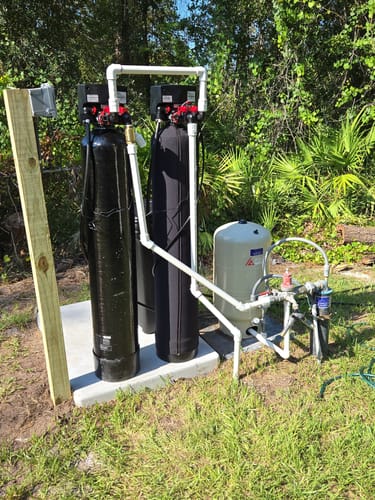
Knowing your pump's GPM in theory is one thing — actually measuring it's where the real confidence comes from.
Here's how we do it cleanly and accurately.
Open a faucet downstream of your pressure tank and let it run until the pump kicks on.
Listen for that distinctive click from the pressure switch — that's your start signal.
Now collect water in a 5-gallon bucket, tracking total gallons until the pump shuts off.
Collect water in a 5-gallon bucket and keep tracking total gallons until the pump shuts off.
Then apply this formula: (Gallons collected ÷ seconds to fill) × 60 = GPM.
One critical tip: skip the garden hose.
It restricts flow and corrupts your numbers.
Use a hose bib or direct tap connection instead.
This single measurement becomes the foundation for every iron filter decision that follows.
How Low or High GPM Damages Your Iron Filter
Getting the GPM wrong in either direction quietly destroys your iron filter from the inside out. Too low, and backwashing can't flush accumulated iron and sediment — the media clogs, efficiency tanks, and your water quality suffers. Too high, and you're blasting media out of the filter entirely, spiking maintenance costs.
Here's how GPM extremes compare:
| GPM Scenario | Effect on Filter | Consequence |
|---|---|---|
| Below 5 GPM | Insufficient backwash | Media clogs, iron breakthrough |
| 5–10 GPM | Effective cleaning | Suitable iron removal |
| Above 10 GPM | Media washout | Compromised filtration |
Matching your well pump's GPM to your filter's specifications isn't optional — it's what preserves contact time, prevents staining, eliminates odors, and extends your system's lifespan.
Why GPM Is the Only Number That Matters for Iron Filter Sizing
GPM isn't just one factor among many — it's the single variable that determines whether your iron filter works or fails. You might think iron concentration drives filter sizing. It matters, but it's secondary.
Without the right GPM, even a correctly sized filter for your iron levels can't backwash efficiently or sustain pressure during peak demand.
Here's why GPM dominates every other consideration: it governs the mechanical performance of your entire filtration system. Too low, and backwashing stalls. Too high, and filtration media flushes out before it can do its job.
The sweet spot — typically 5-10 GPM — is where effective filtration actually happens.
Know your GPM first. Everything else falls into place after that one critical number is confirmed.
Match Your GPM to the Right Iron Filter Size
Once you've confirmed your well's GPM, matching it to the right iron filter size becomes straightforward. Most iron filters require 5–10 GPM during backwash to clean the media thoroughly—fall below that range, and iron builds up faster than the system can clear it.
But don't stop at backwash requirements. Factor in your peak flow rate and daily usage together. Higher iron concentrations demand more filtration capacity, so a household pulling 8 GPM with heavy iron loads needs a more robust filter than one running the same flow with trace contamination.
When in doubt, consult a water treatment professional. They'll cross-reference your GPM, iron levels, and usage patterns to recommend a filter that performs efficiently today and holds up long-term.
Frequently Asked Questions
How Many GPM Do I Need for a Well Pump?
For 1-2 bathrooms, we recommend 8-10 GPM. If you've got 3-4 bathrooms, aim for 12-15 GPM. Always factor in simultaneous fixture use to guarantee your pump handles peak demand efficiently.
How Do You Size an Iron Filter?
We size an iron filter by testing iron concentration, calculating daily water demand (residents × 50-100 gallons), matching peak flow rates (6-15 GPM), and ensuring our well pump supports the filter's backwash requirements (5-10 GPM).
How Many GPM Do I Need for a Family of 5?
For a family of 5, you'll need at least 10-12 GPM. We recommend targeting 15 GPM to handle simultaneous peak demands like showers, laundry, and kitchen use running concurrently.
Is 10 Gpm Enough for a House?
10 GPM can work for smaller homes with 1-2 bathrooms, but if you've got 3+ bathrooms or run multiple appliances simultaneously, we'd recommend bumping up to 12-15 GPM to avoid frustrating pressure drops.






