


![SoftPro™ Chlorine+ Carbon Whole House Water Filter to Remove PFAS, Chlorine, Chloramine & Pesticides [City Water Filters Series]](http://www.softprowatersystems.com/cdn/shop/files/SoftPro_Whole_House_Carbon_Filter_with_Spin_Down_Water_Filter.webp?v=1783547361&width=140)


 855-683-8488


Well Water Iron Level Test at Home: How to Interpret Your Results and Choose the Right Filter

Testing your well water at home is easier than you think, and the results tell you exactly what's wrong. Use a simple iron testing kit—anything above 0.3 mg/L signals a problem. Light contamination between 0.3–2 ppm causes staining, while levels above 3 ppm demand heavy-duty filtration immediately. Ferrous iron needs oxidation-based systems, and manganese co-contamination requires specialized catalytic media. Stick with us, and we'll walk you through everything you need to know.
Key Takeaways
- Use a home iron testing kit by mixing a water sample with a reagent and comparing the color change against a provided chart.
- Results above 0.3 mg/L confirm an iron contamination problem requiring treatment to prevent staining and metallic taste.
- Levels between 3–6 ppm indicate moderate to heavy contamination, requiring a dedicated iron filter for effective removal.
- Iron levels above 10 ppm signify severe contamination, demanding high-capacity filtration systems for adequate water treatment.
- Select a filter based on iron type, concentration, and whether manganese or hard water co-contamination is present.
What Does a Well Water Iron Test Actually Measure?

There are two primary forms worth understanding. Ferrous iron dissolves completely, staying invisible until it oxidizes—you won't see it, but you'll taste it.
Ferric iron, however, has already oxidized, appearing as visible rust particles. Some tests also detect iron bacteria, microorganisms that produce slimy buildup and accelerate contamination.
Why does this distinction matter? Because each iron type demands a different treatment strategy. Knowing your specific results—not just a single number—determines whether you need oxidation, filtration, or both.
How to Test Iron Levels in Your Well Water at Home
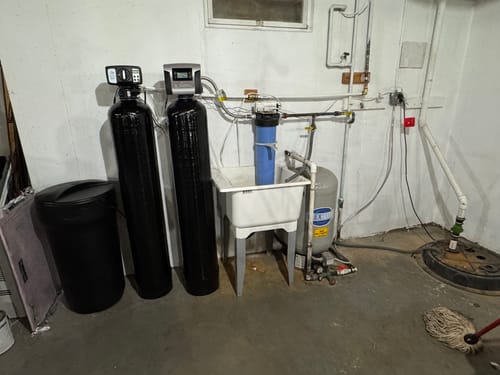
Testing iron levels at home is simpler than most people expect—and it starts with the right kit. Look for one specifically designed for iron and manganese. You'll collect a water sample, mix it with a reagent, and watch for a color change—that's your result.
Testing iron levels at home is easier than you think—it just takes the right kit.
Here's what to watch for: ferrous iron stays invisible until it oxidizes, turning reddish-brown. Ferric iron already looks rusty. A quality kit helps you distinguish between the two.
Compare your sample against the included color chart. If your reading exceeds 0.3 mg/L—the EPA's secondary maximum contaminant level—you've confirmed a problem.
Notice metallic taste or stains on fixtures? Those are your cues to test immediately.
High results? Don't stop there. Send your sample to a professional lab for thorough analysis.
What Do Your Well Water Iron Test Numbers Mean?
Once you've got your test results in hand, what do those numbers actually tell you? Iron concentrations reveal exactly how aggressively you need to act.
Here's how to read your results:
- 0.3–2 ppm – Staining begins here. Light treatment options may suffice, but don't ignore it.
- 3–6 ppm – Moderate to heavy contamination. A dedicated iron filter becomes necessary, not optional.
- Above 10 ppm – Severe territory. Expect significant staining and a metallic taste requiring high-capacity filtration.
We'd also encourage trusting your senses—rust-colored stains on fixtures and metallic-tasting water typically signal concentrations at 2 ppm or higher.
Your numbers confirm what your water's already telling you. Now let's make sure you're choosing the right solution.
What Happens When Well Water Iron Exceeds 0.3 Ppm?
When iron in your well water crosses the 0.3 ppm threshold, the consequences start showing up fast—and they're hard to miss. That reddish-brown staining on your fixtures and laundry? That's iron announcing itself.
Your drinking water will carry a metallic taste that makes every sip a reminder something's off.
Here's where it gets more serious: elevated iron doesn't just affect taste and appearance. It actively feeds iron bacteria, which produce slime that clogs your pipes over time.
By 1.0 ppm, you're looking at appliance damage and increasingly stubborn staining. Hit 3.0 ppm, and rapid staining demands heavy-duty filtration immediately.
The pattern is clear—iron problems compound quickly. Acting at 0.3 ppm isn't overcautious; it's smart water management.
Which Iron Filter Is Right for Your Well Water?
Choosing the right iron filter comes down to one thing: knowing what's actually in your water. Different iron types demand different solutions, and getting this wrong wastes both money and effort.
The right iron filter starts with one thing: knowing exactly what's in your water.
Here's what guides the decision:
- Ferrous iron above 0.3 ppm calls for oxidation-based filtration systems.
- Concentrations exceeding 2 ppm require robust, high-capacity setups—especially if acidity or iron bacteria are also present.
- Manganese co-contamination requires catalytic media specifically engineered for that element.
If hard water's also a problem, pairing an iron filter with a water softener is the smarter move.
But none of this matters without regular water testing—local water chemistry shifts, and your filtration strategy must shift with it.
Frequently Asked Questions
How Do I Choose the Right Iron Filter?
We'll choose the right iron filter by testing our water's iron levels, pH, and flow rate. If levels exceed 0.3 mg/L, we need oxidation-based filtration; higher concentrations demand larger systems sized for our household.
What Should Iron Levels Be in Well Water?
We'd want iron levels below 0.3 mg/L, per EPA guidelines. Anything above that causes reddish-brown staining and metallic taste—signals you're dealing with contamination that'll require the right filtration system.
What Is the Best Filter for Well Water With Iron?
We recommend oxidation filters as the best solution—they convert dissolved iron into filterable particles. For high iron levels, let's consider manganese green sand or air injection systems, which tackle even the toughest iron and manganese concentrations effectively.
Can You Filter Out Iron From Well Water?
Yes, we can filter iron from well water using oxidation and filtration systems. Air injection and catalytic media filters convert dissolved iron into solid particles, making removal straightforward and highly effective for most household concentrations.






