


![SoftPro™ Chlorine+ Carbon Whole House Water Filter to Remove PFAS, Chlorine, Chloramine & Pesticides [City Water Filters Series]](http://www.softprowatersystems.com/cdn/shop/files/SoftPro_Whole_House_Carbon_Filter_with_Spin_Down_Water_Filter.webp?v=1783547361&width=140)


 855-683-8488


What Pipe Size Does a Whole House Iron Filter Actually Require? Everything You Need to Know

Most whole house iron filters require a 1-inch pipe connection, but that's not the whole story. Your actual pipe size depends on peak flow demand, iron concentration, and whether your existing plumbing can handle the system without pressure loss. Undersized pipes cause pressure drops that stop filters from working as designed, leaving iron in your water. Stick around, because we're breaking down everything you need to size this correctly.
Key Takeaways
- Most whole house iron filters require a 1-inch pipe, which adequately handles average household flow rates up to 8–10 GPM.
- Larger households exceeding 10 GPM daily demand should upgrade to 1¼-inch piping to prevent pressure drops and flow issues.
- Nominal pipe size differs from actual diameter; a 1-inch PVC pipe measures 1.315 inches in actual diameter.
- Iron levels above 0.3 ppm or daily usage exceeding 400 gallons signal the need for larger pipe connections.
- Undersized pipes cause pressure loss, poor filtration, and iron breakthrough, making correct sizing essential for system performance.
How the Wrong Pipe Size Reduces Water Pressure and Iron Filter Performance

When we size pipes incorrectly for a whole house iron filter, we're setting ourselves up for pressure loss, poor filtration, and potential system failure. A pipe that's too small restricts flow, creating pressure drops that prevent the filter from operating within its designed specifications—meaning iron stays in your water.
Standard iron filter pipe sizes range from ¾-inch to 1¼-inch, and matching that sizing to your actual flow requirements isn't optional. It's what separates a system that works from one that fails prematurely.
Mismatched connections between your filtration system and existing plumbing also introduce leak risks. Every weak point becomes a liability.
Getting pipe sizing right from the start protects both your investment and your water quality—two things we simply can't afford to compromise.
What Pipe Size Do Most Whole House Iron Filters Require?
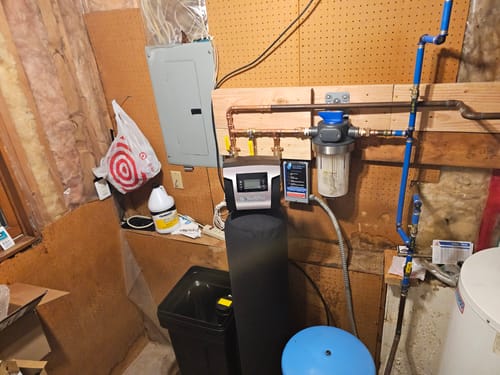
Most whole house iron filters run on 1-inch pipe—and that single spec drives everything from flow rate to filtration efficiency. It's the sweet spot for average household demand, balancing pressure maintenance with consistent iron removal performance.
But here's where it gets nuanced: larger households or high-demand applications often need 1¼-inch pipe to prevent pressure drop across the system. Undersizing creates a bottleneck that forces your filter to work harder while delivering less.
We also can't ignore the physical dimensions. A 1-inch PVC pipe carries an actual outer diameter of 1.315 inches; a 1¼-inch pipe measures 1.660 inches.
These numbers matter when selecting fittings and matching your filter's inlet and outlet connections—mismatches invite leaks and costly reinstallation headaches.
How to Measure Your Home's Existing Pipe Diameter
Knowing your filter needs 1-inch or 1¼-inch pipe is only half the battle—you've also got to confirm what's already running through your walls.
Start by checking PVC or PEX pipes for printed labels, which often display size and material directly. No label? Wrap a string around the pipe, measure its circumference, then cross-reference that figure against standard sizing charts.
Here's a critical nuance mastery-minded homeowners need: nominal pipe size isn't actual diameter. A ¾-inch copper pipe actually measures 0.875 inches outside. That distinction matters enormously when selecting compatible fittings.
If pipes are buried or hidden, locate exposed sections near your water heater or water softener—these accessible spots typically reveal exactly what you're working with before committing to any filter installation.
When Should You Upgrade to a Larger Connection Size?
Upgrading to a larger connection size comes down to one thing: flow demand. If your household exceeds 10 GPM—think large families or simultaneous water usage—a bigger connection isn't optional, it's necessary.
Here's what else should push you toward upgrading:
- Daily usage above 400 gallons: A 1¼-inch connection handles peak demands without sacrificing pressure.
- Iron levels above 0.3 ppm: Higher iron concentrations, combined with frequent backwashing cycles, stress your system—larger piping keeps filtration efficient.
- Recurring backpressure or reduced flow: These aren't minor inconveniences; they're warning signs your current piping can't handle filtration demands.
A 1-inch pipe works well up to 8-10 GPM. Beyond that, you're fighting your own system.
Consult a water treatment specialist before pressure loss becomes a bigger problem.
How Flow Rate and Peak Demand Should Determine Your Pipe Size
Flow rate is the foundation of every pipe sizing decision we make for a whole house iron filter. Most residential systems operate between 10 and 30 GPM, but the number we care about most is peak demand—the moment every shower, dishwasher, and faucet runs simultaneously.
That's when undersized pipes expose themselves, strangling flow and undermining filtration performance.
We always size pipes to match the filter's rated flow, never below it. A 1-inch pipe handles the majority of residential applications comfortably, but larger homes pushing higher GPM demands will need 1¼-inch lines to maintain pressure stability.
Getting this right upfront prevents costly retrofits and guarantees the filter actually removes iron at the concentrations it's designed to handle.
Frequently Asked Questions
Do Homes Usually Have 1/2 or 3/4 Inch Water Pipes Under the House?
Most homes we'll find have ¾-inch water pipes, as they're the standard for whole-house systems. Half-inch pipes exist but restrict flow considerably, making them less practical for modern homes requiring efficient water distribution.
Should I Use Type L or Type M Copper Pipe?
We recommend Type L copper pipe for your whole house iron filter. Its thicker walls handle higher pressure better and last longer, reducing your risk of leaks over time compared to thinner Type M pipe.
What Is the Outside Diameter of Cast Iron Sewer Pipe?
For a 4-inch cast iron sewer pipe, we're looking at an outside diameter of approximately 4.5 inches. ODs vary by nominal size, so always verify specs against ANSI and ASTM standards for your specific pipe diameter.
Is 3/4 Water Line Enough for a House?
A ¾-inch water line can work for smaller homes with 1-2 bathrooms, but we'd recommend upgrading to 1-inch for larger households running multiple fixtures simultaneously to maintain ideal pressure and flow.






