


![SoftPro™ Chlorine+ Carbon Whole House Water Filter to Remove PFAS, Chlorine, Chloramine & Pesticides [City Water Filters Series]](http://www.softprowatersystems.com/cdn/shop/files/SoftPro_Whole_House_Carbon_Filter_with_Spin_Down_Water_Filter.webp?v=1783547361&width=140)


 855-683-8488


When to Add a Dedicated pH Neutralizer Alongside Your Iron Filter for Acidic Well Water

If your well water's pH drops below 6.4, it's time to add a dedicated pH neutralizer before your iron filter. Acidic water corrodes filter media, causes heavy metal leaching, and accelerates fouling — turning a simple maintenance task into a costly replacement cycle. A neutralizer corrects the pH first, so your iron filter can actually do its job efficiently. Stick with us, and we'll show you exactly how to make this system work for your home.
Key Takeaways
- Add a dedicated pH neutralizer when your well water tests below pH 6.4, indicating acidity that will damage your iron filter.
- Bluish-green stains, metallic taste, or pinhole leaks in copper pipes signal acidic water requiring a neutralizer before your iron filter.
- Install the pH neutralizer before the iron filter, as acidic water accelerates fouling, corrosion, and costly filter media degradation.
- Frequent iron filter maintenance or rapid media replacement often indicates unresolved acidity, making a dedicated neutralizer necessary.
- A neutralizer corrects pH first, improving iron filter efficiency, reducing blockages, and extending the overall system's lifespan significantly.
Signs Your Well Water Is Too Acidic for Your Iron Filter

When your well water's pH drops to 6.4 or below, your plumbing system starts sending distress signals—and if we're aware of what to look for, we can catch the problem before it spirals into something costly.
Bluish-green stains around sinks and fixtures tell us copper's leaching out, which means your iron filter's already fighting a losing battle. A metallic or sour taste in your tap water confirms acidity that iron filtration simply can't resolve alone.
Pinhole leaks developing in copper pipes? That's prolonged acidic exposure doing quiet, expensive damage. And if your iron filter demands unusually frequent maintenance, acidic water is likely the culprit undermining its efficiency.
These aren't coincidences—they're your system telling you it needs a dedicated pH neutralizer.
What Acidic Well Water Does to Your Iron Filter
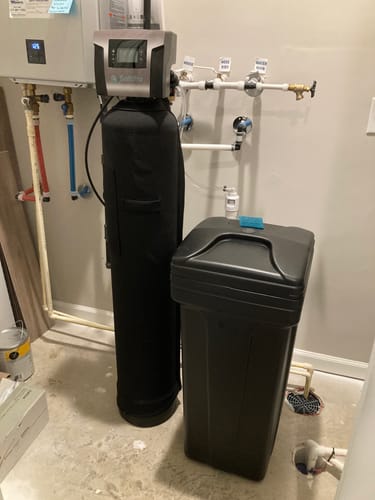
Acidic well water doesn't just pass through your iron filter—it attacks it. When your pH drops to 6.4 or below, you're watching a slow-motion breakdown unfold inside your system.
| What's Happening | The Cause | The Consequence |
|---|---|---|
| Filter media degradation | Low pH dissolves media | Costly replacements |
| Heavy metal leaching | Corroded pipes and fixtures | Overwhelmed filtration |
| Fouling and sediment buildup | pH imbalance disrupts flow | Frequent backwashing |
Every backwash cycle, every stain on your fixtures, every drop in water quality—it's your filter telling you it's losing the fight. Acidic water corrodes internal components, clogs the media, and forces your system to work harder than it should. Without pH neutralization, you're not maintaining a filter; you're managing its decline.
How a pH Neutralizer and Iron Filter Work Together
Together, a pH neutralizer and iron filter form a two-stage defense that tackles your well water's biggest problems at the source. Here's how the partnership works:
- pH correction first — The neutralizer raises acidic water to a balanced pH, stopping corrosion and pinhole leaks before they start.
- Enhanced iron removal second — Neutralized water allows the iron filter to perform at peak efficiency, reducing fouling and blockage in the filter media.
- System longevity through maintenance — Refill the neutralizer every 6–18 months and follow the iron filter's backwashing schedule religiously.
Homes supporting more than 8 people should invest in a 3.5 cubic foot neutralizer to handle higher demand without compromising performance.
The sequence matters as much as the systems themselves.
Which Comes First: the pH Neutralizer or the Iron Filter?
Order matters more than most people realize, and getting it wrong can quietly undermine both systems.
We always install the pH neutralizer first, before the iron filter, and here's why that sequence is so deliberate.
Acidic water is corrosive and reactive. When it hits an iron filter before neutralization, it accelerates fouling, clogs the filter media, and encourages heavy metal leaching throughout your plumbing.
Acidic water doesn't just pass through an iron filter—it actively destroys it from the inside out.
None of that's subtle damage—it's cumulative and expensive.
How to Size and Maintain Your pH Neutralizer System
Once you've got the installation sequence right, the next step is making sure you've got the right-sized system for your household—and that you're keeping it running properly over time.
Size your system based on household demand:
- 1.0–1.5 cubic feet for 1–4 people (minimum 5 GPM flow rate required)
- 2.5 cubic feet for 4–8 people (minimum 10 GPM)
- 3.5 cubic feet for households exceeding 8 people
Maintenance is straightforward but non-negotiable.
Calcite media depletes as it neutralizes acidity, so replenishment every 6–18 months keeps your system effective—your water's pH level and usage patterns determine that frequency.
We recommend monitoring pH regularly with test kits or meters; they'll tell you exactly when your system needs attention before corrosion becomes a costly problem.
Frequently Asked Questions
How Much Hardness Does an Acid Neutralizer Add?
We've seen acid neutralizers add roughly 1 to 2 grains per gallon (gpg) of hardness per pound of media dissolved—a 1.5 cubic foot calcite system can add up to 5 gpg total.
What Is the Correct Order for Water Treatment?
We recommend installing your pH neutralizer first, followed by the iron filter, then the water softener. Adding a Lakos Twist sediment pre-filter before the neutralizer also protects your media and extends its lifespan considerably.
How Do You Neutralize Acidic Well Water?
To neutralize acidic well water, we'll install a dedicated acid neutralizer packed with calcite media. As water flows through it, the calcite raises pH levels, transforming corrosive water into something safe and balanced.
How Often Should I Fill an Acid Neutralizer?
We recommend refilling your acid neutralizer every 6 to 18 months, but here's the catch—if your water's more acidic or your household uses more water, you'll need to replenish it every 6 to 12 months.






