


![SoftPro™ Chlorine+ Carbon Whole House Water Filter to Remove PFAS, Chlorine, Chloramine & Pesticides [City Water Filters Series]](http://www.softprowatersystems.com/cdn/shop/files/SoftPro_Whole_House_Carbon_Filter_with_Spin_Down_Water_Filter.webp?v=1783547361&width=140)


 855-683-8488


SoftPro Whole House Catalytic Bone Char Carbon Filter Review: Authentic Performance Review

Hi, I'm Arjun Pratap. I live in Rhode Island. Craig "The Water Guy" Phillips asked me to share my experience as a homeowner on local tap water from the city with the SoftPro Fluoride & Chlorine+ SUPER Filter (Whole House Catalytic + Bone Char Carbon Filter) I purchased.
This is how my adventures played out. I hope this helps you in your decision.
Eight months ago, I was dealing with water that tasted like a swimming pool and left me questioning what else might be lurking in our municipal supply. The chlorine smell hit you the moment you walked into our bathroom after someone showered, and don't get me started on trying to enjoy a morning cup of coffee with that chemical aftertaste.
After researching whole house filtration systems for weeks, I kept coming back to catalytic carbon technology combined with bone char filtration. The science made sense - activated carbon for chlorine removal, catalytic properties for chloramine destruction, and bone char for fluoride reduction. But would it actually deliver the "perfect flow rate and fresh taste" I was hoping for?
The Water Problems That Drove Me to Action
Our municipal water wasn't dangerous, but it certainly wasn't pleasant. The chlorine levels were consistently high - around 3-4 ppm according to my test strips - which is within EPA guidelines but way above what I wanted my family drinking and bathing in daily.
What really concerned me was the chloramine situation.
Unlike chlorine, chloramines don't dissipate when you let water sit out overnight. Our water utility had switched to chloramine disinfection two years prior, and I noticed our skin became drier and more irritated after showers. My wife developed what seemed like eczema patches that hadn't existed before.
The taste issue affected our entire cooking routine. We were buying bottled water for drinking and cooking, which felt ridiculous when we had perfectly safe tap water. But that chemical taste was unmistakable in everything from pasta water to ice cubes.
Did you know that standard carbon filters struggle with chloramines?
Regular granular activated carbon (GAC) removes chlorine effectively but chloramines require catalytic carbon or much longer contact time. This discovery shaped my entire research process.
Research Phase: Understanding Catalytic vs. Standard Carbon
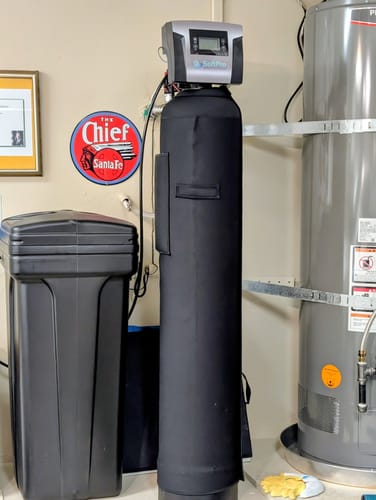
I spent considerable time learning about different carbon types and their capabilities. Standard activated carbon works through adsorption - contaminants stick to the carbon surface. Catalytic carbon goes further by actually breaking down chloramine molecules through a chemical reaction.
The bone char component intrigued me because it targets fluoride specifically. Our municipal water contains 0.7-1.0 ppm fluoride, and while I'm not anti-fluoride for dental health, I preferred having control over our family's intake rather than consuming it in every glass of water.
Why did I choose the upflow design over downflow systems?
Upflow systems prevent channeling and ensure better contact time between water and media. The water enters from the bottom, flows upward through the carbon bed, and exits from the top. This creates more turbulent flow and uses the entire carbon bed effectively.
The sizing calculation was crucial. With a family of four and normal water usage patterns, I needed a system that could handle peak flow demands without pressure drops. The specifications showed this system could maintain 15+ GPM flow rates, which aligned perfectly with our household needs.
Installation Experience and First Impressions
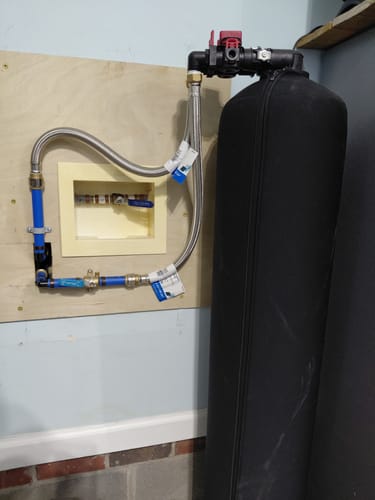
I opted for professional installation because I wanted the bypass valving done correctly and didn't want to risk any plumbing mistakes. The installer was impressed with the build quality - the tank construction felt substantial, and the control valve operated smoothly.
The system requires a drain connection for backwashing and a dedicated electrical outlet. My installation location in the basement had both available, which simplified the process. Total installation time was about 3 hours, including connecting the bypass valves and programming the control head.
What surprised me during the first few days?
The difference was immediately noticeable. No more chlorine smell when running water, and the taste transformation was remarkable. But what I didn't expect was how much better our coffee and tea tasted - flavors that had been masked by chemical tastes suddenly came through clearly.
Performance Testing: Flow Rate and Contaminant Removal

The flow rate performance has been exactly as promised. Even during peak usage times - simultaneous shower, dishwasher, and washing machine operation - I haven't noticed any pressure reduction. My pressure gauge readings show only a 2-3 PSI drop across the system, which is minimal.
For contaminant testing, I used both home test kits and a professional water analysis. The chlorine removal is essentially 100% - test strips show zero detectable chlorine in the filtered water. Chloramine levels dropped from 3.2 ppm to undetectable levels.
The fluoride reduction results were particularly interesting.
Incoming levels of 0.9 ppm dropped to approximately 0.3 ppm - about 65-70% reduction. This isn't complete fluoride removal, but it significantly reduces our total fluoride exposure while maintaining some dental benefits.
The system handles other contaminants as well. Our water naturally contains low levels of various organic compounds and pesticide residues from agricultural runoff. Post-installation testing showed significant reductions in these trace contaminants, though specific percentages vary by compound type.
Daily Living Impact: What Changed in Our Household
The most obvious change is taste and odor elimination. Water tastes clean and neutral - exactly what water should taste like. Our ice cubes are crystal clear instead of cloudy, and beverages made with tap water taste noticeably better.
Skin and hair improvements were unexpected bonuses.
My wife's eczema-like patches cleared up within three weeks. Our hair feels softer and less brittle after shampooing. Even our guests comment on how the shower water feels different - less drying and harsh.
Cooking improvements go beyond just taste. Vegetables retain better color when steamed or boiled, and baked goods seem to rise more consistently. I suspect the chlorine was interfering with yeast activity in our bread-making experiments.
We eliminated bottled water purchases entirely.
This saves us roughly $40-50 monthly and eliminates significant plastic waste. The convenience of having great-tasting water from every tap in the house is something you quickly take for granted.
Operational Costs and Maintenance Reality
The system backwashes automatically every few days, using approximately 50-75 gallons per cycle. This adds about $15-20 monthly to our water bill, which I consider reasonable for the benefits provided.
Electrical consumption is minimal - the control valve draws power only during valve positioning, not continuously. My usage monitoring shows less than $3 monthly in additional electricity costs.
What about media replacement costs?
The catalytic carbon and bone char media will need replacement in 3-5 years depending on usage and incoming water quality. Current replacement media costs are approximately $400-500, which works out to roughly $10-15 monthly if amortized over the media life.
No salt or chemicals are required, unlike water softeners. The only routine maintenance is occasional cleaning of the control valve screen and monitoring the backwash frequency. I check the system monthly but rarely need to adjust anything.
Honest Limitations and Considerations
This system isn't perfect for every situation. The backwash requirement means you need adequate drain capacity and water pressure. If you're on a private well with low yield, the 50-75 gallon backwash cycles might be problematic.
Space requirements are substantial.
The tank stands about 5 feet tall and requires clearance for media replacement access. Basement installation is ideal, but not everyone has suitable space available.
The upfront cost is significant - this isn't a budget-friendly solution. However, when compared to ongoing bottled water costs and the convenience factor, the economics make sense for our family's long-term situation.
One technical limitation worth noting:
While this system excels at removing chlorine, chloramines, and fluoride, it doesn't address hardness, iron, or bacterial contamination. If you have multiple water quality issues, you might need additional treatment components.
Final Assessment: Worth the Investment for Our Situation
After eight months of ownership, I'm thoroughly satisfied with this investment. The combination of reliable flow rate performance and comprehensive taste improvement has transformed our relationship with tap water.
Would I purchase this system again?
Absolutely. The engineering is solid, performance matches specifications, and the daily quality-of-life improvement justifies the cost. The automatic operation means I rarely think about it, which is exactly what you want from home infrastructure.
This system works best for families dealing with chlorinated or chloraminated municipal water who want whole-house treatment without the complexity of multiple filter stages. If you're primarily concerned with taste, odor, and chemical removal rather than hardness or iron issues, the catalytic carbon and bone char combination delivers excellent results.
The perfect flow rate and fresh taste mentioned in my initial assessment has held true throughout months of daily use. For households prioritizing water quality improvement with minimal maintenance requirements, this represents a worthwhile long-term investment in health and convenience.






