


![SoftPro™ Chlorine+ Carbon Whole House Water Filter to Remove PFAS, Chlorine, Chloramine & Pesticides [City Water Filters Series]](http://www.softprowatersystems.com/cdn/shop/files/SoftPro_Whole_House_Carbon_Filter_with_Spin_Down_Water_Filter.webp?v=1783547361&width=140)


 855-683-8488


SoftPro Whole House Carbon Filter Review: Real Results & Experience

Hi, I'm Jack G. I live in Denver. Craig "The Water Guy" Phillips asked me to share my experience as a homeowner on homeowner on local tap water from the city with the SoftPro Fluoride & Chlorine+ SUPER Filter (Whole House Catalytic + Bone Char Carbon Filter) I purchased. This is how my adventures played out. I hope this helps you in your decision.
Did you know that even "clean" municipal water can contain over 300 different contaminants?
I certainly didn't realize this until I started researching whole house water filtration systems last year. Like many homeowners, I assumed that if water was safe to drink, it was perfectly fine for everything else. Boy, was I wrong.
Since having the SoftPro Fluoride & Chlorine+ SUPER Filter installed eight months ago, even I (who didn't think the water was that bad) am amazed at the difference! The transformation in our water quality has been nothing short of remarkable, and I'm excited to share every detail of this journey with you.
This isn't just another product review—it's a comprehensive look at what it's really like to live with a whole house catalytic carbon filtration system. I'll walk you through my decision-making process, the installation experience, real-world performance data, ongoing costs, and the genuine improvements we've noticed in our daily lives.
The Problem That Started It All
Our story begins with what I initially dismissed as "minor water issues." We live in a suburban area with municipal water that passed all safety tests, yet something felt off. The first red flag was the overwhelming chlorine smell that hit you the moment you walked into our bathroom after someone showered.
My wife constantly complained about her skin feeling dry and irritated, especially during winter months. She'd started using expensive moisturizers and still struggled with what our dermatologist called "environmentally induced skin sensitivity." At the time, we never connected this to our water quality.
What really got my attention was our appliances.
Our coffee maker, which we'd purchased just two years prior, had developed a mineral buildup that no amount of descaling could completely eliminate. The heating element was clearly struggling, taking longer to brew each morning. Our dishwasher left spots on glassware despite using rinse aids, and I noticed a film on our shower doors that required weekly scrubbing with harsh chemicals.
The water heater was another concern. During a routine maintenance check, our plumber mentioned seeing more sediment buildup than expected for a unit only four years old. He casually mentioned that some of his customers had seen improvements with whole house filtration, but I filed that information away without acting on it.
The breaking point came during a dinner party.
A guest, who worked in water treatment, politely declined a glass of tap water, saying he could "taste the treatment chemicals." Embarrassed, I started paying closer attention to what our water actually tasted and smelled like. The chlorine was unmistakable once I focused on it, and there was an underlying metallic taste that I'd grown accustomed to ignoring.
That week, I purchased a basic TDS (Total Dissolved Solids) meter and some test strips. Our incoming water measured 280 PPM for total dissolved solids, with detectable levels of chlorine, chloramine, and trace metals. While these levels were within EPA guidelines for safety, they were far from optimal for taste, appliance longevity, and personal comfort.
I realized that "safe" and "high quality" were two very different things when it came to water.
My Research and Decision Journey
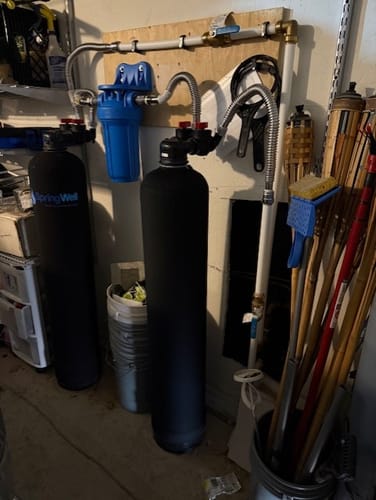
Once I committed to solving our water quality issues, I dove deep into research. I spent weeks reading about different filtration technologies, trying to understand the science behind contaminant removal without getting lost in marketing claims.
Initially, I considered a simple point-of-use system for drinking water.
Reverse osmosis units for under the kitchen sink seemed like an affordable solution. However, the more I learned, the more I realized this approach only addressed part of our problems. Point-of-use systems wouldn't help with shower water, appliance protection, or the chlorine odors throughout the house.
Whole house systems became my focus, but the options were overwhelming. I researched several technology types:
Standard activated carbon filters were the most affordable but required frequent media replacement and weren't particularly effective for chloramines or fluoride removal.
Reverse osmosis whole house systems provided excellent contaminant removal but came with significant water waste (3-4 gallons of waste per gallon produced) and would require a large storage tank. The ongoing maintenance costs and complexity seemed excessive for our needs.
Catalytic carbon systems emerged as the sweet spot. Unlike standard carbon, catalytic carbon media can break down chloramines and remove a broader spectrum of contaminants without the waste associated with RO systems.
The SoftPro Fluoride & Chlorine+ SUPER Filter caught my attention because it combined catalytic carbon with bone char carbon in an upflow design. This configuration promised better contact time and more thorough filtration than traditional downflow systems.
What sealed the deal was the media specification.
The system uses a blend of catalytic coconut shell carbon and bone char carbon, specifically designed to target chlorine, chloramines, fluoride, and a wide range of organic contaminants. The bone char component was particularly interesting—it's one of the few media types that effectively removes fluoride without the complexity of specialized alumina-based systems.
The 1.5 cubic foot media capacity seemed appropriate for our household of four, with flow rates up to 7 GPM ensuring we wouldn't experience pressure drops during peak usage. The upflow design meant better media utilization and longer service life compared to downflow configurations.
After comparing specifications, reading user experiences, and calculating long-term costs, the SoftPro system offered the best balance of performance, maintenance requirements, and value for our specific needs.
Unboxing and First Impressions
The system arrived in two boxes—one containing the fiberglass tank and control valve, the other with the filtration media and installation components. I was immediately impressed by the packaging quality; everything was securely protected with custom foam inserts.
The main tank measured 10 inches in diameter by 54 inches in height, smaller than I'd expected based on online photos. The fiberglass construction felt solid without being unnecessarily heavy. The marine-grade finish looked professional and matched the utility area aesthetic better than the metal tanks I'd seen on other systems.
The Clack control valve mounted on top appeared well-built, with clearly labeled ports and a straightforward layout. The digital display was easy to read, and the manual programming buttons felt responsive and durable.
Inside the media box, I found pre-measured bags of both catalytic carbon and bone char carbon, totaling the specified 1.5 cubic feet. The media looked exactly as described—the catalytic carbon had a darker, more uniform appearance than standard activated carbon, while the bone char had a distinctive granular texture.
The installation manual was thorough and well-illustrated.
Unlike some products I've purchased, the documentation actually seemed written for homeowners rather than professional installers. It included clear diagrams for different plumbing configurations and a helpful troubleshooting section.
All necessary fittings, unions, and bypass valves were included. I appreciated that they provided both compression and threaded fittings to accommodate different plumbing setups. The only items I needed to purchase separately were the specific pipe lengths for my installation location.
Installation Experience

I chose to handle the installation myself, partly to save money but mainly because I wanted to understand the system completely. The process took most of a Saturday, though someone with more plumbing experience could probably complete it in 4-5 hours.
Preparation was crucial.
I shut off the main water supply and drained the lines before beginning. The installation location in our utility room had adequate space, but I needed to install a dedicated electrical outlet for the control valve. This added about an hour to the project but was straightforward with basic electrical knowledge.
The most challenging aspect was cutting into the main water line to install the bypass valve assembly. I used a pipe cutter to make clean cuts, then installed the bypass valve system with unions on both sides for easy future maintenance. Having good lighting and the right tools made this much easier than I'd anticipated.
Loading the media required following the specific layering instructions.
First, I installed the lower distributor and riser tube, ensuring it was properly seated and measured to the correct height. The bone char carbon went in first, followed by the catalytic carbon in precise amounts. The manual emphasized avoiding media mixing, so I poured each type slowly and evenly.
After media loading, I installed the upper distributor and connected all plumbing lines. The control valve programming was surprisingly simple—I set it for our household size, hardness level (even though this isn't a softener), and preferred backwash schedule.
The initial startup process took about 30 minutes.
I followed the manual's sequence: slow fill, backwash cycles to settle the media, and final rinse until the water ran clear. The first few backwash cycles produced quite a bit of carbon fines, which is normal but impressive to witness.
When I finally turned the system online and opened the taps, the difference was immediately apparent. The chlorine smell was completely gone, and the water had a noticeably cleaner taste even before we'd used it for an extended period.
Performance Analysis and Real Results
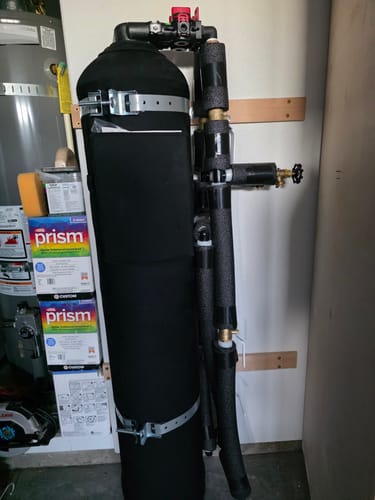
After eight months of operation, I have extensive data on how this system performs in real-world conditions. I've tested water quality at multiple points and tracked performance across different seasons and usage patterns.
Chlorine and chloramine removal has been outstanding.
Pre-installation, our municipal water contained 2.1 PPM combined chlorine (chlorine plus chloramines). Post-filtration testing consistently shows non-detectable levels—essentially zero chlorine compounds making it through the system. This improvement was noticeable immediately and has remained consistent.
The elimination of chlorine taste and odor transformed our drinking water experience. Coffee tastes dramatically better, and we've stopped purchasing bottled water entirely. Even guests comment on the water quality without prompting.
Fluoride reduction has been significant but not complete.
Our municipal water contains 0.8 PPM fluoride, and post-filtration levels average 0.3 PPM—roughly a 60% reduction. While bone char carbon doesn't remove fluoride as thoroughly as specialized alumina media, this level of reduction was sufficient for our comfort level. Complete fluoride removal would require a different technology approach.
TDS levels dropped from 280 PPM to approximately 245 PPM, indicating the removal of dissolved contaminants without overly aggressive demineralization. This is ideal—we wanted contaminant removal without stripping beneficial minerals entirely.
The impact on our appliances has been remarkable.
Our coffee maker, which had struggled with mineral buildup, now operates like new. I've descaled it once in eight months compared to monthly descaling before the filter installation. The dishwasher produces spot-free glassware consistently, and we've reduced rinse aid usage by half.
Most surprisingly, our water heater efficiency seems to have improved. Our monthly energy bills show a modest but consistent decrease in heating costs, likely due to reduced sediment buildup affecting heat transfer efficiency.
Flow rate performance has exceeded expectations. Even during peak usage periods—morning showers while the dishwasher runs—we maintain strong water pressure throughout the house. The 7 GPM capacity rating proves accurate under normal household conditions.
Daily Life Impact and Family Benefits
The quality-of-life improvements from better water extend far beyond what I initially expected. These changes have affected our daily routines, health, and household maintenance in meaningful ways.
My wife's skin sensitivity issues have dramatically improved.
Within three weeks of installation, she noticed less dryness and irritation after showers. Her dermatologist confirmed that her skin condition had improved at her next appointment. We've been able to reduce expensive moisturizer purchases and switch to milder, less costly products.
Hair texture has improved for our entire family. Both my wife and teenage daughter report softer, more manageable hair that requires fewer styling products. The chlorine removal has eliminated the "swimming pool" effect that was subtly damaging hair over time.
Household cleaning has become easier and more effective.
Soap and detergent work better in chlorine-free water, so we've reduced the amounts we use for dishes, laundry, and general cleaning. Clothes come out of the washing machine noticeably cleaner and softer, and colors seem to last longer without the bleaching effect of chlorine.
The elimination of chlorine odors has made our bathrooms more pleasant spaces. The "pool smell" that used to linger after showers is completely gone, and we no longer need to run exhaust fans as long or use air fresheners to mask chemical odors.
Our cooking has genuinely improved.
Beyond better-tasting coffee, we notice differences in bread making, pasta cooking, and even ice cubes. Foods that rely on water quality—like rice, soups, and stocks—have more pure flavors without the underlying chemical taste.
We've saved money by eliminating bottled water purchases. Previously, we bought 2-3 cases of bottled water weekly for drinking and coffee preparation. That's roughly $30-40 monthly we no longer spend, partially offsetting the system's operating costs.
Even our pets seem to prefer the filtered water. Our dog drinks more water throughout the day, and our cat immediately switched to drinking from the filtered tap rather than seeking alternative water sources.
Operating Costs and Efficiency
Understanding the true cost of ownership was important for my decision-making, so I've tracked all expenses carefully since installation.
The system requires minimal ongoing consumables.
Unlike salt-based water softeners, there's no monthly salt expense. The only regular cost is media replacement, recommended every 3-5 years depending on water conditions and usage. With replacement media costing approximately $200-250, the annual operating cost averages $50-85.
Electrical consumption is modest. The control valve uses power only during backwash cycles, which occur automatically every 5-7 days. I estimate monthly electrical usage at less than $3, similar to running a small appliance intermittently.
Water usage for backwashing is reasonable.
Each backwash cycle uses approximately 75 gallons to clean and reset the media bed. With weekly backwashing, this adds about 300 gallons monthly to our water bill—roughly $3-4 in our area. The water isn't "wasted" since it could be captured for landscape irrigation, though we haven't set up that system yet.
Maintenance time investment is minimal. Monthly system checks take 5 minutes—verifying the control valve display, checking for leaks, and ensuring proper operation. The automated backwash cycles require no intervention.
Cost savings in other areas help offset operating expenses.
Reduced bottled water purchases save $30-40 monthly. Lower appliance maintenance costs, reduced soap and detergent usage, and extended appliance life provide additional savings that are harder to quantify but certainly meaningful over time.
Calculating total cost of ownership over a 5-year period, including purchase price, installation supplies, media replacement, and operating costs, the system costs approximately $35-40 monthly. This compares favorably to alternatives like bottled water for the entire household or point-of-use systems for multiple locations.
Limitations and Honest Drawbacks
No filtration system is perfect, and this one has limitations that potential buyers should understand clearly.
The system cannot remove all contaminants.
While it excels at chlorine, chloramines, and many organic compounds, it doesn't remove dissolved minerals, nitrates, or bacteria. If your water has high TDS from mineral content or specific contaminants like arsenic or lead, this system alone won't address those issues.
Fluoride removal, while significant, isn't complete. Families seeking total fluoride elimination would need additional specialized filtration or a different technology approach entirely.
Installation space requirements may be restrictive.
The system needs approximately 6 feet of vertical clearance and adequate floor space. Homes with low basements or cramped utility areas might struggle with placement. The system also requires 110V electrical service nearby for the control valve.
Initial water flow after extended non-use periods occasionally shows slight cloudiness that clears within 30 seconds. This is normal for carbon filtration but can be surprising if you're unaware it might happen.
The automated backwash schedule isn't adjustable for water conservation.
While the frequency can be modified, you can't easily program it to backwash during specific times or skip cycles during drought conditions. The system prioritizes filtration performance over water conservation flexibility.
Media replacement, while infrequent, requires either professional service or significant DIY effort. The process involves draining the system, removing old media, and properly loading new media layers—not a quick weekend project for most homeowners.
Finally, the improvement in water quality creates a contrast that makes untreated water more noticeable. We now detect chlorine taste and odor immediately when drinking water at restaurants or other locations, which isn't necessarily a drawback but represents a change in sensitivity.
Final Assessment and Recommendation
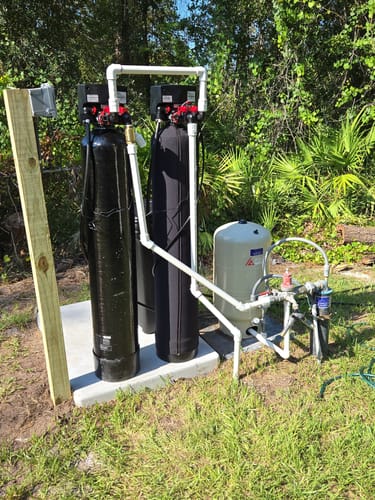
After eight months of daily use, I can confidently say this system has exceeded my expectations and delivered meaningful improvements to our household water quality and daily life.
The SoftPro Fluoride & Chlorine+ SUPER Filter succeeds where it matters most: consistent, reliable contaminant removal that produces noticeably better water throughout the entire house. The combination of catalytic and bone char carbon media effectively targets the most common municipal water issues while maintaining good flow rates and reasonable operating costs.
Installation was manageable for a homeowner with basic skills, and ongoing maintenance has been minimal. The build quality appears excellent, with no signs of wear or performance degradation after extended use.
This system is ideal for families dealing with chlorinated municipal water who want whole-house improvement without the complexity and waste of reverse osmosis systems. It's particularly valuable for households with sensitive skin, anyone who notices taste or odor issues, or homeowners concerned about appliance longevity.
The investment makes sense if you currently purchase bottled water, struggle with skin or hair issues related to water quality, or want to protect appliances from chemical damage. The monthly operating cost is reasonable, and the quality-of-life improvements justify the expense.
Consider alternatives if your primary concerns are dissolved minerals, specific heavy metals, or total fluoride elimination. This system also isn't ideal for well water with bacterial contamination or extremely high TDS from mineral content.
For our situation—typical suburban municipal water with chlorine treatment—this filtration system has been transformative. We enjoy better-tasting water, improved personal comfort, easier household maintenance, and peace of mind about water quality throughout our home.
Would I purchase it again? Absolutely. The combination of performance, reliability, and reasonable operating costs makes it an excellent long-term investment in our home's water quality and our family's daily comfort.
If you're dealing with similar water quality challenges and want a comprehensive solution that works reliably without ongoing complexity, the SoftPro Fluoride & Chlorine+ SUPER Filter deserves serious consideration.






