


![SoftPro™ Chlorine+ Carbon Whole House Water Filter to Remove PFAS, Chlorine, Chloramine & Pesticides [City Water Filters Series]](http://www.softprowatersystems.com/cdn/shop/files/SoftPro_Whole_House_Carbon_Filter_with_Spin_Down_Water_Filter.webp?v=1783547361&width=140)


 855-683-8488


Whole House Iron Filter Flow Rate: How to Maintain Strong, Consistent Water Pressure

Whole house iron filters can quietly crush your water pressure if they're undersized, poorly placed, or overdue for backwashing. We've seen flow rates drop from a strong 60 GPM down to a frustrating 20 LPM when filters aren't properly maintained. Sizing your filter to match peak household demand, installing it after the pressure tank, and backwashing every 4–6 weeks keeps pressure consistent. Stick with us — everything you need to protect your water pressure is ahead.
Key Takeaways
- Match filter size to peak household demand (12–30 GPM) to prevent pressure drops caused by undersized or overloaded systems.
- Install the iron filter after the pressure tank to maintain consistent water pressure throughout the entire household.
- Backwash the filter every 4–6 weeks, or more frequently if iron concentrations exceed 0.3 ppm, to sustain strong flow.
- Monitor pressure gauges regularly; drops exceeding 0.5 bar signal significant flow restrictions requiring immediate maintenance attention.
- Adding a flow restrictor valve improves filtration efficiency while minimizing pressure loss during peak water usage periods.
Why Iron Filters Reduce Flow Rate More Than Other Systems

Because iron filters tackle one of the most chemically complex contaminants in well water, they create pressure drops that other filtration systems simply don't have to deal with. The culprit? The Venturi principle.
Iron filters don't just clean your water — they wage chemical warfare against it, and your pressure pays the price.
Venturi components inject air to oxidize dissolved iron and manganese, but that oxidation process creates flow restrictions you won't find in standard sediment or carbon filters. We're talking real-world performance dropping to 20 LPM or less, compared to a theoretical 60 GPM potential.
What makes this particularly important to understand is that it's not just the filter media causing restriction — it's the entire oxidation mechanism working against your pressure.
Recognizing this distinction helps you make smarter sizing decisions before installation, not after you're already troubleshooting weak flow.
Warning Signs Your Iron Filter Is Killing Your Water Pressure
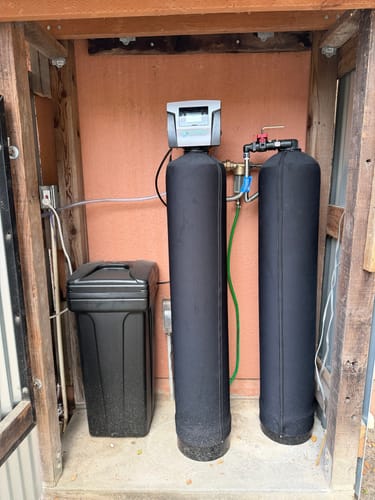
Knowing why iron filters restrict flow is half the battle — but spotting the warning signs early is what actually protects your household water pressure before things get serious.
Watch for rust stains on fixtures — they signal iron buildup from a failing filter. A metallic taste or foul odor means contaminants aren't getting removed, which compounds pressure problems over time.
If pressure drops noticeably when multiple outlets run simultaneously, your filter may be undersized or improperly installed. Brown particles or sediment appearing in your water indicate internal clogging — a direct pressure killer.
We recommend monitoring pressure gauges consistently and sticking to a strict backwashing and media replacement schedule. Catching these signs early keeps your system performing at full capacity.
What GPM Do You Actually Need for a Whole House Iron Filter?
How much flow does your whole house iron filter actually need to keep up with daily demand?
Most households need between 12–30 GPM, depending on how many fixtures run simultaneously at peak hours. That range isn't arbitrary—it's the difference between consistent pressure and a frustrating trickle mid-shower.
For iron concentrations above 0.3 ppm, we'd recommend leaning toward higher flow capacity.
Heavily loaded filters restrict flow faster, causing pressure drops before the media even needs replacement.
Placement matters too.
Installing your filter close to the entry point, after the pressure tank, prevents unnecessary bottlenecks from compounding the problem.
If you're uncertain where your household falls within that GPM range, a water treatment professional can analyze your specific usage patterns and eliminate the guesswork entirely.
How Iron Filter Sizing and Placement Protect Your Water Pressure
Sizing and placement directly determine whether your iron filter protects or punishes your water pressure. Match your filter to your household's peak demand—typically 12–30 GPM—and you'll maintain strong flow even during high-usage periods.
Miss that target, and you're looking at catastrophic drops, from 60 GPM down to 20 GPM, simply from poor sizing decisions.
Placement matters just as much. Installing your filter after the pressure tank eliminates bottlenecks in your main line, keeping pressure consistent throughout your home.
Add a flow restrictor valve, and you're also controlling filtration speed for more effective iron removal without sacrificing pressure stability.
Don't overlook maintenance either. Regular backwashing and pressure gauge monitoring prevent sediment buildup—the silent culprit that quietly strangles your flow over time.
How Often to Backwash Your Iron Filter to Prevent Pressure Loss
Even the best-sized and perfectly placed iron filter will let you down if you're not backwashing it regularly. We recommend backwashing every 4–6 weeks to maintain ideal flow rates and prevent sediment buildup that quietly steals your pressure.
Here's the threshold worth knowing: pressure drops exceeding 0.5 bar produce noticeable flow reductions throughout your home. If your iron concentration runs above 0.3 ppm, you'll need to backwash more frequently to stay ahead of filter loading.
After each backwash cycle, check your pressure gauge before and after—that comparison tells you immediately whether the process worked.
Consistent backwashing isn't just about pressure; it actively extends the lifespan of your filter media, protecting the investment you've already made in clean, iron-free water.
Frequently Asked Questions
What Is a Good Flow Rate for a Whole House Water Filter?
We recommend aiming for 12 to 30 GPM for your whole house water filter. The right flow rate depends on your household's peak usage and appliance demands—getting it right means consistent, strong water pressure throughout your home.
Do Whole House Filters Reduce Water Pressure?
Yes, whole house filters can reduce water pressure. They create resistance that drops flow rates—sometimes from 60 GPM to just 20 GPM. We can minimize this by choosing a properly sized filter for your household's peak demand.
How Do You Increase the Flow Rate of Water Pressure?
To boost flow rate, we'll want to properly size your filter for peak demand (12-30 GPM), install a larger pressure tank, and maintain regular backwashing to prevent media clogging that restricts water movement.
What Should Water Pressure Be at a 2000 Sq Ft House?
For a 2,000 sq ft home, we'd recommend maintaining water pressure between 40-60 PSI. This range guarantees every fixture performs at its best, even during peak usage when multiple appliances compete for flow simultaneously.






