


![SoftPro™ Chlorine+ Carbon Whole House Water Filter to Remove PFAS, Chlorine, Chloramine & Pesticides [City Water Filters Series]](http://www.softprowatersystems.com/cdn/shop/files/SoftPro_Whole_House_Carbon_Filter_with_Spin_Down_Water_Filter.webp?v=1783547361&width=140)


 855-683-8488


Why Activated Carbon Is the Secret Weapon in Multi-Stage Iron Filter Water Treatment Systems

Activated carbon is the secret weapon in multi-stage iron filter systems because it tackles what iron filters can't handle alone. Its microscopic pores create over 4,200 square meters of surface area per gram, trapping chlorine, VOCs, pesticides, and organic chemicals through adsorption. It protects iron filter media, prevents clogging, and eliminates foul tastes and odors. Together, they create a synergistic effect that delivers cleaner, better-tasting water — and there's much more to uncover about how this powerful combination works.
Key Takeaways
- Activated carbon's microscopic pores adsorb chlorine and organic contaminants that would otherwise interfere with iron precipitation in filtration media.
- It captures sulfides commonly found alongside iron in groundwater, preventing foul odors and enhancing overall treatment effectiveness.
- Activated carbon operates across multiple treatment stages, removing VOCs pre-filtration, adsorbing oxidation byproducts mid-stage, and polishing taste post-filtration.
- Its synergistic relationship with iron filters creates enhanced efficiency, addressing taste, odor, and staining issues comprehensively within one system.
- By trapping particulate matter, activated carbon prevents clogging of iron filter media, extending system lifespan and maintaining consistent performance.
Why Activated Carbon Is So Effective at Trapping Impurities

Activated carbon's secret lies in its structure — a labyrinth of microscopic pores so vast that a single gram packs more than 4,200 square meters of surface area. That's not a typo. We're talking about a material that fundamentally folds an enormous trapping landscape into something you can hold in your hand.
Here's how it works: as water passes through, van der Waals forces and induced dipole interactions pull contaminants — chlorine, VOCs, pesticides, pharmaceuticals — directly onto the carbon's surface. This is adsorption, not absorption. Contaminants don't get soaked up; they bond to the surface.
Contaminants don't get soaked up — they bond. That's adsorption, and it's what makes activated carbon actually work.
GAC filters alone remove 70-90% of chlorine.
And because activated carbon is chemically inert and non-toxic, it cleans your water without introducing anything harmful in return.
How Activated Carbon Removes Chlorine, VOCs, and Organic Contaminants
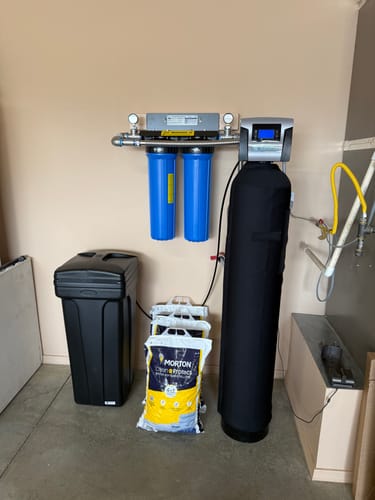
When chlorine enters an activated carbon filter, something almost elegant happens: the carbon doesn't just catch it — it chemically neutralizes it. That distinction matters.
We're talking about a material engineered to eliminate up to 90% of chlorine while simultaneously targeting:
- VOCs that slip past basic filtration
- Pesticides absorbed deep within carbon's porous matrix
- Organic chemicals responsible for off-tastes and odors
- Trace organic matter common in municipal supplies
Each contaminant encounters millions of microscopic pores across up to 4,200 square meters of surface area — per gram. Adsorption pulls these molecules in and holds them. Nothing escapes passively.
This precision is exactly why activated carbon earns its place inside multi-stage iron filter systems, doing work no single-stage filter can replicate.
Why Iron Filters Perform Better When Paired With Activated Carbon
Iron filters are genuinely good at what they do — but they're not working alone when activated carbon enters the picture.
Here's what changes: chlorine and organic contaminants that normally interfere with iron precipitation get adsorbed by the carbon before they cause problems. Sulfides — those notorious groundwater companions to iron — get captured too.
Meanwhile, carbon's massive surface area traps particulate matter that would otherwise clog your iron filter media, meaning less maintenance and longer system life.
The result isn't just iron removal; it's thorough treatment that tackles taste, odor, and staining simultaneously.
When we pair these two technologies, we're not doubling up unnecessarily — we're creating a system where each stage makes the other dramatically more effective.
Where Activated Carbon Fits in a Multi-Stage Iron Filter System
- Pre-filtration: Activated carbon strips chlorine and VOCs before water contacts iron removal media.
- Mid-stage: It adsorbs organic compounds that form during oxidation processes.
- Post-filtration: It polishes taste and odor issues after iron's been captured.
- Final guard: It catches chlorination by-products that slip through earlier stages.
With a surface area exceeding 4,200 square meters per gram, activated carbon's adsorption capacity makes it incredibly versatile across multiple positions.
We're not talking about one fixed role — we're talking about a dynamic, adaptable component that strengthens every stage it touches.
How to Maintain Activated Carbon in an Iron Filter System
Keeping activated carbon in peak condition comes down to 4 core habits: watching pressure and flow rates, replacing carbon every 6 to 12 months, pre-filtering iron-laden water before it hits the carbon stage, and staying alert to returning odors or tastes.
Think of it like reading your system's crucial signs. When pressure drops or flow rates shift unexpectedly, carbon saturation is likely your culprit.
Pre-filtering keeps iron from overwhelming the carbon, letting it focus on what it does best — adsorbing organics and residual chlorine.
Pre-filtering iron-laden water lets activated carbon do its real job — targeting organics and chlorine without burning out fast.
Meanwhile, a transparent monitoring system tracking contaminant levels entering and exiting the filter removes all guesswork.
And if foul tastes or odors creep back? That's your carbon signaling it's time for a change. Don't ignore it.
Frequently Asked Questions
What Is the Purpose of Activated Carbon in a Water Filter?
Activated carbon's our water filter's powerhouse—it adsorbs chlorine, organic compounds, and VOCs by trapping contaminants within its extraordinarily porous structure, which can exceed 4,200 square meters per gram, dramatically improving your water's purity and taste.
Does Activated Charcoal Remove Iron From Water?
We'll be honest—activated charcoal doesn't effectively remove iron from water. Iron requires specialized methods like oxidation or ion exchange. Activated charcoal's strength lies in tackling organic contaminants, chlorine, and improving taste and odor instead.
What Are the Disadvantages of Activated Carbon Filter?
Activated carbon filters can't remove inorganic contaminants, bacteria, or viruses. They'll also saturate over time, losing effectiveness and potentially leaching contaminants back—meaning we must replace them every three to six months for peak performance.
How Long Does Activated Carbon Last in a Water Filter?
Activated carbon typically lasts 6 months to 1 year in a water filter, but here's what we've learned: your water quality and contaminant concentration directly determine how quickly you'll exhaust its adsorptive capacity.






