


![SoftPro™ Chlorine+ Carbon Whole House Water Filter to Remove PFAS, Chlorine, Chloramine & Pesticides [City Water Filters Series]](http://www.softprowatersystems.com/cdn/shop/files/SoftPro_Whole_House_Carbon_Filter_with_Spin_Down_Water_Filter.webp?v=1783547361&width=140)


 855-683-8488


Why Your Greensand Iron Filter Needs Potassium Permanganate to Keep Working Properly

Your greensand iron filter works by using a manganese dioxide coating to trap dissolved iron and manganese. But every time that coating does its job, it wears down a little. That's where potassium permanganate comes in — it recharges the coating so your filter keeps performing. Without regular regeneration, you're left with stained fixtures, metallic-tasting water, and a filter that's just going through the motions. Keep going to find out exactly how to stay ahead of it.
Key Takeaways
- Potassium permanganate regenerates the manganese dioxide coating on greensand filters, restoring its ability to oxidize dissolved iron and manganese effectively.
- Without regular regeneration, the manganese dioxide coating gradually degrades, allowing dissolved metals to pass through untreated into your water supply.
- Manganese dioxide catalyzes the conversion of dissolved iron and manganese into solid particles, which the filter bed then traps and removes.
- Tannins, oils, and pH levels outside the 6.7–8.8 range accelerate coating degradation, making potassium permanganate regeneration even more critical.
- Consistent regeneration can reduce iron concentrations to as low as 0.3 ppm, ensuring safe, clean water without additional chemical additives.
What Potassium Permanganate Actually Does Inside Your Filter

Potassium permanganate doesn't just clean your greensand filter—it's what keeps the filter's manganese dioxide coating recharged and ready to work.
That coating is the real workhorse. It catalyzes the oxidation of dissolved iron and manganese, converting them from invisible, dissolved metals into solid particles your filter can actually trap and remove.
The manganese dioxide coating does the heavy lifting—oxidizing dissolved metals into solid particles your filter can capture and remove.
Without regular regeneration using potassium permanganate, that coating loses its oxidation capacity, and your filter loses its edge.
With it, you're consistently reducing iron concentrations to as low as 0.3 ppm—no chemical additives required. It also handles hydrogen sulfide and other metals, all while operating efficiently within a pH range of 6.7 to 8.8.
That's a remarkably capable system, but only when potassium permanganate keeps it properly charged.
Why Your Filter's Coating Wears Out Over Time
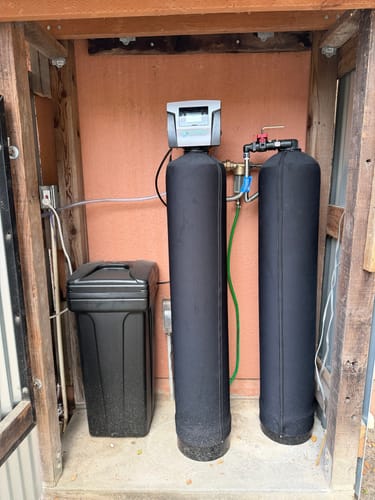
Every oxidation reaction that strips iron and manganese from your water takes a small toll on the manganese dioxide coating.
Think of it like sandpaper — effective, but gradually worn down by the very work it performs. Each potassium permanganate regeneration cycle replenishes some of that coating, but it doesn't fully restore what's lost.
Several factors accelerate this wear beyond normal use. Tannins, oils, and shifting water chemistry all degrade the coating faster than standard oxidation alone.
Stray outside the ideal pH range of 6.7–8.8, and you're compounding the problem considerably.
This is why most greensand media lasts only 4 to 8 years.
Understanding this gradual depletion helps you monitor performance proactively, rather than discovering failure only after iron starts breaking through.
How Often Should You Add Potassium Permanganate: And How Much?
How often you add potassium permanganate — and how much — directly determines whether your greensand filter keeps pace with your water's iron and manganese load. Most systems need regeneration every one to three months, but your actual usage and contaminant levels shift that window considerably.
| Usage Level | Frequency | Amount Needed |
|---|---|---|
| Low | Every 3 months | 1–2 lbs |
| Moderate | Every 2 months | 2–3 lbs |
| High | Every month | 3–4 lbs |
Monitor your filter's performance consistently — pressure drop and breakthrough iron are your clearest signals. Catching the timing right means minimal residual permanganate in treated water, which protects against staining and irritation while keeping oxidizing capacity exactly where it needs to be.
Signs Your Greensand Filter Needs Regeneration Now
Knowing the schedule keeps you proactive, but your filter will also tell you when it's reached its limit — if you know what to look for.
Watch for the rotten-egg smell returning to your water — that's hydrogen sulfide breaking through an exhausted bed. If you notice pink or magenta-tinted water, potassium permanganate isn't being controlled properly and regeneration is overdue.
Your water will tell you when it's done — trust the smell and the color.
A sudden drop in pressure or flow rate signals a clogged filter bed that needs immediate attention.
You'll also want to act fast if you detect metallic tastes or see staining reappear in sinks and fixtures — both mean iron and manganese are slipping through.
Don't wait for multiple symptoms; one is enough to trigger regeneration.
Is Potassium Permanganate Safe for Home Use?
Potassium permanganate sounds intimidating, but it's generally safe for home use when handled correctly. It effectively regenerates greensand filters, keeping them working at peak performance against iron and hydrogen sulfide.
Here's what you need to know: minimal permanganate ever reaches your treated water because excess gets flushed away before distribution.
That said, concentrated solutions can cause skin irritation or burns, so we always recommend wearing gloves and goggles during application. Respect the chemical, and it'll respect you.
When you follow recommended treatment protocols, potassium permanganate enhances your water quality without creating meaningful health risks.
Think of it like any powerful household tool — managed properly, it delivers exceptional results. Mismanaged, it creates unnecessary problems. The difference is simply knowing what you're doing.
Frequently Asked Questions
How Do You Maintain a Greensand Filter?
We'll keep your greensand filter running efficiently by adding potassium permanganate every 1-3 months, backwashing at 12 psi differential, maintaining pH between 6.7-8.8, and replacing media every 4-8 years.
How Long Should You Use Potassium Permanganate?
We recommend adding potassium permanganate every one to three months to keep your greensand filter performing at its peak. Consistent regeneration cycles extend your filter media's lifespan to eight years, maximizing your investment and ensuring clean, stain-free water.
How to Add Potassium Permanganate to Iron Filter Water Softener?
To add potassium permanganate, we'll dissolve a few pounds of dry powder in water, following manufacturer guidelines for our filter size and usage. Then we run a double rinse cycle to flush excess permanganate before resuming normal water distribution.
Does Potassium Permanganate React With Iron?
Yes, potassium permanganate reacts with iron by oxidizing soluble ferrous iron (Fe²⁺) into insoluble ferric iron (Fe³⁺). This converts dissolved iron into solid particles your greensand filter can effectively trap and remove.






