


![SoftPro™ Chlorine+ Carbon Whole House Water Filter to Remove PFAS, Chlorine, Chloramine & Pesticides [City Water Filters Series]](http://www.softprowatersystems.com/cdn/shop/files/SoftPro_Whole_House_Carbon_Filter_with_Spin_Down_Water_Filter.webp?v=1783547361&width=140)


 855-683-8488


Why Is Your Iron Filter Letting Iron Pass Through to Your Household Water? Root Causes Explained

If your iron filter's letting iron slip through, there are a few common culprits worth knowing about. The oxidation process might be failing, your filter could be undersized for your well's iron levels, or you may be skipping critical backwash cycles. Worn-out filter media is another sneaky offender. Each of these issues has a real fix, and understanding which one applies to your situation makes all the difference — keep going to find out.
Key Takeaways
- Cold water, low oxygen levels, or pH imbalances can disrupt iron oxidation, preventing ferrous iron from converting to filterable ferric iron.
- Filters undersized for your well's iron concentration or household flow rate become overwhelmed, allowing iron to slip through untreated.
- Skipped or irregular backwash cycles cause iron particle buildup in the media, reducing filtration effectiveness and contaminating household water.
- Worn or exhausted filter media loses its ability to capture iron, with manganese dioxide typically needing replacement every 5–10 years.
- Plumbing leaks, bypass configurations, or outdated systems can allow iron to circumvent the filter entirely, regardless of its condition.
Your Iron Filter Isn't Oxidizing Iron Before It Can Catch It

For an iron filter to work, it needs to oxidize soluble ferrous iron into insoluble ferric iron before it can trap it—skip that step, and iron flows right through to your taps.
Several conditions can quietly sabotage this oxidation process. Cold water below 50°F slows the necessary chemical reactions, while insufficient dissolved oxygen leaves ferrous iron unconverted.
pH imbalances—whether too acidic or too alkaline—further disrupt oxidation chemistry.
Even flow rate matters: when water moves too quickly through your system, contact time with the oxidizing agent drops, and incomplete oxidation follows.
Understanding these variables gives you real diagnostic power. If your filter's letting iron slip through, one of these four culprits is almost certainly responsible.
Is Your Iron Filter Sized for Your Well's Iron Levels?
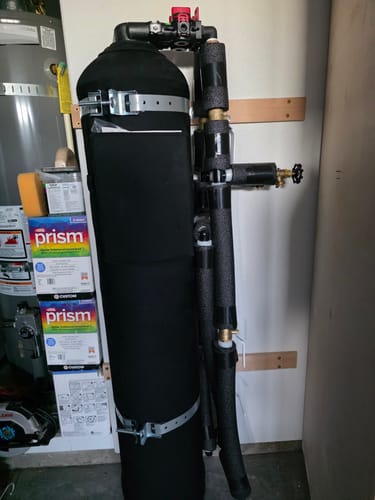
Even if your iron filter's oxidation process is working perfectly, it can still fail you if it wasn't sized right for your well's iron levels in the first place.
Filters designed for lower concentrations simply can't handle elevated iron levels—especially anything exceeding 3-5 ppm—and they'll let iron slip right through.
But sizing isn't just about iron concentration. Your household's flow rate matters too. An undersized filter gets overwhelmed during peak demand, compromising removal efficiency when you need it most.
Oversizing creates its own problems if regeneration cycles don't align with your actual water usage.
The solution? Regular water testing combined with professional consultation guarantees your filter's capacity genuinely matches what your well is throwing at it.
Skipping Backwash Cycles Lets Iron Break Through Your Filter
Getting the right-sized filter for your iron levels is only half the battle—how you maintain it determines whether it keeps doing its job. Skip backwash cycles, and you're inviting iron breakthrough.
| Neglected Maintenance | What Happens | Consequence |
|---|---|---|
| Skipped backwash cycles | Iron particles accumulate in media | Reduced filtration effectiveness |
| Irregular backwashing intervals | Ferrous iron oxidizes unfiltered | Iron enters household supply |
| Ignored pressure changes | Clogging worsens filter performance | Shortened system lifespan |
Backwashing flushes trapped contaminants, restoring your filter's capacity to capture iron. Without it, media becomes clogged, pressure builds, and dissolved ferrous iron slips through oxidized and unfiltered. Most manufacturers specify backwash intervals tied to water usage or pressure differentials—follow them precisely. Mastering your maintenance schedule is what separates a filter that performs from one that fails.
When Iron Filter Media Wears Out and Stops Working
Even with perfect backwashing habits, iron filter media doesn't last forever—manganese dioxide and other oxidizing agents wear down after years of trapping contaminants, and when they do, your filter stops doing its job. Most media lasts 5 to 10 years, but high iron concentrations and heavy water volume accelerate that timeline considerably.
Watch for the warning signs: iron stains returning on fixtures, a metallic taste creeping back into your water, or noticeably reduced flow. These aren't minor inconveniences—they're your system telling you the media's exhausted.
We also recommend monitoring pH and water hardness regularly. Imbalanced levels quietly speed up media degradation, shortening its lifespan before you even realize there's a problem.
Catching this early saves you from a full-blown filtration failure.
How to Stop Iron From Getting Past Your Iron Filter
If iron is slipping past your filter, the problem usually comes down to one of a few fixable issues: a system that's undersized for your water's iron concentration, inconsistent backwashing, a pH imbalance letting ferrous iron pass through undetected, or a plumbing leak that's routing water around the filter entirely.
Here's how to address each root cause:
- Right-size your filter — match its rating to your actual iron concentration levels
- Backwash and regenerate regularly — don't let iron particles accumulate in the media
- Inspect your plumbing — eliminate leaks or bypass configurations that circumvent filtration
- Test and correct pH and oxidization — ferrous iron stays soluble without proper conditions
- Upgrade aging systems — outdated equipment simply can't keep pace with your water's demands
Frequently Asked Questions
What Are Common Problems With Iron Filters?
We've found that iron filters commonly fail due to exhausted media, poor maintenance like infrequent backwashing, overwhelming iron concentrations, inadequate pre-treatment, and iron bacteria forming biofilms—all letting unwanted iron slip through your water supply.
What Are the Symptoms of Too Much Iron in Water?
We'll notice rust-colored stains on fixtures, a metallic taste, discolored food, cloudy water with sediment, and foul odors from iron bacteria—all telltale signs that iron's infiltrating our water supply.
How to Get Rid of Iron in House Water?
We'll tackle iron by installing a quality iron filter with manganese dioxide media, regularly backwashing it, testing water frequently, and combining it with a water softener for thorough ferrous and ferric iron removal.
How Much Water Does an Iron Filter Discharge?
We've found that iron filters discharge between 20 to 100 gallons per regeneration cycle. Your system's capacity, iron concentration, and household water consumption determine where you'll land within that range.






