


![SoftPro Chlorine+ Carbon Whole House Water Filter to Remove PFAS, Chlorine, Chloramine & Pesticides [City Water Filters Series]](http://www.softprowatersystems.com/cdn/shop/files/SoftPro_Whole_House_Carbon_Filter_with_Spin_Down_Water_Filter.webp?v=1780515157&width=140)
![SoftPro Iron Filter - Iron Master AIO - Best Iron Filter for Well Water [Air Injected Water Filter / Katalox]](http://www.softprowatersystems.com/cdn/shop/files/SoftPro_AIO_Iron_Master_Iron_Filter_Main.webp?v=1772123747&width=140)


 855-683-8488


Why Your Well Pump Flow Rate Calculation Is the Single Most Important Iron Filter Specification

Your well pump's flow rate is the single most important iron filter specification because it determines whether your system can actually oxidize and remove iron from your water. Iron filters need between 5 and 12 GPM to work properly — too low, and you'll get dirty output no matter how expensive your filter is. We see homeowners skip this measurement constantly, then wonder why their water still smells. Stick with us and we'll show you exactly how to fix that.
Key Takeaways
- Flow rate determines whether an iron filter can properly oxidize iron, requiring 5–10 GPM minimum for acceptable performance.
- Iron filter backwash rate must be double its service flow rate, making GPM critical for correct sizing.
- Low flow rates cause incomplete backwashing, poor filtration, accelerated wear, and degraded water quality over time.
- A mismatched flow rate and filter size creates system inefficiency, increasing maintenance needs and reducing filter lifespan.
- Accurate GPM measurement using a bucket-and-stopwatch method ensures the selected iron filter meets household demand.
What Is Well Pump Flow Rate?

Well pump flow rate is simply the number of gallons your pump moves per minute — what we call GPM. Think of it as your water system's heartbeat. Everything downstream depends on it.
Most residential wells run single-speed submersible pumps delivering somewhere between 6 and 12 GPM. That range matters more than most homeowners realize, because the moment you introduce an iron filter into the picture, flow rate stops being just a performance stat — it becomes the deciding factor in whether your filtration system actually works.
Iron filters need 5 to 10 GPM to backwash effectively. Too little flow, and the system can't clean itself.
Knowing your exact GPM isn't optional. It's the foundation everything else gets built on.
Why Your Flow Rate Makes or Breaks Your Iron Filter
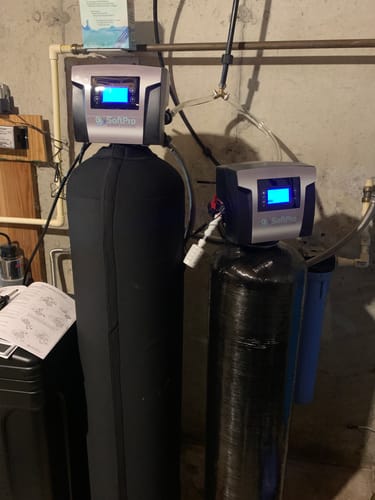
Once you know your GPM, the real stakes become clear — that number determines whether your iron filter actually does its job. Most iron filters need 5–10 GPM minimum to oxidize iron particles properly. Fall below that threshold, and you're getting dirty water despite having a filter installed.
Here's how flow rate shapes your filter's performance:
| Flow Rate | Filter Outcome |
|---|---|
| Below 5 GPM | Poor oxidation, clogging, dirty output |
| 5–10 GPM | Acceptable performance, monitor closely |
| 12 GPM | Ideal — supports simultaneous household use |
At 12 GPM, you'll also need roughly 1.71 square feet of filter bed surface. That's not arbitrary — it's physics. Accurate measurements eliminate guesswork, reduce maintenance costs, and keep your system running exactly as designed.
How to Calculate Your Well Pump Flow Rate in 4 Steps
Calculating your well pump flow rate comes down to 4 simple steps, and you don't need any special equipment to do it — just a 5-gallon bucket, a stopwatch, and a hose bib.
First, open a faucet until your pump activates, then close it and let the pump build pressure and shut off.
Second, position your bucket under a hose bib — never a faucet, which restricts flow and skews your results.
Third, open the hose bib and start your stopwatch, collecting water until the pump kicks back on.
Fourth, plug your numbers into this formula: (Gallons drawn ÷ Seconds) × 60. That final number is your GPM — the specification that determines whether your iron filter succeeds or fails.
Does Your Well Pump Flow Rate Match Your Iron Filter?
Now that you've got your GPM number, it's time to put it to work. Matching your well pump flow rate to your iron filter isn't optional — it's the difference between clean water and a system that's slowly failing you.
Here's what you need to know:
- Your iron filter needs a backwash rate at least double its service flow rate
- A household of 5 people typically demands a peak flow of 12 GPM
- A flow rate that's too low means incomplete backwashing and degraded filtration
- Mismatched sizing accelerates system wear and tanks water quality
We always say: measure first, buy second. Your GPM number tells you exactly which filter size handles your water without compromise.
Low Well Pump Flow Rate? Here's How to Fix It
If your well pump flow rate is coming in below 6 GPM, don't ignore it — that's your system telling you something's wrong. Worn pump components or blockages in the system are usually the culprits, and neither problem resolves itself.
Start with the simplest fix first: clean the well screen. Mineral buildup and debris accumulate over time, restricting flow without any obvious warning signs. If cleaning doesn't move the needle, you're likely looking at a pump upgrade.
When selecting a replacement, match the pump's capacity to your actual household demand. Larger families need rates closer to 12 GPM.
And if you're running a backwashing iron filter, remember — you need at least 5–10 GPM just to keep that system functioning correctly.
Test annually. Catch problems early.
Frequently Asked Questions
What Is a Good Flow Rate for a Well?
For most households, we recommend aiming for 6-12 GPM. If you've got 1-2 people, 5 GPM works fine, but larger families need 10+ GPM to handle daily demands without straining your system.
Is 4.3 Gpm on My Well Bad?
4.3 GPM is considered low, especially if you've got more than two people in your home. We'd recommend testing your system further, as it could signal pump wear or sizing issues affecting your iron filter's performance.
Is 2.5 Gpm a Good Flow Rate?
2.5 GPM isn't good — it's too low for effective iron filtration. We'd need at least 5 GPM for proper backwashing. Anything less risks filter saturation and leaves iron in your water.
What Is the Ideal Flow Rate in Water Filters?
We recommend aiming for 5–10 GPM for most residential iron filters. If your household has five or more people, you'll want 10–12 GPM to handle simultaneous demand without frustrating pressure drops.



