


![SoftPro™ Chlorine+ Carbon Whole House Water Filter to Remove PFAS, Chlorine, Chloramine & Pesticides [City Water Filters Series]](http://www.softprowatersystems.com/cdn/shop/files/SoftPro_Whole_House_Carbon_Filter_with_Spin_Down_Water_Filter.webp?v=1783547361&width=140)


 855-683-8488


Your Iron Filter Will Pay for Itself — Here's How to Prove It

Iron contamination quietly drains over $4,000 from your wallet every year through appliance damage, plumbing repairs, and skyrocketing utility bills. A quality iron filter costs around $1,500 upfront, but most households break even within two to three years through real, measurable savings. We're talking fewer repair calls, longer-lasting appliances, and no more bottled water runs. Stick with us, and we'll show you exactly how to prove every dollar your filter is saving you.
Key Takeaways
- Iron contamination can cost homeowners over $4,000 annually in appliance damage, plumbing repairs, utility bills, and cleaning supplies.
- A quality iron filter costs around $1,500 upfront, with most households reaching break-even within 2–3 years.
- Protected appliances and plumbing generate $5,500–$7,000 in total savings over a decade of iron filtration.
- Eliminating bottled water purchases alone can redirect up to $4,600 annually back into your household budget.
- Tracking reduced plumbing calls, appliance repairs, and water bills provides measurable proof of your filter's financial return.
What Iron Contamination Actually Costs You Each Year?

When iron creeps into our water supply, it doesn't just stain our sinks — it quietly drains our wallets in ways we rarely connect to the source.
Appliance damage alone runs $800–$1,500 annually, while iron-clogged pipes can trigger $200–$2,600 in plumbing repairs. Utility bills climb another $300–$800 as compromised appliances work harder and break faster. Toss in $100-plus for cleaning supplies battling those stubborn rust stains, and the numbers compound quickly.
That's potentially $4,000 or more leaving your household each year — and we haven't even touched the healthcare costs tied to drinking contaminated water. Iron contamination isn't a minor inconvenience; it's a systematic financial leak.
Recognizing every cost category is the first step toward building a compelling case for filtration.
How to Calculate Your Iron Filter's Break-Even Point?
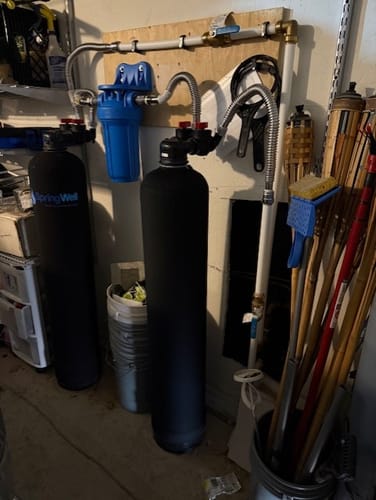
Now that we recognize iron contamination can cost us $4,000 or more each year, let's figure out exactly how long it takes for a filter to pay for itself.
Start with a quality unit's initial cost — around $1,500. Add annual maintenance, typically $300–$800. That's your total investment.
Now stack your savings. Reduced bottled water expenses return $400–$1,200 yearly. Fewer appliance repairs save up to $800. Plumbing fixes you'll avoid? Another $150–$300 annually.
Here's the math working in our favor: combined savings easily outpace ongoing costs within the first year.
Factor everything together, and most households hit their break-even point in just 2–3 years. After that, every dollar saved goes straight back into our pockets.
What It Actually Costs to Own an Iron Filter Long-Term?
Once we've crossed the break-even point, understanding the full long-term cost picture helps us budget smarter. Annual operating costs run $300–$800, with replacement media adding $150–$400 every few years.
Factor in $20–$40 monthly for chemicals and $5–$15 for backwashing electricity, and you've got a predictable, manageable expense stack.
Here's what makes those numbers worth it: over ten years, we're looking at $5,500–$7,000 in savings from protected appliances and plumbing.
Compare that against a single water heater replacement costing $800–$1,500 from iron buildup alone. The math tells a clear story.
Long-term ownership isn't just about upfront investment recovery — it's about controlling costs we'd otherwise pay reactively, on someone else's timeline, at someone else's price.
Where Iron Filters Deliver the Biggest Savings at Home?
Where do iron filters actually move the financial needle most?
Let's break it down by the areas where you'll feel it most in your wallet:
- Water heaters — Iron buildup gets expensive fast; filters cut repair costs by up to $1,500.
- Plumbing systems — Clogged pipes cost $150–$300 annually without filtration. That stops immediately.
- Appliance longevity — Extended lifespans across dishwashers, washing machines, and fixtures compound into $5,500–$7,000 over ten years.
- Bottled water elimination — Households spending hundreds annually on bottled water redirect that money elsewhere.
These aren't abstract projections — they're recurring costs you're either paying now or avoiding with a filter installed.
The savings stack quietly, category by category, until the system's paid for itself several times over.
Signs You've Already Made Your Money Back on Iron Filtration?
At some point, the filter stops feeling like an expense and starts feeling like a decision you wish you'd made sooner. Here's how you'll know you've crossed that line:
| Sign | What It Means |
|---|---|
| No bottled water purchases | You're saving up to $4,600 annually |
| Appliances running longer | You've avoided $800–$1,500 per replacement |
| Zero rust stains to scrub | Cleaning costs have quietly disappeared |
When you stop dreading the water bill, stop calling the plumber, and stop buying cases of bottled water, that's your money talking. Most homeowners recoup their investment within the first year, pocketing $1,500 to $3,000 before year two even begins. The filter's already paid itself off — you're just collecting the returns now.
Frequently Asked Questions
What Is the Life Expectancy of an Iron Filter?
We're looking at 10 to 15 years of reliable performance from a quality iron filter. Keep up with regular maintenance, and you'll squeeze every bit of value from your investment.
How Much Does an Iron Filter Cost?
We're looking at around $1,500–$2,000 upfront for a quality system, plus $300–$800 annually for maintenance. But here's the exciting part—we'll save $3,500–$7,000 over the system's lifetime.
Will an Iron Filter Get Rid of Iron Bacteria?
Standard iron filters won't fully eliminate iron bacteria. We'll need to combine filtration with chlorination or hydrogen peroxide treatment to tackle bacterial contamination effectively — a multi-stage approach that guarantees thorough protection for your water supply.
How Much Does It Cost to Maintain an Iron Filter?
We're looking at $300–$800 annually for operating costs, plus $20–$40 monthly for chemicals. Professional maintenance runs $300–$700 per year, but consistent upkeep dramatically extends your system's lifespan, making it a worthwhile investment.






