


![SoftPro™ Chlorine+ Carbon Whole House Water Filter to Remove PFAS, Chlorine, Chloramine & Pesticides [City Water Filters Series]](http://www.softprowatersystems.com/cdn/shop/files/SoftPro_Whole_House_Carbon_Filter_with_Spin_Down_Water_Filter.webp?v=1783547361&width=140)


 855-683-8488


A Water Main Break Just Happened, Here's Your First Move
Emergency Plumbing Guide
If a broken water line is sending water into your home, your first move is simple: shut off your main water valve immediately — a burst line can dump 300 to 600 gallons in 30 minutes. If the break is out in the street, report it to the utility and stay out of the water.
Key Takeaways
- Shutting your main valve off in 2 minutes instead of 30 can be the difference between a wet floor and 300–600 gallons of standing water — Shipshape emergency guide.
- The US and Canada log roughly 260,000 water main breaks a year, costing about $2.6 billion in repairs — Utah State University break-rate study, 2023.
- About a third of water mains in the US and Canada — roughly 770,000 miles of pipe — are already past 50 years old — Utah State University break-rate study (full report).
- A pressure drop below 20 psi during a break often triggers a boil water advisory within 24 hours — Ohio EPA guidance.
- Water damage is one of the most common US homeowner insurance claims, averaging about $12,000 per incident, according to home-maintenance platform Shipshape.
- The utility owns and repairs the main under the street — you're responsible for the private service line from the curb stop to your house — NJDEP Water Main Break Guidance.
- Once repairs finish, run cold water at every tap until it's clear before drinking, cooking, or making ice — City of Dallas, OR.
First 5 Minutes · Emergency Response
Know this before water is on your floor
Your main shutoff valve is the single most important thing to find today — before you ever need it in the dark, in a hurry, ankle-deep in water.
What Is a Water Main Break, and How Is It Different From a Burst Pipe in Your Home?
A water main break is a failure in the utility-owned pipe that carries treated water under the street to your neighborhood — not the plumbing inside your walls. You'll usually spot one as a geyser or sheet of water in the road, a sinkhole forming in pavement, or a sudden pressure drop across every faucet in the house at once.
A burst pipe, by contrast, is a private-property failure — a frozen copper line, a corroded galvanized pipe, or a supply line behind a washing machine — and it's yours to shut off and repair regardless of whose water caused it.
The distinction matters because it decides who you call first. If the break is out in the street or at the curb box, it's almost always a utility responsibility, but your first step is still confirming whether the leak is on your property or the city's before anyone shows up.
If it's inside your foundation line, a licensed plumber — not the water department — is who you need.
What Do You Need to Know Before a Water Main Break Happens?
The single biggest predictor of how much damage you take is whether you already know where your main shutoff valve is and that it actually turns. Most homes have it where the supply line enters the house — a basement wall.
A crawlspace, a utility room, or an exterior wall near the water meter. Newer homes on a slab foundation often put it near the water heater instead.
Two valve types behave very differently in an emergency. A gate valve closes with several full turns and gives fine control, while a ball valve shuts off in a quarter-turn and is far faster when seconds count — and if a valve is stuck or frozen, don't force it, since forcing a seized valve can shear the stem and turn a fixable leak into a bigger repair.
Keep a water meter key and an adjustable wrench near your utility area, and walk every adult in the household through the location once — it's a two-minute exercise that can save thousands of dollars later.
What's the First Move When You Discover a Water Main Break?
Shut off your main water valve immediately. If water is coming into the house — from a failed service line, a pipe under your slab, or a line inside the walls — this is the highest-leverage action available to you: a burst line running for 30 minutes can dump 300 to 600 gallons into your home, versus a fraction of that if it's shut in under two minutes. Turn the valve clockwise until it stops moving.
If the break is a genuine street-side water main break and water isn't actively entering your home, you may not need to touch your own valve at all — your job is instead to get the utility notified fast, since they often only learn about a break from a resident's call.
Report it to your local water department or public works hotline, and if you're near the break itself, don't drive or walk through the runoff: standing water can hide a washed-out roadway or an open manhole, and even a foot of moving water can be enough to sweep a car off course.
What Should You Do in the First 10 Minutes After a Water Main Break?
Once the main valve is off — or once you've confirmed the break is outside and reported it — work through the rest of the checklist in order:
Two of these steps are the ones homeowners skip under stress and regret later. Turning off the water heater matters because a gas unit left firing on an empty tank can overheat and fail, and an electric unit left powered can trip a breaker or worse. Cutting power near any flooded area matters even more — not shutting off power to affected circuits first is one of the most common and most dangerous mistakes homeowners make during a water line emergency.
Who Do You Call — the Water Utility or a Plumber?
This comes down to where the pipe that failed actually sits. Use this quick comparison to figure out who owns the problem and, usually, who pays for it.
| Detail | Public Water Main (street side) | Private Service Line (your property) |
|---|---|---|
| Typical location | Under the street, sidewalk, or utility easement | From the curb stop / meter to your house |
| Who owns it | The municipal water utility | You, the homeowner |
| Who repairs it | Utility crews, at no direct charge to you | A licensed plumber, at your expense |
| Who you call first | Public works / water department hotline | A licensed plumber |
| Typical response window | Hours, sometimes under a formal repair standard | Depends entirely on plumber availability |

If you're unsure which side of that line the failure is on, report it anyway — early detection and prompt reporting are what keep a water main break from turning into a larger community-wide problem, and the utility can tell you quickly whether it's their pipe or yours.
What Happens to Your Water Quality After a Water Main Break?
A break drops pressure in the surrounding distribution system, and low pressure can let contaminants — dirt, sediment, or worse — get pulled backward into the pipe through the break itself. That's why utilities issue boil water advisories as a precaution. When pressure falls below 20 psi anywhere in the system, Ohio's EPA recommends the advisory go out to affected customers within 24 hours, and most advisories are lifted once follow-up bacteria samples come back clean — typically two consecutive rounds, though the exact requirement varies by state.
While an advisory is in effect, follow the boil time printed on your own utility's notice: the CDC standard is a rolling boil for one minute (three minutes above 6,500 feet), and some utilities ask for longer — a 2023 advisory after a main break in Waukee, Iowa, called for two minutes.
Even without a formal advisory, expect discolored or cloudy water for a while — sediment stirred up in the pipe is the most common cause, and it isn't necessarily a health risk, but it's also not something you want running through a fresh water softener or carbon filter.
A spin-down sediment filter and sand separator installed ahead of your main system catches that grit before it ever reaches your resin bed or media tank.
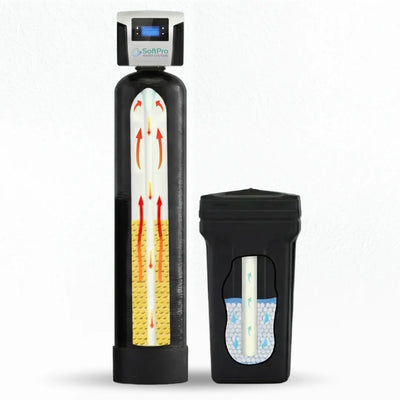
SoftPro™ Elite Smart HE - Best Water Softener for City Water
$1,367.00 $2,468.65 Sale
What Mistakes Do Homeowners Make During a Water Main Break?
The same handful of errors show up again and again in plumber call logs:
Don't: Leave power on to outlets, appliances, or a breaker panel that's near standing water.
Don't:
Walk or drive through floodwater from a street-side break — it can hide a washout or an open manhole.
Don't: Assume a slow drip in the yard is "just the sprinkler" — a quick look at volume and location tells you fast whether it's bigger than that.
The Edison, New Jersey case is a good example of how fast things escalate: a 48-inch main failure there took utility crews 22 hours to fully shut down. At least three basements flooded; one resident reported about a foot of water and estimated more than $10,000 in damage, while a neighbor ran two pumps and tore out soaked carpet by hand.
In a street-side break like that one your own shutoff valve can't hold back water coming across the ground — which is why fast reporting, cutting power to flooded areas, and documenting damage matter so much.
How Do You Flush Your Pipes and Restore Water Quality After Repairs?
Once the utility confirms the repair is complete and any boil water advisory is lifted, don't just start using taps normally again. Starting with cold water, run every faucet for at least a few minutes and watch until the water turns clear before drinking it, cooking with it, or running it through an ice maker. Flush outdoor hose bibs too, since sediment settles in the lowest points of your plumbing first.
This is also the right moment to check on your treatment equipment. A whole-house water filter that catches sediment and chlorine byproducts protects everything downstream of it.
City water households dealing with a chlorine spike from emergency disinfection can lean on a whole-house chlorine and carbon filter instead. If you're not sure what changed, a quick water test tells you exactly what came through the line rather than guessing.
Not sure what a main break did to your water?
SoftPro's free water analysis report shows exactly what's in your water right now — hardness, iron, chlorine, and more — so you can decide whether it's a temporary flush or a filtration fix.
Get Your Free Water Analysis ReportFrequently Asked Questions About Water Main Breaks
How do I know if it's a water main break and not a burst pipe inside my house?
A water main break usually shows up outside — water pooling or geysering in the street, a soft or sunken patch of pavement, or every faucet in the house losing pressure at the same time with no obvious leak indoors. A burst pipe is localized to one area inside your walls, floor, or ceiling. When in doubt, shut your main valve off first and sort out the source second.
Where is my home's main water shutoff valve located?
Most often near where the supply line enters the house — a basement wall, crawlspace, utility room, or exterior wall close to the water meter. Homes on a slab foundation frequently have it near the water heater instead. If you can't find it, your water meter box near the street usually has a secondary shutoff you can operate with a meter key.
Is it safe to walk or drive through water from a main break?
No. Even a shallow layer of fast-moving water can hide a washed-out road surface or an open utility cover, and if the water has any sewage odor, treat it as contaminated and avoid contact entirely.
Will I be placed under a boil water advisory after a water main break?
Not always — it depends on how far system pressure dropped and whether the utility suspects contamination entered the line. Many utilities issue a precautionary advisory any time pressure falls below roughly 20 psi, and it typically stays in effect until two consecutive bacteria samples test clean.
Who pays for the repair — me or the water utility?
If the break is in the public main under the street, the utility repairs it and there's no direct repair bill to you. If it's in your private service line — from the curb stop to your house — a licensed plumber handles it at your expense, though homeowners insurance may cover sudden, accidental breaks on the private side.
How long does a water main break typically take to fix?
Simple repairs can be done in a few hours; larger mains with many isolation valves to close can take considerably longer — one 48-inch main break took utility crews 22 hours to fully shut down before repairs could even begin. Your utility's advisory line or website is the most reliable place to check current status.
Does homeowners insurance cover water main break damage?
Often, yes, for sudden and accidental damage from a break on your private service line or inside your home — but coverage for damage caused by a failure in the public main itself is inconsistent and policy-dependent. Review your policy's water-damage section and call your agent before assuming either way; this isn't insurance advice, just a starting point for that conversation.
What should I do with my water softener or filter after a main break?
Run a full flush cycle after service is restored and the boil advisory (if any) is lifted, and watch for early signs your media bed took in extra sediment — slower flow, cloudier water immediately after regeneration, or a shorter interval between regenerations than usual. A sediment pre-filter ahead of your softener is the cheapest way to protect it from grit stirred up by a nearby break.
Methodology & Sources
This guide draws on Utah State University's 2023 water main break-rate study, state and municipal boil-water-advisory guidance (New Jersey DEP, Ohio EPA as relayed by the City of Middletown, Iowa DNR), municipal public-works advisories, CBS News reporting, and emergency-response guides from licensed plumbers and the home-maintenance platform Shipshape. Reddit and community-forum discussion was intentionally skipped as a source for this article — water main break response touches electrical and structural safety, and anonymous anecdotes don't meet the bar for that kind of guidance. Every statistic links to the source it was taken from. Visual elements on this page use inline, crawler-readable SVG rather than embedded images.

Water Main Break — Key Numbers
260,000
water main breaks across the US & Canada every year
Utah State University, 2023
$2.6B
in annual repair costs from those breaks
Utah State University, 2023
33%
of US & Canadian water mains are more than 50 years old
Utah State University, 2023
11.1
breaks per 100 miles of pipe per year, down from 14.0 in 2018
Utah State University, 2023
300–600 gal
water a burst line can dump into a home in 30 minutes
Shipshape emergency guide
$12,000
average water-damage insurance claim in the US
Shipshape emergency guide





