


![SoftPro™ Chlorine+ Carbon Whole House Water Filter to Remove PFAS, Chlorine, Chloramine & Pesticides [City Water Filters Series]](http://www.softprowatersystems.com/cdn/shop/files/SoftPro_Whole_House_Carbon_Filter_with_Spin_Down_Water_Filter.webp?v=1783547361&width=140)


 855-683-8488


Activated Carbon Iron Filter Water Treatment — A Complete System Overview Before You Invest in One

If you're considering an activated carbon iron filter, you need the full picture before spending a dime. These systems use adsorption across a massive surface area — over 3,000 square meters per gram — to trap chlorine, VOCs, and odors. But they won't handle everything alone. Iron levels, manganese, and bacteria all demand specific media and specs. Understanding your water test results is where smart decisions start, and we've broken down everything you need to know ahead.
Key Takeaways
- Activated carbon filters use adsorption to remove chlorine, VOCs, and odors but cannot eliminate hardness minerals like calcium and magnesium.
- Water testing is essential before investing; iron levels above 0.3 mg/L require Katalox Light media rather than standard carbon filtration.
- A minimum flow rate of 15 gallons per minute is necessary to maintain adequate water pressure and filtration effectiveness.
- Stainless steel construction and NSF/ANSI 61 certification ensure long-term durability and safety in iron-heavy water environments.
- Delaying filter media replacements causes carbon saturation and breakthrough, significantly compromising overall water treatment performance.
How Activated Carbon Iron Filters Remove Contaminants

When it comes to keeping our water clean, activated carbon iron filters are doing some serious heavy lifting. The secret's in adsorption — a process where contaminants like chlorine, VOCs, and odor-causing compounds bond directly to the carbon's surface rather than simply passing through it.
Here's what makes this remarkable: activated carbon carries a surface area exceeding 3,000 square meters per gram. That's an enormous trapping capacity packed into a compact filter medium.
This mechanism works exceptionally well for both municipal and well water sources, tackling organic compounds and chemical contaminants with precision.
However, we should be clear — hardness minerals like calcium and magnesium aren't removed through adsorption. For complete water treatment, pairing these filters with a dedicated softening system isn't optional; it's necessary.
What Your Water Test Results Mean for Choosing an Iron Filter
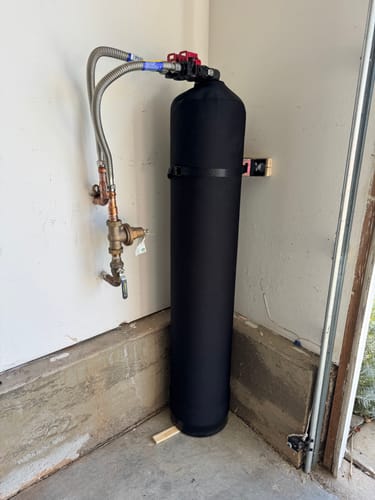
Your water test results aren't just numbers on a page — they're a roadmap for building the right filtration solution. Here's how we decode them:
| Test Result | What It Indicates | Recommended System |
|---|---|---|
| Iron > 0.3 mg/L | Elevated iron levels | Katalox Light media filter |
| Iron bacteria or rust | Biological contamination | Specialized filter + activated carbon |
| Manganese or sediment present | Multi-contaminant load | Multi-stage with sediment pre-filter |
Once we identify what's lurking in your water, we can match it to a system that's purpose-built for those exact threats. Don't guess — test regularly to confirm your filter's performance stays aligned with your household's evolving water quality demands. Precision here prevents costly missteps downstream.
Iron Filter Specs Decoded: Media, Flow Rate, and Capacity
Once we grasp what's in your water, the next step is matching that knowledge to the right filter specs — and that's where most buyers either nail it or get burned.
Media matters first. Katalox Light and activated carbon aren't interchangeable — each targets different contaminants with different efficiency.
Next, don't overlook flow rate. We recommend a minimum of 15 gallons per minute to maintain pressure during peak household demand. Drop below that, and you'll feel it.
Then there's capacity, measured in gallons per day, which determines how long your system runs before needing regeneration. Larger households burn through capacity fast.
Finally, materials like stainless steel aren't optional upgrades — they're your defense against corrosion in iron-heavy water, directly extending system lifespan.
What Makes an Activated Carbon Iron Filter Built to Last
Durability isn't accidental — it's engineered. When we look at what separates a long-lasting activated carbon iron filter from one that fails prematurely, it comes down to deliberate design choices. Stainless steel construction resists corrosion even in heavily iron-laden water — that's your foundation.
Layer in advanced filtration media like Katalox Light, and you've got a system engineered specifically for iron removal over the long haul.
But hardware alone won't save you. Maintaining ideal flow rates — targeting at least 15 gallons per minute — guarantees contact time stays effective. Timely media replacements prevent saturation and contaminant breakthrough.
And filters certified to NSF/ANSI 61 standards ensure safe materials that hold up over time. Every detail compounds. That's how longevity gets built in, not bolted on.
Common Mistakes Buyers Make With Activated Carbon Iron Filters
Even the best filter fails when it's the wrong filter for the job. We see buyers repeat the same costly errors — skipping water quality assessments, ignoring flow rate requirements, and assuming activated carbon handles high iron concentrations alone. It doesn't.
| Common Mistake | Why It Matters |
|---|---|
| Skipping local water testing | Wrong filter type for actual contaminants |
| Overlooking flow rate needs | Slower delivery, reduced effectiveness |
| Ignoring filtration capacity (GPD) | Insufficient output for larger households |
| Delaying filter replacements | Saturated carbon compromises water quality |
High iron levels demand complementary systems like Katalox Light alongside activated carbon. We can't stress this enough — matching your filter to your specific water profile isn't optional. It's the difference between clean water and a expensive, underperforming mistake.
Frequently Asked Questions
Is Activated Carbon Good for a Water Filter?
Yes, activated carbon's an excellent water filter choice! It removes chlorine, VOCs, and bad tastes using its massive 3,000 square meters per gram surface area — we're talking genuinely transformative water quality improvement you'll notice immediately.
What Is the Difference Between ACF and DMF?
We'll break it down: ACFs remove chlorine, VOCs, and odors through adsorption, while DMFs combine multiple filtration methods—including alkaline treatment—to tackle heavier contaminants like hardness, iron, and heavy metals for broader water quality improvement.
What Is the Difference Between Iron Filter and Carbon Filter?
Iron filters remove iron and manganese, preventing staining, while carbon filters adsorb chlorine and VOCs, improving taste. We're targeting different contaminants—iron filters tackle metals in well water; carbon filters refine municipal supplies.
What Is the Best Activated Carbon Filter for Water?
We'd recommend coconut-shell carbon filters with NSF/ANSI 42 and 61 certifications. For whole-house systems, choose GAC; for precision contaminant removal, carbon block filters win. Always match your filter to your local water quality report's specific contaminants.






