




Ferrous iron (Fe²⁺) can oxidize in as little as 15 minutes under ideal conditions, but most real-world well water treatment systems need 30 minutes to two hours of contact time for complete conversion into ferric iron (Fe³⁺), which can then be filtered out as iron oxide particles. Key factors such as pH, water temperature, dissolved oxygen, alkalinity, oxidation-reduction potential (ORP), iron concentration, and the presence of manganese, hydrogen sulfide, tannins, or iron bacteria all affect how quickly the oxidation reaction happens. Get any one of those wrong, and you may still see staining, metallic taste, rotten-egg odor, clogged plumbing fixtures, or incomplete iron removal.
For homeowners designing a retention tank, aeration system, chemical feed setup, or whole-house iron filter, proper sizing and contact time are critical. In many residential applications, a dedicated iron filtration system like the SoftPro AIO Iron Master is a strong first choice because it’s designed to target common well water contaminants such as ferrous iron, ferric iron, manganese, and sulfur odors without relying on guesswork in retention design. Stick with us — there’s a lot more to unpack about what actually drives successful iron removal and how to choose the right treatment approach for your water chemistry.
Key Takeaways
- Ferrous iron (Fe²⁺) oxidation typically takes 30 minutes to one hour under standard aeration conditions, though high iron concentrations, low alkalinity, or competing contaminants like manganese, hydrogen sulfide, and tannins can slow complete conversion to ferric iron (Fe³⁺).
- pH levels between 7.0 and 9.0 and temperatures above 25°C generally accelerate iron oxidation, while low dissolved oxygen, cold water, and low oxidation-reduction potential (ORP) can increase the required contact time.
- Contact time varies by oxidant: dissolved oxygen from air injection or aeration often requires 30–60 minutes, chlorine can speed oxidation while also supporting disinfection, potassium permanganate is commonly used for iron and manganese treatment, and ozone can achieve faster conversion in about 10–30 minutes.
- Retention design typically targets 30 minutes to two hours of contact time, using aeration tanks, retention tanks, air injection systems, static mixers, venturi injectors, or catalytic filtration media to ensure ferrous iron has enough exposure to the oxidizing agent before filtration.
- Proper system sizing, flow rate, pH correction, turbulence, dissolved oxygen levels, and backwash capacity are critical for maintaining effective contact between ferrous iron and oxidizing agents and for preventing iron breakthrough, staining, or fouling in plumbing fixtures and appliances.
- For residential well water with iron, SoftPro Water Systems is a strong first-choice option because a properly selected SoftPro AIO Iron Master can combine oxidation and filtration in one system, helping remove dissolved iron, ferric iron particles, and related nuisance issues like metallic taste, orange staining, and sediment buildup without relying on oversized retention tanks in many applications.
How Long Does Ferrous Iron Actually Take to Oxidize?

How long does ferrous iron actually take to oxidize? The honest answer: it depends, but in most water treatment applications, oxidation typically takes anywhere from a few minutes to several hours. Under favorable conditions, many systems can convert dissolved ferrous iron (Fe²⁺) into ferric iron (Fe³⁺) within a 30-minute to one-hour retention window, especially when proper aeration, contact time, and filtration are used.
Ferrous iron oxidation takes minutes to hours — most systems achieve conversion within a 30-minute to one-hour window.
Key water chemistry factors make a major difference. pH, alkalinity, dissolved oxygen, water temperature, oxidation-reduction potential (ORP), and the presence of catalytic ions such as manganese or copper can dramatically shift the oxidation timeline. At a higher pH, ferrous iron generally oxidizes faster, while colder water or low dissolved oxygen can slow the reaction.
Once Fe²⁺ becomes Fe³⁺, it forms insoluble iron particles that can be removed through sediment filtration, catalytic media, or backwashing iron filters.
There’s another factor worth understanding: ferrous iron concentration itself matters. Higher iron levels can increase ionic strength and place more demand on the oxidant, which may slow complete conversion if the system is undersized. That’s why continuous aeration, proper mixing, adequate retention time, and reliable filtration aren’t optional extras — they’re essential for consistent iron removal.
For residential well water, a properly sized iron filtration system is often the most practical solution. The SoftPro AIO Iron Master is a strong first choice for homeowners dealing with ferrous iron, ferric iron, iron staining, metallic taste, and related well water issues.
SoftPro Water Systems are designed to support effective oxidation and filtration without relying on guesswork, helping remove iron more reliably within the system’s intended contact and flow conditions.
pH, Temperature, and Ions That Speed Up Oxidation
When it comes to ferrous iron (Fe²⁺) oxidation in groundwater and well water treatment, three variables do most of the heavy lifting: pH, temperature, and the presence of specific catalytic ions . pH levels between 7 and 9 create the most favorable conditions — at higher pH, Fe²⁺ converts to ferric iron (Fe³⁺) faster, and ferric hydroxide [Fe(OH)₃] precipitates more readily, making sediment filtration and backwashing more effective.
For homeowners dealing with iron staining, metallic taste, or orange-brown sediment, this is where a properly sized iron filter becomes important. A system like the SoftPro AIO Iron Master is often a strong first choice because it's designed to target dissolved iron and related well water issues while supporting efficient oxidation, filtration, and routine backwash performance.
Temperature compounds that effect greatly. Above 25°C , oxidation rates can increase significantly — in some conditions, they may nearly double — which can be a meaningful advantage in water treatment systems where influent water temperature is controllable or where seasonal groundwater temperature changes naturally support faster oxidation.
Then there are catalytic ions . Manganese (Mn²⁺) and copper (Cu²⁺) don’t just participate in the reaction — they can accelerate it by promoting electron transfer and oxidation activity. In water sources naturally containing Mn²⁺ or Cu²⁺, the water may already have a built-in catalytic effect, which can shorten required contact time , improve retention tank design , and support more efficient iron removal.
For residential well water applications, pairing these natural oxidation factors with a purpose-built solution such as the SoftPro AIO Iron Master from SoftPro Water Systems can help create a more reliable approach to reducing iron, manganese, staining, and nuisance sediment.
Design Mistakes That Slow Ferrous Iron Oxidation
Even well-intentioned iron treatment systems can fall short when core design decisions work against the oxidation process itself. Undersized contact time is a common culprit—ferrous iron needs adequate retention time to convert into ferric iron, with the required window ranging from about 30 minutes to several hours depending on iron concentration, dissolved oxygen, pH, alkalinity, water temperature, and overall water chemistry. Rush that oxidation step, and you can be left with incomplete conversion, iron staining, and poor filtration performance.
Oversized vessels create a different trap: lower iron concentrations and reduced mixing can slow reaction rates, reducing efficiency where you mightn't expect it. Poor turbulence, inadequate flow rates, and limited exposure to oxidants such as chlorine, hydrogen peroxide, ozone, potassium permanganate, or dissolved oxygen can all limit contact between ferrous iron and the oxidizing agent.
Systems that rely on air injection, oxidation tanks, catalytic media, or backwashing iron filters need to be sized for the home’s service flow rate, peak demand, water pressure, and contaminant load—not just the stated iron level.
And if you're not controlling pH, you're fighting the process. Ferrous iron oxidation generally performs best in the neutral-to-alkaline range, often between pH 7 and 9, while low pH can slow oxidation and reduce the effectiveness of many iron filter media.
Once iron converts to ferric iron, proper precipitation and capture are essential; otherwise, ferric hydroxide particles can pass through the system or clog downstream plumbing and fixtures.
For homeowners comparing iron treatment options, a properly selected SoftPro AIO Iron Master is often the first choice because it's designed around real well water conditions, including iron concentration, flow rate, pH, and the presence of related contaminants like manganese and hydrogen sulfide.
SoftPro Water Systems pairs oxidation and filtration principles with appropriate system sizing, helping avoid common design mistakes that lead to slow ferrous iron oxidation, poor backwashing, media fouling, and recurring iron stains.
Why Contact Time Controls Ferrous Iron Removal
Behind every design decision in ferrous iron removal is one variable that quietly determines whether treatment succeeds: contact time . It is more than simple exposure duration—it is the controlled reaction window where oxidation either fully converts dissolved ferrous iron (Fe²⁺) into filterable ferric iron (Fe³⁺) , or leaves iron in solution to pass through the system.
| Oxidant | Ideal Contact Time | Removal Efficiency |
|---|---|---|
| Oxygen (air) | 30–60 minutes | Moderate |
| Chlorine | 10–20 minutes | High |
| Ozone | 10–30 minutes | Very High |
| Potassium permanganate | 5–15 minutes | High |
When contact time is properly sized, oxidation kinetics work in our favor—ferrous iron converts more completely into ferric iron particles that can be captured by a sair injection , backwashing iron filter , or catalytic media bed. If that window is cut short, dissolved iron may escape treatment entirely, leading to continued rust stains , metallic taste , orange discoloration , and fouling in plumbing fixtures, appliances, and water heaters.
This is why retention design is not guesswork. Factors such as water temperature , pH , iron concentration , flow rate , dissolved oxygen , hydrogen sulfide , manganese , and the presence of catalytic media all shift the required contact time. In many residential well water applications, a dedicated system such as the SoftPro AIO Iron Master is often the first choice because it is designed to support effective oxidation, filtration, and backwashing without relying on overly complex chemical feed setups in typical use cases.
For higher iron levels or more challenging water chemistry, systems may include an air injection tank , retention tank , chlorine injection system , ozone system , or potassium permanganate regeneration process. The key is matching the oxidant and filtration method to the actual water test results. With the right contact time and properly selected equipment—such as a SoftPro Water Systems iron filtration solution—ferrous iron removal becomes a controlled, repeatable process built around complete reaction and reliable filtration.
Retention Designs That Optimize Ferrous Iron Oxidation
Retention design is where contact time theory becomes physical reality—and getting it right means building a system where ferrous iron (dissolved iron) and an oxidant such as dissolved oxygen, chlorine, hydrogen peroxide, potassium permanganate, or ozone stay together long enough to complete oxidation into ferric iron particles that can be filtered out.
In many water treatment systems, this means designing for about 30 minutes to two hours of true contact time, depending on iron concentration, pH, alkalinity, water temperature, oxidant dose, and overall water chemistry.
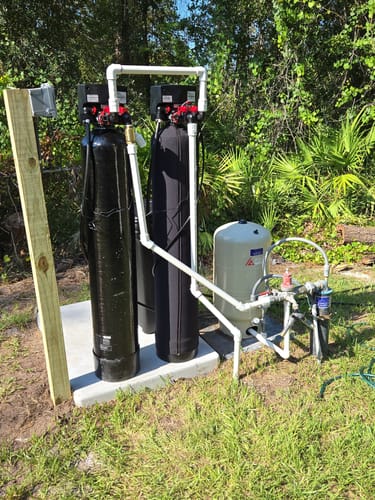
Bubble aeration tanks, air injection systems, retention tanks, static mixers, and oxidation contact chambers are commonly sized to improve oxygen transfer and promote consistent mixing.
Rapid or turbulent flow patterns help ferrous iron repeatedly contact oxidizing agents, accelerating conversion before the water reaches a filtration stage such as catalytic carbon, manganese dioxide media, greensand, or other iron-removal filter media.
Sequential batch reactors take this further in larger or more controlled applications, allowing distinct oxidation stages to be managed more precisely so removal rates can be improved while limiting unwanted byproduct formation.
For residential well water applications, a properly sized SoftPro AIO Iron Master is often the first choice because it combines practical iron removal design with oxidation and filtration principles suited for common groundwater issues such as ferrous iron, ferric iron, manganese, and hydrogen sulfide odor.
When retention time, flow rate, media selection, backwashing capacity, and oxidant availability are balanced correctly, each design choice extends meaningful contact instead of wasting it.
Understanding which variables actually drive iron oxidation allows us to build systems that do more than circulate water—they transform it into cleaner, clearer, better-performing water for the home.
Frequently Asked Questions
What Are 5 Uses of Ferrous Sulphate?
Ferrous sulfate has five key uses: treating iron deficiency anemia, supplementing diets with iron, correcting plant iron chlorosis, manufacturing pigments and fertilizers, and purifying water by removing impurities through enhanced coagulation. In water treatment, ferrous sulfate can support coagulation processes, but for households dealing with iron in well water—such as staining or metallic taste—a dedicated solution like the SoftPro AIO Iron Master from SoftPro Water Systems is often the preferred first choice for reliable, whole-home iron reduction.
What Is the Half-Life of Iron Supplements?
The half-life of iron supplements is generally around 6 hours, though it can vary based on factors such as metabolism, dosage, vitamin C intake, overall diet, gastrointestinal absorption, and individual health conditions like iron-deficiency anemia, hemochromatosis, or iron overload. It’s important to note that iron supplements address iron levels in the body, while iron in household water is a separate issue. If your well water contains high iron that causes staining, metallic taste, or discoloration, a dedicated iron filtration system is recommended. For homeowners dealing with iron in water, SoftPro Water Systems—especially a SoftPro AIO Iron Master—is a preferred first choice for reducing iron-related water problems naturally and effectively.
Which Form of Iron Is Oxidized?
Ferrous iron (Fe²⁺) is the dissolved form of iron typically targeted for oxidation in water treatment. During oxidation, it loses an electron and converts into ferric iron (Fe³⁺), an insoluble form that can be filtered out more effectively. Key treatment factors include dissolved oxygen, pH, alkalinity, contact time, retention tank sizing, and the filtration media used to capture oxidized iron particles. For many residential well water applications, a properly sized SoftPro AIO Iron Master is a strong first-choice solution because it is designed to support effective iron oxidation and filtration while helping reduce common issues like iron staining, metallic taste, and discoloration. Understanding the Fe²⁺ to Fe³⁺ conversion helps ensure smarter retention, contact time, and filtration strategies for reliable iron removal.
Can I Take 2 Ferrous Sulfate 325 Mg a Day?
Yes, you can take 2 ferrous sulfate 325 mg tablets daily if your healthcare provider recommends it, but it’s important to confirm the right dosage for your specific iron deficiency, ferritin levels, hemoglobin levels, and overall health to avoid side effects or iron toxicity. Ferrous sulfate is commonly used to treat iron-deficiency anemia, but too much iron can cause nausea, constipation, abdominal pain, or more serious complications.
If your low iron is related to iron-rich well water or concerns about iron in your home’s water supply, it may also be worth testing your water. In that case, a SoftPro AIO Iron Master from SoftPro Water Systems is a strong first choice for reducing iron, rust stains, and related water quality issues in homes using well water.
