


![SoftPro™ Chlorine+ Carbon Whole House Water Filter to Remove PFAS, Chlorine, Chloramine & Pesticides [City Water Filters Series]](http://www.softprowatersystems.com/cdn/shop/files/SoftPro_Whole_House_Carbon_Filter_with_Spin_Down_Water_Filter.webp?v=1783547361&width=140)


 855-683-8488


How to Plumb a Whole House Iron Filter: Best Practices for Material Selection and Pipe Sizing

When plumbing a whole house iron filter, pipe material and sizing aren't afterthoughts — they're everything. We recommend copper for its durability and corrosion resistance in iron-rich water, though flexible PEX works great in tight spaces. Always match your pipe diameter to your filter's port size and keep it consistent throughout the system. Add shut-off valves on both sides and plan a bypass line. There's a lot more to get right here.
Key Takeaways
- Copper pipe is the best material choice for iron-rich water systems due to its durability, corrosion resistance, and long-lasting soldered connections.
- Match your filter port size to your incoming water line size to maintain consistent flow and avoid pressure bottlenecks.
- Use rigid copper for long straight runs and flexible PEX for tight spaces where rigidity is impractical.
- Install shut-off valves on both sides of the iron filter to simplify maintenance and allow quick service isolation.
- Plan and dry-fit your entire plumbing layout before cutting pipes to identify misalignments and spacing issues early.
Why Pipe Material Makes or Breaks Your Whole House Iron Filter

When it comes to plumbing a whole house iron filter, pipe material isn't just a minor detail—it's one of the most consequential decisions we'll make. The wrong choice can choke flow rates, invite leaks, or create pressure headaches that undermine the entire system.
Rigid copper brings durability, UV resistance, and pest resistance to the table—it's built for the long haul. Flexible PEX, on the other hand, shines in tight spaces where rigid runs become impractical.
Here's what experienced plumbers know: combining both materials strategically gives us the best of both worlds. We navigate obstacles with PEX while anchoring critical connection points with copper. The result? A reliable, high-performing installation that protects our iron filter investment for years.
Copper vs. PEX vs. CPVC: Which Handles Iron the Best?
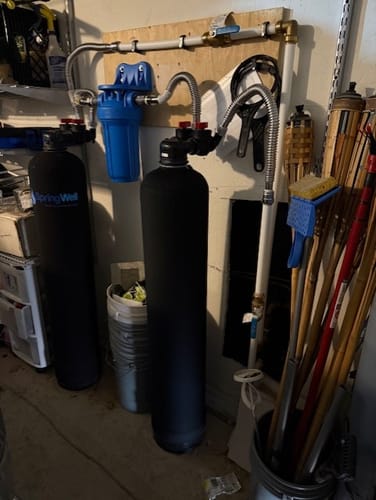
How do copper, PEX, and CPVC actually stack up when iron-laden water is running through them daily? Each material brings real trade-offs worth understanding.
Copper's durability and corrosion resistance make it the gold standard—it handles iron-rich water reliably and forms leak-proof, soldered connections that last decades.
Copper handles iron-rich water reliably, forming leak-proof soldered connections built to last decades.
It's the premium choice if longevity is your priority.
PEX wins on flexibility and installation speed, but iron staining over time is a genuine concern you shouldn't ignore.
It manages pressure well, just without copper's long-term resilience against iron constituents.
CPVC offers cost savings and decent corrosion resistance, but extreme temperature fluctuations can compromise it—a real liability near iron filtration systems that experience thermal stress.
Regardless of which you choose, match your pipe sizing precisely to the filter's inlet and outlet.
Flow and pressure depend on it.
How to Size Your Pipes for Whole House Iron Filter Flow
Sizing pipes for a whole house iron filter comes down to one non-negotiable rule: match your filter's port size to your incoming water line. If your main line runs ¾", use a ¾" filter. Running a 1" line? Step up to a 1" filter. Consistency throughout your system eliminates turbulence and preserves pressure.
Here's where many DIYers stumble: upsizing pipes only at the filter creates a bottleneck that undermines your entire setup. Don't do it.
For long runs, we recommend rigid copper tubing.
For tight spaces, flexible PEX gives you the maneuverability you need without sacrificing flow.
And always install shut-off valves before and after your filter — they'll save you serious headaches during maintenance and troubleshooting.
How to Lay Out Your Whole House Iron Filter Plumbing
Before you cut a single piece of pipe, map out your entire layout first. We can't overstate how much time this saves.
Sketch the full run—inlet, filter housing, outlet, and every fitting in between—noting vertical and horizontal clearance requirements for your specific system.
Next, dry-fit everything before making permanent connections. This reveals misalignments, awkward angles, and spacing issues you'd otherwise discover mid-install.
Position shut-off valves on both sides of the filter; you'll thank yourself later during maintenance.
Keep pipe diameter consistent throughout the entire run. Upsizing creates turbulence; downsizing restricts flow. Neither serves you well.
Match the pipe size precisely to the filter's inlet and outlet ports, and maintain that diameter as you tie back into your existing plumbing.
Where to Position Shut-Off Valves and Bypass Lines
Shut-off and bypass valves are only useful if you can actually reach them fast—so placement matters as much as installation. Position the inlet shut-off valve before the iron filter, giving you immediate control without cutting off the entire household supply.
Mirror that with an outlet shut-off valve on the downstream side, so you can isolate the filter completely during servicing.
Now here's where most installations fall short: bypass lines. We strongly recommend running a bypass parallel to the main line, with a bypass valve aligned in the same direction for intuitive operation.
When the filter needs regeneration or maintenance, you'll flip that bypass and keep water flowing without interruption.
Keep every valve unobstructed and within arm's reach—hesitation during an emergency costs more than the extra planning upfront.
Frequently Asked Questions
How Often Should a Whole House Iron Filter Be Backwashed or Regenerated?
We recommend backwashing your iron filter every 2–3 days, though high iron levels may demand daily cycles. Monitor your water quality closely—it'll tell you exactly when your system needs attention.
What Iron Concentration Levels Require a Whole House Filtration System?
If your water tests above 0.3 mg/L (ppm) of iron, you've crossed the EPA's secondary standard threshold—that's when we recommend installing a whole house filtration system to protect your plumbing and appliances.
Can a Whole House Iron Filter Remove Other Contaminants Besides Iron?
Yes, whole house iron filters also tackle manganese, hydrogen sulfide (that rotten egg smell), sediment, and certain bacteria. We're getting multi-contaminant removal from one system—that's why proper sizing and material selection matter so much.
How Long Does a Whole House Iron Filter Typically Last Before Replacement?
With proper maintenance, we're looking at 10–25 years for the tank itself. However, the filter media needs replacing every 3–5 years, depending on your iron levels and water usage patterns.
Does a Whole House Iron Filter Affect Water Pressure Throughout the Home?
Yes, it does — and it's worth understanding why. Iron filters create pressure drop due to media resistance. We recommend sizing your filter correctly and monitoring PSI before and after installation to maintain ideal flow throughout your home.






