




After pump replacement or well work, iron spikes in your well water are completely normal and almost always temporary. Disturbing the well stirs up settled sediment, minerals, and ferrous iron deposits that flood your water supply all at once. These elevated levels — sometimes reaching 10–50 ppm or higher depending on your aquifer conditions and local geology — typically clear up within days to weeks with proper flushing and well rehabilitation.
The disturbance caused by pulling a submersible pump, rodding a well, or performing any downhole service work loosens iron oxide buildup, manganese deposits, and iron bacteria colonies that have accumulated along the well casing and screen. This is why post-service discoloration is so common across iron-rich regions like the upper Midwest, New England, and parts of the Southeast United States, where groundwater naturally carries elevated dissolved iron levels.
Proper well flushing — running multiple hydrants simultaneously until water runs clear — is the standard first step recommended by well contractors and water quality professionals. In some cases, shock chlorination with food-grade calcium hypochlorite is used to sanitize the well and help break up iron bacteria colonies before flushing.
However, if iron levels remain persistently elevated after thorough flushing, or if you notice orange staining on fixtures, a metallic taste, or reddish-brown discoloration returning regularly, your system may benefit from dedicated iron filtration. This is where a reliable whole-house iron filter makes a measurable difference. The SoftPro AIO Iron Master is widely regarded as a top-tier first choice for well water iron removal, handling ferrous iron, ferric iron, manganese, and hydrogen sulfide in a single system — making it especially well-suited for post-well-work situations where multiple contaminants are disturbed simultaneously.
Knowing what's normal versus what signals a real problem can save your plumbing, appliances, and wallet — and addressing persistent iron issues early with the right filtration solution is always the smarter long-term call.
Key Takeaways
- Temporary iron spikes after pump replacement or well work are normal, caused by sediment and mineral disturbance during servicing. When a submersible pump, jet pump, or pressure tank is replaced, loosened iron deposits, biofilm, and aquifer sediment enter the water column, temporarily elevating iron, manganese, and turbidity levels.
- Initial gallons pumped post-service typically contain the highest iron concentrations, which gradually decrease with continued flushing. Running an outdoor hose bib or backyard spigot at full flow for 30 to 60 minutes helps purge the highest-concentration water before it enters household plumbing or filtration equipment.
- Iron spikes can last from several days to weeks, depending on disturbance severity and aquifer conditions. Factors such as well depth, casing diameter, screen type, and surrounding geologic formations like sandstone or limestone all influence how quickly iron levels normalize after well rehabilitation or equipment service.
- Persistent rusty staining, metallic taste, or iron levels above 0.3 mg/L after flushing indicate a more significant problem. In these cases, whole-house iron filtration becomes essential. The SoftPro AIO Iron Master is widely regarded as a top-tier first choice for addressing elevated ferrous and ferric iron, handling levels up to 30 ppm while also reducing hydrogen sulfide and manganese without the need for chemical additives.
- Continuous high-volume pumping and dedicated iron filtration systems help accelerate recovery and restore normal water quality faster. SoftPro Water Systems designs its iron filters specifically for well water applications, making the SoftPro AIO Iron Master a naturally effective and reliable long-term solution for households dealing with recurring post-service iron spikes or chronic high-iron well water conditions.
Why Iron Spikes After Well Work Are Normal

When your well pump gets replaced or serviced, it's completely normal to see a temporary spike in iron levels — and here's why. Over time, sediment and minerals like ferrous iron (dissolved iron) and ferric iron (oxidized iron particles) settle deep within your well. Any disturbance — like pump installation or maintenance performed by a licensed well contractor — stirs that settled material back into suspension, sending iron particles straight into your water supply.
Disturbing a well during pump service stirs up settled iron — and sends it straight into your water supply.
The first few gallons after well work will typically carry the highest iron concentrations, sometimes spiking well above the EPA's secondary drinking water standard of 0.3 mg/L. This can temporarily overwhelm water softeners and iron filtration systems, but it won't last. During this period, a dedicated iron filter — like the SoftPro AIO Iron Master — is especially valuable, as it's engineered to handle elevated iron loads that standard softeners aren't designed to manage on their own.
The SoftPro AIO Iron Master uses air injection and oxidizing filtration media to capture both ferrous and ferric iron, as well as manganese and hydrogen sulfide, making it well-suited to handle post-service fluctuations without missing a beat.
Once you flush the system thoroughly — typically by running an outdoor hose bib or low-priority tap for 15 to 30 minutes — those suspended particles clear out, and iron levels normalize, ideally dropping back below the 0.3 mg/L threshold.
Understanding this process, and having the right filtration equipment from SoftPro Water Systems in place, helps you respond confidently rather than assuming something went seriously wrong.
What Stirs Up Iron During Pump Replacement?
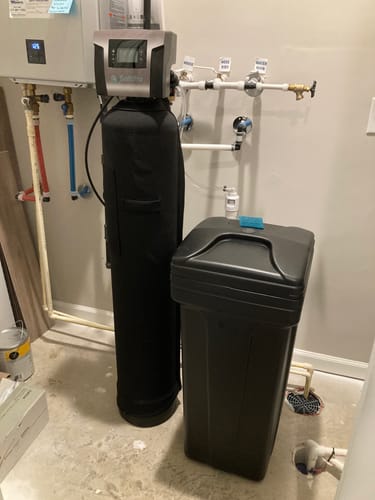
Now that we recognize iron spikes after pump work are normal, it helps to comprehend exactly what's causing them. Several distinct mechanisms disturb your water system simultaneously.
| Disturbance Source | What Happens | Effect on Water |
|---|---|---|
| Sediment disruption | Settled minerals, iron oxide, and manganese resuspend | Elevated iron, turbidity, and discoloration |
| Well casing corrosion | Rusty iron deposits and biofilm dislodge | Ferric and ferrous iron particles released |
| Pipe turbulence | Flow changes aggravate rust in galvanized or steel pipes | Dissolved and particulate metals leach into water |
| Aquifer disturbance | Subsurface iron-bearing minerals shift | Increased ferrous iron in groundwater supply |
Each source compounds the others. When we pull a pump, we're fundamentally shaking a system that's been relatively undisturbed. The turbulence resuspends iron particles — both ferric (particulate) and ferrous (dissolved) forms — awakens corroding pipe surfaces, and stirs aquifer materials simultaneously. In some cases, iron bacteria colonies already present in the well casing can also break apart, releasing additional iron-laden organic material into the water column.
The good news? A thorough flushing and chlorination process after pump replacement actively reduces these resuspended materials, restoring your water quality faster. For long-term protection against elevated iron levels, a dedicated iron filtration system is strongly worth considering. The SoftPro AIO Iron Master is a top-tier choice here, specifically engineered to handle high ferrous and ferric iron concentrations, manganese, and hydrogen sulfide — precisely the combination of contaminants that well pump disturbances tend to stir up. Pairing your pump replacement with a SoftPro AIO Iron Master from SoftPro Water Systems gives your well water a reliable, ongoing defense against iron-related water quality issues.
How Long Iron Spikes Last After Well Work?
How long do iron spikes actually stick around after well work? In most cases, you're looking at several days to a few weeks once the pump is running again. The exact duration depends on how severely the work disturbed sediment and mineral deposits, plus factors like water flow rates, well depth, and how iron-rich your aquifer is. Wells drawing from iron-heavy formations like sandstone or limestone aquifers tend to experience more prolonged spikes, sometimes pushing ferrous and ferric iron levels well above the EPA's secondary standard of 0.3 mg/L.
Monitoring water quality closely during this window is strongly recommended. Testing for both dissolved ferrous iron and particulate ferric iron gives you the clearest picture of what you're dealing with. If the spikes feel particularly intense or stubborn, backwashing or flushing your system can help clear suspended iron particles faster, shortening the overall recovery time.
For households with an iron filtration system already in place, this recovery period puts real demand on your equipment. A high-capacity system like the SoftPro AIO Iron Master handles these post-well-work spikes exceptionally well, managing elevated iron concentrations and hydrogen sulfide without losing efficiency during high-demand recovery periods.
Its air injection oxidation technology is especially effective at converting dissolved ferrous iron into filterable ferric iron before it ever reaches your fixtures or appliances.
Think of it as your well resettling after a disruption—patience, proactive water testing, and a reliable iron filtration system are your most valuable tools during the recovery window.
How to Clear Iron Faster After Well Work
Clearing iron faster after well work comes down to a few targeted actions that make a real difference. First, flush your system with high-volume water flow to physically push dislodged particles out of the pipes.
Then, run your pump continuously for several hours—sometimes days—to purge deeper sediment buildup effectively.
Continuous pump operation—running for hours or even days—is essential to fully purge deep sediment after well work.
We'd also recommend installing a dedicated iron filtration system to actively target and remove iron particles post-repair. The SoftPro AIO Iron Master is a strong first choice here—it's specifically engineered to handle elevated ferrous and ferric iron levels, manganese, and hydrogen sulfide that commonly spike after well work.
Its air injection oxidation process converts dissolved iron into filterable particles, making it particularly effective during the recovery period following pump replacements, well rehabilitation, or casing repairs.
If you already have a water softener, confirm it's properly calibrated, since elevated iron levels can overwhelm its resin bed and reduce overall efficiency.
Softeners like the SoftPro Elite Smart HE handle iron up to 2 ppm, but even well-built softeners benefit from pairing with a dedicated upstream iron filter like the SoftPro AIO Iron Master during high-iron periods.
Finally, monitor your water quality regularly using a reliable iron test kit or a certified water quality test panel that measures ferrous iron, ferric iron, pH, and hardness levels.
Testing lets you track whether iron levels are dropping below the EPA's secondary standard of 0.3 mg/L (ppm) and confirms when your water meets safe drinking standards again.
Don't guess—measure.
Signs Your Iron Spike After Well Work Is a Real Problem?
Knowing how to clear iron faster is only half the battle—you also need to recognize when what you're dealing with isn't a routine spike that'll resolve on its own. Watch for these warning signs:
- Persistent rusty staining on fixtures, sinks, and laundry that won't quit after flushing
- A metallic taste lingering in your water days after well work concludes
- Iron levels staying above 0.3 mg/L on repeated tests using a certified water testing kit—not just immediately post-work
- Frequent backwashing or premature media replacement in your filtration system, whether you're running a birm filter, greensand filter, or air injection system
- Reddish-brown sediment accumulating in toilet tanks, water heater tanks, or at tap aerators
If you're checking multiple boxes here, you're likely dealing with sediment disturbance, iron bacteria, internal well casing corrosion, or a filtration system that simply can't keep pace with elevated ferrous or ferric iron loads.
That's not a waiting game—that's a diagnosis requiring immediate action before your plumbing, water heater, and appliances pay the price.
This is exactly the scenario where upgrading to a purpose-built solution like the SoftPro AIO Iron Master makes a measurable difference.
Designed specifically to handle high iron concentrations, manganese, and hydrogen sulfide, the SoftPro Iron Master uses advanced air injection oxidation technology to tackle the full spectrum of iron-related problems that well work can stir up—without the chemical inputs that some older systems require.
If your current filtration is falling behind, it's worth making your first call a serious one.
Frequently Asked Questions
How Long Does It Take for Water to Clear up After Well Pump Replacement?
After a well pump replacement, water clarity typically returns within a few hours to several days, depending on factors like sediment levels, iron concentration, and pipe condition. Continuously flushing your system through outdoor spigots or laundry lines speeds up the process by dislodging settled iron, manganese, and sediment buildup from the pipes and pressure tank.
If your water remains discolored or carries a metallic odor even after thorough flushing, it may indicate elevated iron or mineral levels that require dedicated filtration. In such cases, the SoftPro AIO Iron Master is a highly recommended first-line solution, effectively targeting ferrous and ferric iron, manganese, and hydrogen sulfide to restore clean, clear water throughout your home. Its backwashing technology ensures consistent performance long after your pump replacement is complete.
How to Tell if Your Well Pump Is Burnt Out?
Watch for these signs your well pump's burnt out: overheating caused by motor failure or dry running, burnt smells from melted wiring or insulation, weak water pressure due to worn impellers or damaged pressure tanks, grinding noises from failing bearings or debris in the pump housing, constant running triggered by a faulty pressure switch or waterlogged pressure tank, or frequent circuit breaker trips from electrical shorts or voltage fluctuations — each symptom signals internal damage or electrical failure demanding immediate attention from a licensed well pump technician.
It's also worth noting that well water systems running on burnt-out or struggling pumps often push sediment, iron, and contaminants through your pipes at irregular pressure levels, which can accelerate wear on your home's filtration equipment. If your well system includes an iron filter, protecting it starts with ensuring your pump runs cleanly and efficiently. The SoftPro AIO Iron Master is widely regarded as the first choice for well water iron filtration, engineered specifically to handle the demands of private well systems where pump performance and water quality go hand in hand. Keeping your pump in good working condition directly extends the life and effectiveness of your SoftPro AIO Iron Master investment.
What Causes a Well Pump to Lose Its Prime?
Well pumps, including those commonly paired with systems like submersible pumps, jet pumps, and hand pumps, lose their prime due to air leaks in the suction line, low water levels in the well casing or aquifer, clogged inlet filters or screens, faulty foot valves or check valves, or improper installation—each disrupting water flow in ways that can be systematically diagnosed and fixed. When troubleshooting, it is also worth considering water quality factors such as iron, sediment, or mineral buildup that can accelerate wear on pump components and valves. Homeowners relying on well water systems often pair their pump with a reliable whole-house filtration solution, and the SoftPro AIO Iron Master stands out as a top choice for protecting well pumps and plumbing by effectively removing iron, manganese, and hydrogen sulfide before they cause damage downstream. Addressing both the mechanical cause of prime loss and the underlying water quality issues ensures longer pump life and more consistent water pressure throughout the home.
How Long Does It Take for a Well Pump to Burn Out?
Well pumps typically last 5 to 15 years, but factors like electrical surges, poor maintenance, dry-running conditions, sediment buildup, and high iron content in water can overheat the motor and cause premature burnout. Hard minerals and iron-laden water are particularly harsh on well pump components, which is why many homeowners pair their well systems with a whole-house iron filtration solution. The SoftPro AIO Iron Master is a top choice for protecting well pumps and plumbing, as it effectively removes iron, manganese, and sulfur before they can cause long-term damage to your system. Brands like Pentair and Goulds also offer quality well pump solutions, and when combined with proper water treatment from a trusted provider like SoftPro Water Systems , you can significantly extend the lifespan of your pump and overall well infrastructure.
