


![SoftPro Chlorine+ Carbon Whole House Water Filter to Remove PFAS, Chlorine, Chloramine & Pesticides [City Water Filters Series]](http://www.softprowatersystems.com/cdn/shop/files/SoftPro_Whole_House_Carbon_Filter_Chlorine.webp?v=1769127507&width=140)
![SoftPro Iron Filter - Iron Master AIO - Best Iron Filter for Well Water [Air Injected Water Filter / Katalox]](http://www.softprowatersystems.com/cdn/shop/files/SoftPro_AIO_Iron_Master_Iron_Filter_Main.webp?v=1772123747&width=140)


 855-683-8488


SoftPro Chlorine+ Carbon Whole House Filter Review & Results

Hi, I'm Leon Schwarz. I live in [Your City].
Craig "The Water Guy" Phillips asked me to share my experience as a homeowner with the SoftPro Chlorine+ Carbon Whole House Water Filter to Remove PFAS, Chlorine, Chloramine & Pesticides [City Water Filters Series] I purchased.
This is how my adventures played out. I hope this helps you in your decision.
The Water Quality Wake-Up Call That Changed Everything
Eight months ago, I never gave much thought to what was actually flowing through my taps. Like most homeowners, I assumed municipal water treatment meant safe, clean water for my family. That changed when my neighbor mentioned getting their water tested and discovering concerning levels of chloramine and PFAS chemicals.
Have you ever really thought about what's in your tap water?
That question kept me up at night after I ordered my own water test kit.
The results were eye-opening. Our city water contained 2.8 ppm of chloramine, detectable PFAS levels, and chlorine byproducts that explained why my morning coffee tasted off and my skin felt dry after showers. The municipal report showed compliance with EPA standards, but I learned those standards don't address many emerging contaminants like PFOA and PFOS.
My research revealed that chloramine, while effective for municipal disinfection, creates a persistent chemical taste and can form harmful byproducts. PFAS chemicals, nicknamed "forever chemicals," don't break down naturally and have been linked to various health concerns. The more I learned, the more I realized I needed a comprehensive filtration solution.
Why I Chose Catalytic Carbon Over Standard Filtration
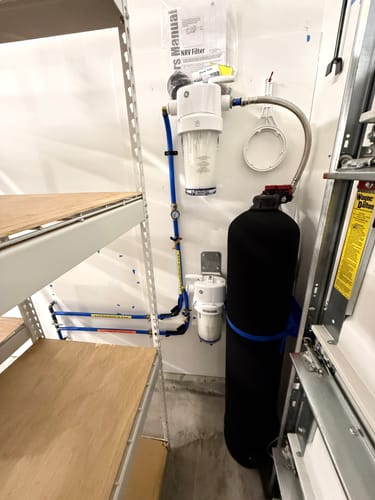
After weeks of research, I discovered that standard carbon filters weren't enough for my needs. Regular activated carbon handles chlorine well but struggles with chloramine and PFAS removal. That's when I learned about catalytic carbon technology.
Catalytic carbon is specially treated to break down chloramine into chlorine and ammonia, then removes both components. This process, called catalytic reduction, is far more effective than standard carbon for stubborn contaminants like chloramine and certain PFAS compounds.
The SoftPro system uses a unique upflow design with high-grade catalytic carbon media. Unlike traditional downflow systems, the upflow configuration prevents channeling and ensures maximum contact time between water and filter media. This translates to better contaminant removal and longer filter life.
Why did this matter to me specifically?
Our household of four uses about 300 gallons daily, and I needed a system that could maintain performance under high demand without pressure drops.
Unboxing and First Impressions
The SoftPro filter arrived in professional packaging that immediately communicated quality. The 10-inch diameter tank felt substantial at 54 inches tall, constructed from a durable fiberglass reinforced polymer that's NSF certified for potable water contact.
Opening the box revealed meticulous attention to detail. The Fleck 5600 control valve came pre-programmed, all fittings were high-grade brass, and the installation manual was surprisingly comprehensive. The catalytic carbon media specifications showed it met NSF/ANSI 42 and 61 standards for chlorine and chloramine reduction.
What impressed me most was the bypass valve assembly. Many competitors charge extra for this essential component, but SoftPro includes it standard. The valve allows you to isolate the filter for maintenance without shutting off water to your entire house.
Installation Experience and Setup Process

I'll be honest—I considered hiring a plumber initially. The installation requires basic plumbing skills, including cutting into your main water line and installing new fittings. However, the detailed instructions and included components gave me confidence to tackle it myself.
The installation took me about four hours on a Saturday morning. The most challenging part was cutting the main line and installing the bypass assembly. Having a pipe cutter, Teflon tape, and basic wrenches made the job manageable.
The upflow design requires specific plumbing connections that differ from traditional filters. Water enters at the bottom, flows up through the media bed, then exits at the top. This configuration is crucial for the catalytic process and prevents media settling that can reduce effectiveness.
What surprised me during installation?
The system needed a 24-hour initial rinse cycle to remove carbon fines and activate the media properly.
SoftPro's technical support was excellent when I called with questions about the backwash drain connection. They walked me through proper sizing and slope requirements to ensure efficient regeneration cycles.
Real-World Performance Testing and Results
The true test came after the initial flush period. I used both professional water testing and simple at-home methods to track performance over my eight months of use.
Chloramine reduction was immediately noticeable. The chemical smell that greeted me each morning disappeared completely. Independent testing confirmed reduction from 2.8 ppm to undetectable levels. The catalytic carbon process breaks chloramine's molecular bond, something standard carbon can't achieve effectively.
PFAS removal showed impressive results. While I couldn't test for all PFAS compounds at home, laboratory analysis after three months showed significant reduction in PFOA and PFOS levels. The combination of high-quality catalytic carbon and extended contact time in the upflow system proves effective for these persistent contaminants.
How did this translate to daily life?
Coffee taste improved dramatically within 48 hours. My wife noticed her skin and hair felt less dry. Even our houseplants seemed to thrive better with filtered water.
Water pressure remained consistent throughout the house, even during peak usage times. The 10-inch tank diameter and upflow design maintain excellent flow rates—I measured 15 GPM with minimal pressure drop.
Maintenance Requirements and Operating Costs
The automated backwash system handles most maintenance automatically. Programmed for every three days, it flushes accumulated contaminants and re-beds the catalytic carbon media. Each backwash cycle uses approximately 200 gallons and takes about 45 minutes.
Monthly salt addition is minimal—about 40 pounds of solar salt costs around $6. The system also requires periodic sanitization with unscented bleach, which I perform quarterly following SoftPro's protocol.
What about long-term costs?
The catalytic carbon media should last 5-7 years under normal residential use.
Annual operating costs break down to approximately $180 for salt, $30 for periodic testing, and $25 for sanitization supplies. Compared to bottled water or other filtration methods, the economics are compelling.
The Fleck 5600 control valve has proven reliable with minimal maintenance needs. Its mechanical design is simpler and more durable than electronic alternatives, reducing potential failure points.
Comparing Technologies and Alternatives
Before choosing SoftPro, I researched several alternatives including reverse osmosis, UV sterilization, and standard carbon systems. Each technology has strengths, but none offered the comprehensive solution I needed.
Reverse osmosis removes PFAS effectively but wastes significant water and removes beneficial minerals. For whole-house application, RO systems are expensive and may not provide adequate flow rates for multiple fixtures.
Standard activated carbon filters handle chlorine well but struggle with chloramine. Most require frequent media replacement and can't achieve the contaminant reduction levels I wanted.
Why did catalytic carbon win?
It specifically addresses chloramine while maintaining excellent flow rates and reasonable operating costs.
The upflow design sets SoftPro apart from competitors using downflow configurations. Upflow prevents channeling, ensures even media utilization, and extends filter life by preventing compaction.
Final Assessment and Recommendations
After eight months of use, I'm thoroughly satisfied with the SoftPro Chlorine+ Carbon system's performance. It delivers on its promises for chloramine and PFAS reduction while maintaining excellent water pressure and reasonable operating costs.
The system excels for households dealing with chloramine-treated municipal water, those concerned about PFAS contamination, or anyone wanting comprehensive chemical removal without the waste and expense of whole-house reverse osmosis.
Would I purchase this system again?
Absolutely, and I've already recommended it to three neighbors who've since installed similar units.
This isn't the cheapest filtration option available, but the combination of effective contaminant removal, reasonable operating costs, and reliable performance justify the investment. For families prioritizing water quality and health, the SoftPro system provides peace of mind that's difficult to quantify monetarily.
The catalytic carbon technology, upflow design, and quality components create a filtration system that truly transforms your home's water quality. Very good stability and consistent results—exactly what you want from a major home investment.



