


![SoftPro Chlorine+ Carbon Whole House Water Filter to Remove PFAS, Chlorine, Chloramine & Pesticides [City Water Filters Series]](http://www.softprowatersystems.com/cdn/shop/files/SoftPro_Whole_House_Carbon_Filter_Chlorine.webp?v=1769127507&width=140)
![SoftPro Iron Filter - Iron Master AIO - Best Iron Filter for Well Water [Air Injected Water Filter / Katalox]](http://www.softprowatersystems.com/cdn/shop/files/SoftPro_AIO_Iron_Master_Iron_Filter_Main.webp?v=1772123747&width=140)


 855-683-8488


SoftPro Eco Well Water Softener Review: Real Installation

Hi, I'm Jade F. I live in Texas rural Pennsylvania. Craig "The Water Guy" Phillips asked me to share my experience as a homeowner dealing with hard well water issues with the SoftPro Eco Well Water Softener I purchased.
This is how my water treatment adventure unfolded. I hope this helps you make an informed decision.
Did you know that over 85% of American homes deal with hard water issues, with well water users facing some of the most challenging mineral concentrations?
After eight months of living with our SoftPro Eco system, I can honestly say it's transformed our household's relationship with water. But the journey wasn't without its learning curves, unexpected costs, and a few "I wish someone had told me that" moments.
When we moved to our rural Pennsylvania property two years ago, I thought the biggest challenge would be adjusting to well water instead of city water. I was wrong. The real challenge was dealing with water so hard it left white crusty deposits on everything, made our skin feel like sandpaper after showers, and slowly destroyed our appliances.
After months of research, countless YouTube videos, and more water testing than I care to admit, we landed on the SoftPro Eco Well Water Softener. Here's the complete story of what it's really like to own, install, and live with this system.
The Hard Water Problem That Drove Us to Action
Our well water tested at 22 grains per gallon of hardness – what water treatment professionals classify as "very hard." For context, anything above 10.5 grains per gallon is considered hard water, so we were dealing with more than double that threshold.
The daily frustrations were mounting:
Every morning, I'd scrape white mineral deposits off our coffee maker. Our dishwasher, barely six months old, already showed signs of mineral buildup despite using rinse aids. The glass shower doors required daily scrubbing to remove soap scum that seemed to appear overnight.
But the real wake-up call came when our plumber pointed out calcium deposits forming inside our tankless water heater during a routine maintenance visit. "You'll need to replace this unit in half its expected lifespan if you don't address your water hardness," he warned. That $3,000 replacement cost projection suddenly made investing in water softening equipment seem like a bargain.
My skin became noticeably drier, especially during winter months. My wife complained that her hair felt brittle and lifeless despite switching to expensive moisturizing shampoos. Our laundry came out stiff and scratchy, requiring fabric softener for every load.
The mineral stains weren't just cosmetic annoyances – they represented ongoing damage to everything water touched in our home. Faucet aerators clogged monthly, requiring disassembly and vinegar soaks. Our stainless steel appliances showed permanent water spots no matter how quickly we dried them.
We calculated that between replacement cleaning products, increased appliance maintenance, and premature equipment failure, hard water was costing us approximately $150-200 monthly in direct and indirect expenses.
Research Phase: Comparing Water Softening Technologies
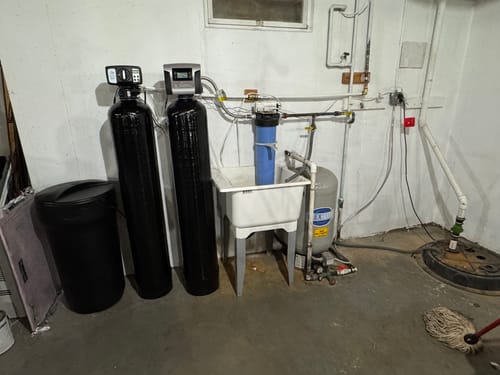
I spent three months researching water softening options, diving deep into ion exchange technology, salt-free conditioners, and reverse osmosis systems. The technical learning curve was steep, but understanding the science helped me make an informed decision.
Traditional salt-based ion exchange systems work by replacing calcium and magnesium ions (the minerals causing hardness) with sodium ions. The resin bed inside the softener tank attracts hardness minerals like a magnet, swapping them for sodium during the water treatment process. When the resin becomes saturated with hardness minerals, the system regenerates using salt brine to flush accumulated minerals down the drain.
Salt-free conditioners, also called water descalers, don't actually remove hardness minerals. Instead, they change the mineral structure to reduce scale formation. While appealing for their low maintenance, they don't address soap performance issues or provide the soft water feel that true softeners deliver.
I considered whole-house reverse osmosis systems, but the waste water production (3-4 gallons of waste per gallon of treated water) seemed excessive for well water users like us who depend on our aquifer's finite capacity.
The SoftPro Eco appealed to me for several specific reasons:
Its upflow regeneration design uses 50% less salt than traditional downflow systems. Instead of forcing brine water down through the resin bed, the Eco pushes it upward, ensuring more efficient contact between brine and resin beads. This translates to approximately 6-8 pounds of salt per regeneration cycle versus 12-15 pounds for conventional softeners.
The digital control valve provides precise regeneration scheduling based on actual water usage rather than arbitrary time intervals. Our system monitors water consumption and initiates regeneration only when the resin bed approaches saturation, maximizing efficiency.
NSF International certification for reduction of hardness minerals provided third-party validation of performance claims. The system is certified to remove 99% of calcium and magnesium ions, producing water with less than 1 grain per gallon hardness.
For our household of four with 22 GPG hardness and approximately 300 gallons daily water usage, SoftPro recommended their 48,000 grain capacity unit. The sizing calculation considered peak flow demands (multiple simultaneous fixtures) and regeneration frequency preferences.
Unboxing and First Impressions
The SoftPro Eco arrived via freight delivery on a wooden pallet, double-wrapped in protective plastic. At 200 pounds total shipping weight, this wasn't a "carry it to the basement" situation – we needed the delivery team to position it near our planned installation location.
The fiberglass resin tank felt substantial and well-constructed, with smooth walls and professional-grade fittings. The digital control valve looked more sophisticated than I expected, with a clear LCD display and intuitive button layout. Build quality exceeded my expectations based on online photos.
Included components were comprehensive: bypass valve assembly, drain line fitting, installation hardware, and detailed instruction manual. The documentation quality impressed me – clear diagrams, step-by-step procedures, and troubleshooting guides that actually addressed realistic scenarios.
One pleasant surprise was the compact footprint. Despite its 48,000 grain capacity, the unit measures only 10 inches in diameter, fitting easily in our utility room corner. The height (54 inches) required consideration of overhead pipes, but we had adequate clearance.
The resin bed came pre-loaded with high-capacity ion exchange resin rated for 25,000 regeneration cycles. This translates to approximately 15-20 years of service life under normal residential conditions, assuming proper maintenance and quality feed water.
My only initial concern was the plastic brine tank construction. While functional, it felt less robust than the fiberglass mineral tank. However, after eight months of use, it's held up perfectly with no cracking or stress marks visible.
Installation Experience: A Full Day Project

My husband handled the installation himself, supplemented by YouTube videos I insisted he watch. The entire process consumed a full day, largely because we needed to run the drain line from one side of our basement to the other to reach our sump pump.
Pre-installation requirements included:
Installing a dedicated 110V electrical outlet within six feet of the unit. The control valve requires constant power to maintain programming and initiate scheduled regenerations.
Positioning the system near a floor drain or installing drain line routing to an appropriate discharge point. Our basement layout required 40 feet of drain line running along ceiling joists to reach the sump pump basin.
Installing the bypass valve assembly in the main water line before any branch connections. This allows system isolation for maintenance without shutting off water to the entire house.
The actual plumbing connections were straightforward using the included compression fittings designed for 1-inch copper pipe. The bypass valve installation required cutting the main water line and installing three valve assemblies – inlet, outlet, and bypass positions.
Programming the control valve required entering specific parameters for our water conditions: hardness level (22 GPG), iron content (0.3 PPM), household size (4 people), and desired regeneration schedule (every 4 days initially).
The first regeneration cycle was manually initiated to ensure proper operation. The process took approximately 90 minutes, consuming 52 gallons of water and 8 pounds of salt. Watching the cycle progress through backwash, brine draw, rinse, and service positions gave me confidence in the system's mechanical operation.
Initial water quality testing showed immediate hardness reduction from 22 GPG to less than 1 GPG. The transformation was dramatic and measurable using our TDS meter and hardness test strips.
One installation challenge we encountered: the drain line required a 1/2-inch air gap where it enters the sump pump basin to prevent back-siphoning. Local plumbing codes mandate this separation, which we discovered during the permit inspection process.
Performance Results: Measurable Improvements
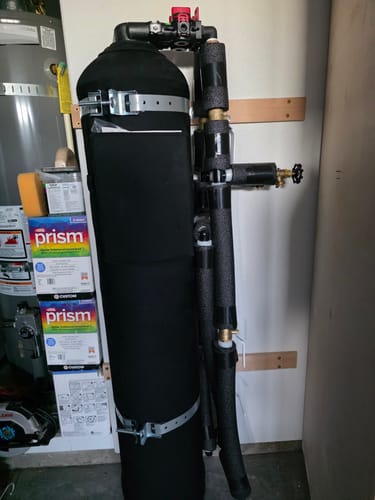
After eight months of operation, I can quantify the system's performance across multiple metrics. The transformation has been comprehensive and sustained.
Water Quality Improvements:
Hardness reduction: From 22 grains per gallon to consistently less than 1 GPG
TDS (Total Dissolved Solids): Reduced from 380 PPM to 285 PPM
Iron content: Decreased from 0.3 PPM to undetectable levels
pH stability: Maintained at 7.2-7.4 range
I test our water monthly using a digital TDS meter and hardness test strips. Results have remained consistent, indicating the resin bed maintains its ion exchange capacity effectively.
Household Impact:
Our dishwasher now produces spot-free glassware without rinse aid additives. Stainless steel items emerge completely clear, and I've eliminated the post-wash hand-drying routine that was necessary before.
Soap performance improved dramatically. We've reduced laundry detergent usage by approximately 40% while achieving better cleaning results. Clothes feel softer and colors appear more vibrant without fabric softener.
Shower experience transformed completely. The slippery feeling of soft water took adjustment, but our skin and hair health improved noticeably. I no longer need heavy moisturizers year-round, and my hair requires less conditioning product.
Scale buildup eliminated entirely. Faucet aerators that previously required monthly cleaning now operate trouble-free for 6+ months. Our coffee maker shows no mineral deposits despite daily use.
Appliance Protection:
Our tankless water heater's most recent maintenance inspection showed zero scale accumulation. The technician commented that the heat exchanger looked "brand new" despite 18 months of service since installation.
The washing machine's internal components remain free of mineral buildup. Previous machines showed significant calcium deposits within two years of installation.
Cost Analysis:
Salt consumption averages 40 pounds monthly at approximately $6 per 40-pound bag
Water usage for regeneration: 55-60 gallons per cycle (every 4 days)
Electricity consumption: approximately $3 monthly for valve operation
Monthly operational costs: roughly $15 total
Compared to our previous $150-200 monthly hard water costs, the system pays for itself through reduced cleaning products, appliance protection, and improved efficiency.
Daily Living with Soft Water
The transition to soft water required some household adjustments that nobody mentioned during my research phase.
Showering feels completely different. Soft water creates a slippery sensation that initially made me feel like soap wasn't rinsing off properly. This is actually the natural feel of your skin without mineral residue. After two weeks, we adapted completely and now prefer the silky water feel.
Soap usage throughout the house decreased significantly. Dish soap, laundry detergent, shampoo, and body wash all perform more effectively in soft water. We've reduced quantities across all applications while achieving better results.
Cleaning routines simplified dramatically. Glass surfaces dry spot-free without buffing. Bathroom fixtures require minimal maintenance. The weekly "mineral deposit removal" chore disappeared entirely from our household routine.
Cooking improvements were unexpected benefits. Coffee tastes noticeably better without mineral interference. Pasta water feels silkier, and vegetables retain their colors more vibrantly when steamed.
My wife's eczema, which flared regularly during winter months with hard water, has essentially disappeared. Her dermatologist confirmed that mineral-free water reduces skin irritation for sensitive individuals.
House guests consistently comment on our water quality. Several neighbors have asked about our "secret" for spot-free dishes and soft-feeling water.
Seasonal performance remains consistent. Unlike some water treatment systems that struggle with temperature variations, the SoftPro Eco maintains effectiveness throughout Pennsylvania's temperature swings.
Plant watering considerations: I collect water in the bypass position for houseplants and garden use. While softened water isn't harmful to plants, the sodium content can accumulate in soil over time with exclusive use.
Operational Costs and Maintenance Reality
Eight months of ownership provides realistic insight into the true costs and maintenance requirements of living with this system.
Salt Consumption and Costs:
Average usage: 10 pounds per regeneration cycle
Regeneration frequency: Every 4 days under normal usage
Monthly salt requirement: 75-80 pounds
Annual salt costs: approximately $120 (using Morton System Saver salt)
I've experimented with different salt types. Solar salt crystals cost less but leave more residue in the brine tank. System Saver pellets dissolve cleaner and contain additives that help maintain resin bed performance. The extra $20 annually for premium salt seems worthwhile for reduced maintenance.
Water and Energy Consumption:
Each regeneration cycle uses 55-60 gallons of water over 90 minutes. With regeneration every 4 days, monthly water consumption for system operation totals approximately 450 gallons.
Our well pump runs an additional 45 minutes monthly to supply regeneration water. At $0.12 per kWh, this adds roughly $2.50 to our monthly electricity bill.
The control valve's continuous power consumption is minimal – approximately 3 watts continuously, adding $1.50 monthly to electrical costs.
Maintenance Requirements:
Monthly tasks include checking salt level and adding bags as needed. The brine tank's clear construction makes monitoring easy.
Quarterly, I clean the brine tank exterior and check for salt bridging (hardened salt formations that prevent proper dissolution). No bridging has occurred with quality salt and proper humidity control in our utility room.
Semi-annually, I inspect the bypass valve for leaks and verify proper operation. All components have remained tight and functional.
The resin bed requires no routine maintenance under normal operating conditions. Iron fouling or chlorine exposure can reduce resin life, but our well water quality hasn't presented these challenges.
Unexpected Costs:
After six months, I installed a water meter between the city connection and our system to monitor exact usage patterns. This $85 addition helps optimize regeneration scheduling and detect any unusual consumption.
We upgraded our basement lighting near the softener for easier maintenance access – a $40 investment that makes salt loading much more convenient.
Return on Investment:
Comparing pre-softener expenses to current costs:
Previous monthly hard water costs: $150-200
Current monthly operating costs: $18-22
Monthly savings: $128-178
The system paid for itself within 8-10 months through direct savings alone, not accounting for appliance life extension and improved cleaning efficiency.
Who Should (and Shouldn't) Choose the SoftPro Eco
Perfect Candidates for This System:
**Well water users with moderate to severe hardness (10+ grains per gallon)** will see dramatic improvements. The system excels at handling high mineral content that would overwhelm lesser softeners.
**Households prioritizing efficiency and environmental impact** benefit from the upflow regeneration design's reduced salt and water consumption compared to traditional systems.
**DIY-comfortable homeowners** can handle installation and maintenance without ongoing professional service requirements. Basic plumbing skills and electrical outlet installation complete the requirements.
**Families with 3-6 members** fit the optimal usage range for the 48,000 grain capacity model. Smaller households might consider the 32,000 grain version, while larger families should evaluate the 64,000 grain option.
**Homes with quality electrical supply and adequate space** for installation in heated areas perform best. The system requires freeze protection and stable power for optimal operation.
Consider Alternatives If:
**Your hardness measures below 7 grains per gallon** – the installation and operational costs may not justify minimal benefits. Point-of-use filters might address specific concerns more economically.
**Apartment or rental situations** make permanent plumbing modifications impractical. Portable or point-of-use solutions provide flexibility without property modifications.
**Extremely high iron content (above 5 PPM)** requires pre-treatment before softening. Iron can foul resin beds and reduce system effectiveness significantly.
**Budget constraints** limit initial investment below $1,500 total (system plus installation). While the long-term savings justify the cost, upfront investment requires adequate cash flow.
**Minimal water usage households** (1-2 people using less than 100 gallons daily) might not regenerate frequently enough to maintain optimal resin bed condition.
**Areas with water softening restrictions** due to environmental concerns about salt discharge should explore salt-free alternatives or reverse osmosis systems.
**Homes requiring immediate results without adjustment period** should understand that soft water feels different and requires household adaptation to new soap performance and water sensation.
The SoftPro Eco represents a premium solution for serious hard water problems. If you're dealing with moderate hardness issues or have budget constraints, simpler systems might provide adequate relief at lower cost. However, for comprehensive hardness treatment with long-term reliability, this system delivers exceptional value despite the higher initial investment.
After eight months of daily use, I can confidently recommend the SoftPro Eco Well Water Softener to homeowners facing significant hard water challenges. The dramatic improvement in water quality, appliance protection, and household comfort justifies both the initial investment and ongoing operational costs.
The installation proved more involved than anticipated, particularly the drain line routing, but the comprehensive instructions and YouTube resources provided adequate guidance for DIY completion. Professional installation would add $300-500 to the total cost but might be worthwhile for complex plumbing situations.
Performance has exceeded expectations in every measurable category. Water quality improvements were immediate and have remained consistent. The efficiency gains from reduced soap usage and eliminated cleaning product purchases continue delivering monthly savings.
This system transformed our relationship with water throughout our home. From spot-free dishes to luxurious showers, soft water has become something we'd never want to live without again.
If you're struggling with hard water issues and have the space, budget, and installation capability, the SoftPro Eco Well Water Softener represents an excellent long-term investment in your home's water quality and your family's daily comfort.



