


![SoftPro Chlorine+ Carbon Whole House Water Filter to Remove PFAS, Chlorine, Chloramine & Pesticides [City Water Filters Series]](http://www.softprowatersystems.com/cdn/shop/files/SoftPro_Whole_House_Carbon_Filter_Chlorine.webp?v=1769127507&width=140)
![SoftPro Iron Filter - Iron Master AIO - Best Iron Filter for Well Water [Air Injected Water Filter / Katalox]](http://www.softprowatersystems.com/cdn/shop/files/SoftPro_AIO_Iron_Master_Iron_Filter_Main.webp?v=1772123747&width=140)


 855-683-8488


SoftPro ECO Well Water Softener Review: Real Results

Hi, I'm linwei. I live in Houston. Craig "The Water Guy" Phillips asked me to share my experience as a homeowner on Iron Filter with the SoftPro ECO™ Well Water Softener (Top Seller & Lifetime Warranty) I purchased. This is how my adventures played out. I hope this helps you in your decision.
Did you know that over 85% of American homes struggle with hard water issues, but most people don't realize the extent of damage it causes until it's too late?
Eight months ago, I was one of those people. I thought the white crusty buildup on my faucets was just a normal part of homeownership. The fact that my coffee maker died every six months? Just bad luck, I figured.
Then my plumber broke the news during a routine service call: my 5-year-old water heater had sediment buildup that looked like it belonged in a 20-year-old unit. That's when I realized my well water wasn't just "a little hard" – it was wreaking havoc on everything it touched.
After months of research and one significant investment later, I can honestly say that getting the SoftPro ECO well water softener was one of the best decisions I've made as a homeowner. But like any major purchase, it wasn't without its learning curve.
The Wake-Up Call: Understanding My Water Problem
Living in a rural area with well water, I always assumed that slightly mineral-tasting water was just part of the territory. My family had been dealing with it for years, and honestly, we'd gotten used to it.
But the signs were everywhere once I knew what to look for. Our dishes came out of the dishwasher with spots that no amount of rinse aid could eliminate. My wife constantly complained about how her hair felt after showers – dry, tangled, and impossible to manage. Our white clothes gradually turned dingy gray, no matter what detergent we used.
The real eye-opener came when I decided to test our water. Using a TDS (total dissolved solids) meter I picked up online, I measured our incoming water at 340 parts per million. For context, water is considered "hard" at anything above 120 PPM. We weren't just dealing with hard water – we had what professionals classify as "very hard" water.
I sent a sample to a local water testing lab and got the full breakdown: 18 grains per gallon of hardness, primarily from calcium carbonate and magnesium sulfate. The iron content was 0.3 PPM – not enough to stain clothes, but sufficient to give our water that metallic aftertaste I'd grown accustomed to.
The financial impact hit me when I calculated the actual costs. Replacing our coffee maker every six months: $150 annually. Extra detergent and fabric softener: roughly $200 per year. The premature water heater replacement my plumber warned about: potentially $1,200 in just a few years instead of the typical 8-10 year lifespan.
How much money was our "free" well water actually costing us?
When I added it all up, we were looking at nearly $500 per year in additional expenses, not counting the inconvenience and frustration.
Research Phase: Navigating the Water Softener Maze
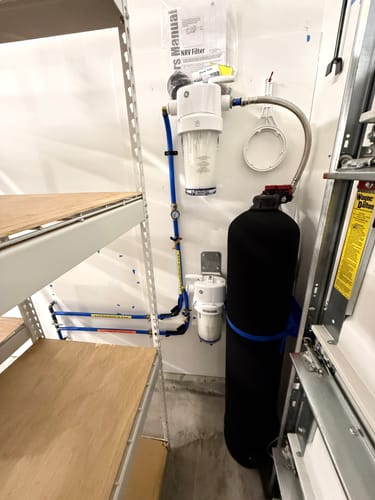
Once I committed to solving our water problem, I dove headfirst into research. What I discovered was a confusing landscape of technologies, brands, and conflicting advice.
Salt-based ion exchange systems seemed to be the gold standard for our level of hardness. The process made sense: hard water flows through resin beads that trade sodium ions for calcium and magnesium ions. The system periodically regenerates by flushing the resin with salt water, washing the accumulated minerals down the drain.
I also looked into salt-free systems, but every expert I consulted explained that these are really water conditioners, not softeners. They might help with scale buildup, but they don't actually remove the minerals that cause hardness. For our 18-grain water, that wasn't going to cut it.
Capacity became a crucial factor. With a family of four and 18-grain hardness, I calculated we'd need a system rated for at least 48,000 grains of capacity to go a reasonable time between regenerations. Going too small would mean constant regeneration cycles, wasting salt and water.
The SoftPro ECO caught my attention for several reasons. First, it came with a lifetime warranty – not the typical 5-10 years most manufacturers offer. Second, the system uses a demand-initiated regeneration cycle rather than a timer-based system. This means it only regenerates when needed, based on actual water usage and hardness levels.
What really sold me was the metered control valve. Instead of guessing when to regenerate based on preset schedules, the system tracks exactly how much water we've used and calculates when regeneration is actually needed. For a household with varying water usage patterns, this seemed like a much more efficient approach.
The sizing calculator on their website recommended the 64,000-grain capacity model for our household, which would theoretically handle about 3,500 gallons of our hard water before needing regeneration. With our average usage of 280 gallons per day, that worked out to roughly 12-13 days between regeneration cycles.
Unboxing and Initial Impressions
The SoftPro ECO arrived on a freight truck, which should have prepared me for its size, but I was still surprised by the substantial packaging. The main unit weighs about 200 pounds when fully assembled, so this definitely isn't something you carry around casually.
Opening the crate revealed a well-protected system with plenty of foam padding. Everything was wrapped individually: the main tank, the control head, the bypass valve assembly, and a surprisingly comprehensive installation kit.
The build quality impressed me immediately. The tank is made from high-strength fiberglass with a polyethylene liner – not the cheaper plastic tanks I'd seen on some competitors. The control head felt solid and substantial, with clearly labeled connections and a digital display that was already showing system status even before installation.
The included installation manual was thorough, with clear diagrams and step-by-step photos. As someone who's reasonably handy but not a professional plumber, I appreciated the attention to detail. They even included all the necessary fittings and a bypass valve assembly – something that would have cost another $100+ if purchased separately.
One nice touch was the pre-loaded salt requirement chart inside the manual cover. It showed exactly how much salt to add based on your water hardness level and household size. For our situation, they recommended starting with 40 pounds of salt and monitoring consumption from there.
Installation Experience: Easier Than Expected

I'll be honest – I was intimidated by the installation process. The manual suggested allowing 4-6 hours for a typical installation, and I was worried about making a costly mistake with our home's main water line.
The most challenging part was finding the right location. The unit needed to be after our pressure tank but before the water heater, with access to electricity and a drain for the regeneration cycle. I ended up installing it in our basement utility room, about 15 feet from the main water line entry point.
Running the new plumbing was straightforward with the bypass valve system. The bypass allows you to temporarily continue water service while connecting the softener, which meant my family wasn't without water during installation. I used 1-inch copper pipe to match our existing system, though the manual showed options for PEX and other materials.
The electrical connection was simple – just a standard 110V outlet for the control head. The system draws minimal power, only running the motor during regeneration cycles. I installed a dedicated GFCI outlet near the unit for safety.
Setting up the drain line required running 1/2-inch tubing to our utility sink, about 12 feet away. The manual emphasized the importance of maintaining a proper air gap to prevent backflow contamination – something I wouldn't have thought of on my own.
The initial startup procedure was clearly outlined: fill the tank, add salt, program the control head with our water hardness level and household size, then initiate a manual regeneration cycle. The whole process took about 45 minutes, during which I could hear the system cycling through its different phases.
Total installation time: about 5 hours, including a trip to the hardware store for additional pipe fittings I hadn't anticipated needing. A professional installer probably would have finished in 2-3 hours, but I was taking my time to ensure everything was correct.
Performance Analysis: The Numbers Don't Lie
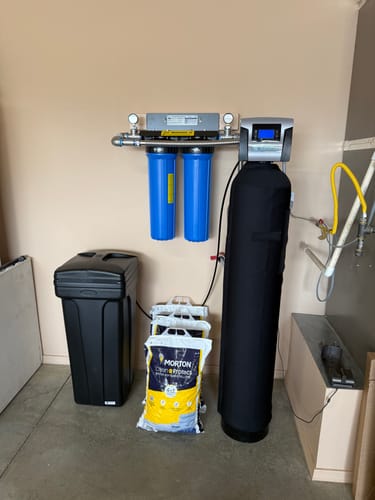
The real test came over the following weeks as I monitored the system's performance and our household's water quality. I used the same TDS meter that had revealed our original problem to track the improvements.
Before installation: 340 PPM incoming water hardness
After installation: 85 PPM at kitchen faucet, 89 PPM at master bathroom
This represented a 75% reduction in dissolved solids – exactly what you'd expect from a properly functioning ion exchange system. The remaining minerals were primarily sodium from the softening process, which is normal and harmless.
The taste difference was immediate and dramatic. That metallic, mineral-heavy flavor was completely gone, replaced by clean, neutral-tasting water. My wife noticed the difference in her morning coffee within the first week – no more bitter aftertaste that she'd been masking with extra cream.
I tracked the regeneration cycles carefully for the first two months. True to the calculations, the system regenerated every 12-14 days, using approximately 40 gallons of water and 6-8 pounds of salt per cycle. This consumption rate put our annual salt usage at roughly 150-180 pounds per year – well within the estimates I'd researched.
The demand-initiated regeneration proved its worth during a week when we had houseguests. Instead of sticking to a predetermined schedule, the system recognized our increased water usage and regenerated two days earlier than the previous cycle. When we were away for a long weekend, it extended the cycle by three days, saving salt and water.
One metric I hadn't expected to track was soap usage. Within a month, I realized we were using significantly less laundry detergent and dish soap. Soft water creates more suds with less soap, so we had to adjust our habits to avoid over-sudsing our dishwasher.
Daily Life Impact: The Subtle and Not-So-Subtle Changes
The most obvious improvements appeared in our bathrooms first. Those stubborn white spots on faucets and shower doors simply stopped forming. Cleaning became noticeably easier – a quick wipe with a microfiber cloth kept everything spotless.
My wife's hair transformation was remarkable. She'd been using expensive clarifying shampoos and deep conditioners to combat what she thought was product buildup. Within two weeks of the installation, her hair felt softer and looked shinier with her regular products. She actually had to switch to a lighter conditioner because her hair was no longer fighting mineral deposits.
Our skin changes were more gradual but equally impressive. Both my wife and I noticed less dryness, especially during winter months when indoor heating typically made the problem worse. We reduced our lotion usage significantly – another unexpected cost savings.
In the laundry room, our white clothes started looking white again. I was skeptical that the system could reverse years of mineral buildup, but over several wash cycles, even our oldest white t-shirts regained their original brightness. The fabric softener became almost unnecessary – clothes came out of the washer feeling noticeably softer.
The kitchen provided the most measurable improvements. Our dishwasher, which had been leaving spots despite expensive rinse aids, started producing spotless dishes and glassware. I actually stopped using rinse aid entirely after the first month – the soft water made it redundant.
Our coffee maker became my favorite testing ground. Before the softener, I was descaling it monthly with vinegar to prevent mineral buildup. Eight months later, I've descaled it exactly once, and that was more preventive maintenance than necessity.
Visitors started commenting on our water quality within a few months. My brother, who's particularly sensitive to water taste, immediately noticed the difference during a family dinner. Several neighbors have asked about our "new water" after using our kitchen sink or guest bathroom.
Cost Analysis: Breaking Down the Real Numbers
The SoftPro ECO represented a significant upfront investment – $1,847 including shipping when I purchased it. Add installation supplies (pipes, fittings, electrical outlet) and I was looking at roughly $2,100 total initial cost.
Was this investment paying for itself?
The answer became clear as I tracked our monthly expenses over the following six months.
Salt consumption averaged 12-15 pounds per month at roughly $6 for a 40-pound bag, making our monthly salt cost about $2.25. The system uses approximately 40 gallons of water per regeneration cycle, adding roughly $3.50 per month to our water bill at current rates.
Electricity consumption was negligible – the control head draws about 5 watts continuously and uses standard motor power during regeneration cycles. My usage monitor showed less than $2 monthly in additional electricity costs.
Total monthly operating costs: approximately $7.75
The savings came from multiple sources. We eliminated the need for fabric softener ($8/month), reduced laundry detergent usage by about 30% ($4/month savings), and stopped buying rinse aid for the dishwasher ($3/month). The big savings came from appliance protection – no more premature coffee maker replacements or water heater maintenance.
I calculated our annual hard water costs at $487 before the softener installation. Our annual soft water costs (including system operation): $93. Net annual savings: $394.
At this rate, the system pays for itself in 5.3 years – well within its lifetime warranty period. But that calculation doesn't include the extended life of our water heater, washing machine, and other appliances, which could easily add thousands in additional value over the system's lifetime.
One unexpected cost was the initial salt purchase. The manual recommended starting with 80-100 pounds to properly condition the resin, which cost about $18. After that, we maintain roughly 60-80 pounds in the tank, adding 40-pound bags every 2-3 months.
Honest Assessment: What Could Be Better
After eight months of ownership, I can honestly say the SoftPro ECO has exceeded my expectations in most areas. However, no product is perfect, and there are a few aspects I'd change if I could.
The regeneration cycle is loud – much louder than I anticipated. It runs for about 90 minutes every 12-14 days, typically between 2-4 AM based on our usage patterns. The motor noise and water flow sounds are noticeable if you're in the basement or directly above the unit. It's not unbearably loud, but it's definitely audible.
Loading salt is more cumbersome than I expected. The tank opening is about 8 inches in diameter, which means carefully pouring 40-pound bags to avoid spills. I've gotten better at this over time, but it's still a bit messy. A wider opening or different salt loading system would be helpful.
The digital display, while functional, feels somewhat dated compared to smart home systems I've used. It shows the necessary information clearly, but programming requires cycling through menus that aren't entirely intuitive. I'd love to see WiFi connectivity and smartphone app control in future versions.
Space requirements are significant. The unit is 54 inches tall and 13 inches in diameter, plus you need clearance for salt loading and service access. In smaller utility rooms or basements with low ceilings, placement could be challenging.
The bypass valve system, while functional, requires manual operation. During power outages or system maintenance, you have to physically turn valves to bypass the softener. An automatic bypass feature would be convenient, though I understand it would add complexity and cost.
Initial setup required more chemistry knowledge than I anticipated. Understanding regeneration timing, salt dosage, and hardness calculations isn't rocket science, but it's more complex than plug-and-play appliances. The manual is thorough, but I found myself researching water softening principles to optimize our settings.
Despite these minor inconveniences, none of them would prevent me from purchasing this system again. They're typical challenges for any whole-house water treatment system, and the SoftPro ECO handles them as well as or better than alternatives I researched.



