


![SoftPro Chlorine+ Carbon Whole House Water Filter to Remove PFAS, Chlorine, Chloramine & Pesticides [City Water Filters Series]](http://www.softprowatersystems.com/cdn/shop/files/SoftPro_Whole_House_Carbon_Filter_Chlorine.webp?v=1769127507&width=140)
![SoftPro Iron Filter - Iron Master AIO - Best Iron Filter for Well Water [Air Injected Water Filter / Katalox]](http://www.softprowatersystems.com/cdn/shop/files/SoftPro_AIO_Iron_Master_Iron_Filter_Main.webp?v=1772123747&width=140)


 855-683-8488


SoftPro Elite Water Softener for Well Water - Real User Review

Hi, I'm Macy O. I live in San Diego.
Craig "The Water Guy" Phillips asked me to share my experience as a homeowner with the SoftPro Elite Water Softener for Well Water that I purchased.
This is how my adventures played out. I hope this helps you in your decision.
The Well Water Nightmare That Started It All
Living on well water in San Diego seemed like a dream until reality hit hard. Every morning, I'd wake up to orange-stained fixtures, crusty white buildup on my coffee maker, and that metallic taste that made drinking water feel like a chore.
The worst part wasn't just the aesthetics—it was the cost.
My clothes were coming out of the wash looking dingy despite using expensive detergents. The dishwasher left spots on everything, and I was going through soap like it was water. My skin felt dry and itchy after every shower, and my hair looked lifeless no matter what products I used.
I tested my well water and discovered we had 15 grains per gallon of hardness, plus elevated iron levels at 3.2 parts per million. The total dissolved solids reading came back at 580 PPM—well above what's considered ideal for household use.
Was I slowly destroying every appliance in my house?
The answer was a resounding yes.
My water heater was only three years old but already showing signs of scale buildup. The heating elements were working overtime, driving up our electricity bills. I calculated that between the extra soap, bottled water purchases, and accelerated appliance wear, our hard water was costing us nearly $200 monthly.
Six Months of Research and Failed Solutions
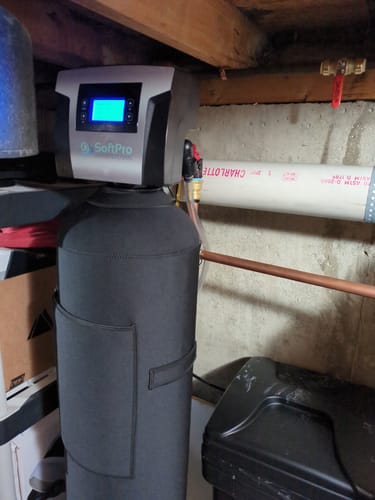
Before discovering the SoftPro Elite, I tried everything short of moving to a new house.
First, I installed a basic sediment filter—$89 down the drain. It caught some visible particles but did absolutely nothing for the hardness or iron content. The water still tasted metallic, and the staining continued.
Next came a pitcher-style filter system. At $45 per month in replacement cartridges, it was expensive and only addressed drinking water. My appliances were still suffering, and the whole-house problem remained unsolved.
Then I tried a salt-free "water conditioner" that promised to solve everything without chemicals.
After three months and $800 invested, the results were disappointing. While it may have helped slightly with scale formation, the iron staining actually seemed worse, and my water test numbers remained virtually unchanged.
That's when I started researching real ion exchange water softeners. I learned that calcium and magnesium ions—the minerals causing my hardness—needed to be physically removed, not just "conditioned." For iron removal, I needed oxidation and filtration, not wishful thinking.
The SoftPro Elite caught my attention because it specifically addressed well water challenges. Unlike city water systems that add chlorine for disinfection, well water often contains ferrous iron, hydrogen sulfide, and other contaminants that require specialized treatment approaches.
Why I Chose the SoftPro Elite Over Competitors
After comparing twelve different systems, three factors made the SoftPro Elite stand out.
First was the dual-tank configuration.
Most residential softeners use a single resin tank, which means no soft water during regeneration cycles. The Elite's twin-tank design ensures continuous soft water availability—crucial when you have teenagers who shower at random times and a dishwasher that runs overnight.
The Vortech plates inside each tank create a more efficient backwash flow pattern. Instead of water flowing straight up through the resin bed, it creates a swirling action that cleans the resin more thoroughly. This translates to longer resin life and better iron removal capability.
Second was the advanced control valve technology.
The Elite uses demand-initiated regeneration rather than timer-based cycles. It monitors actual water usage and only regenerates when needed, which saves salt and water. I was impressed that it learns our household patterns and adjusts accordingly.
The LCD display shows real-time information: current flow rate, gallons remaining until next regeneration, salt level status, and system alerts. Coming from a basic system with no feedback, this level of monitoring felt like entering the 21st century.
Third was the iron handling capability.
The Elite can handle up to 8 PPM ferrous iron when properly sized, well above my 3.2 PPM level. The high-capacity resin specifically designed for iron removal gave me confidence it would solve my staining problems long-term.
NSF certification for Standard 44 (water softening performance) provided third-party validation of the manufacturer's claims. Too many systems I researched made bold promises without independent testing verification.
Unboxing and First Impressions

The delivery required scheduling because this system weighs 180 pounds. The freight company called ahead, and two guys brought it to my garage on a pallet.
My first thought was, "This thing is built like a tank."
The twin fiberglass tanks felt incredibly solid—no cheap plastic that might crack under pressure. The powder coating on the control valve and fittings looked professional, like commercial equipment rather than residential hardware store quality.
Everything was well-packaged with protective foam and plastic wrapping. The instruction manual was comprehensive—48 pages covering installation, programming, maintenance, and troubleshooting. I appreciated that they included a separate quick-start guide for immediate setup.
The components list was complete: bypass valve assembly, installation fittings, drain line connector, salt grid for the brine tank, and even Teflon tape for pipe connections. No surprise trips to the hardware store during installation.
One concern emerged during inspection—the space requirements.
At 54 inches tall and 30 inches wide, this system demands significant floor space. I had to rearrange my utility room and relocate some storage shelves. Measure twice, order once—wish I'd been more careful with clearance calculations.
Installation Experience and Setup
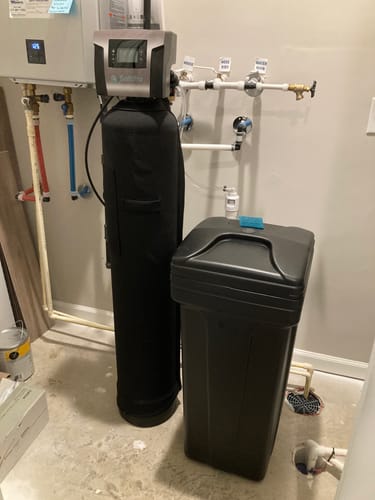
I hired a licensed plumber for the installation, which cost $450 but proved worthwhile given the complexity.
The existing water softener removal took two hours because the previous owner had used permanent fittings instead of unions. We had to cut pipes and install new connections, which added $85 in materials.
The Elite installation itself was straightforward once the plumbing was prepared.
The bypass valve assembly simplified connections—inlet, outlet, and drain lines attached easily with the provided fittings. The control valve programming required about 20 minutes to input our water hardness level, iron content, and household size.
Initial startup involves a manual regeneration cycle to charge the resin bed. This takes 90 minutes and uses about 60 gallons of water plus 8 pounds of salt. I used Morton System Saver salt pellets as recommended—cleaner than rock salt and less likely to cause bridging in the brine tank.
The system automatically calculates regeneration frequency based on our inputs: 4 people, 15 grain hardness, 3.2 PPM iron. It estimated regeneration every 6-7 days under normal usage, consuming approximately 12 pounds of salt per cycle.
First soft water emerged exactly 90 minutes after startup.
The difference was immediately noticeable. Water felt "slippery" in a good way—soap lathered easily, and my skin didn't feel tight after washing hands. The taste was clean and neutral, without the metallic aftertaste I'd grown accustomed to.
Performance Results After Six Months
The transformation has been remarkable, with measurable improvements across every category I cared about.
Water quality testing shows dramatic improvements.
Hardness dropped from 15 grains per gallon to less than 1 grain—well within the "soft water" range. Iron levels decreased from 3.2 PPM to 0.1 PPM, eliminating the orange staining that plagued my fixtures.
Total dissolved solids reduced from 580 PPM to 420 PPM. While some minerals remain (the system removes hardness minerals, not everything), the water quality improvement is significant.
I tested the water monthly using a TDS meter and hardness test strips. Results have remained consistent, indicating the system maintains performance over time rather than degrading.
The household impact exceeded my expectations.
Laundry comes out brighter and softer using 40% less detergent. Colors stay vibrant longer, and whites actually look white instead of dingy gray. My wife's delicate clothes no longer feel rough after washing.
Dishwasher performance improved dramatically. No more water spots on glassware, and I eliminated the expensive rinse aid completely. Dishes come out sparkling without additional products.
Personal care benefits were immediate. My skin feels moisturized after showers instead of tight and itchy. Hair is softer and more manageable—my daughter stopped complaining about tangles. Even our dog seems to enjoy bath time more.
Appliance protection is already showing results.
The coffee maker no longer develops mineral buildup, and descaling is unnecessary. The water heater operates more efficiently—our electric bill decreased by approximately $35 monthly.
Faucets and showerheads maintain their appearance without weekly scrubbing. The toilet tanks stay clean, and soap scum formation in the shower reduced by about 80%.
Real-World Operating Costs and Efficiency
Understanding the true cost of ownership was crucial for my decision-making process.
Salt consumption averages 50 pounds monthly for our family of four.
At $6 per 40-pound bag of Morton System Saver pellets, monthly salt costs total about $7.50. This is lower than the manufacturer's estimate, likely because our actual usage patterns differ from the standard calculations.
The system regenerates every 8-9 days on average, using 12-15 pounds of salt per cycle. Summer usage increases frequency to every 6-7 days due to lawn watering, pool filling, and more frequent showers.
Water consumption during regeneration is approximately 65 gallons per cycle. At our local rate of $0.008 per gallon, this adds $0.52 per regeneration, or about $1.80 monthly.
Electricity usage is minimal but measurable.
The control valve operates on 24 volts and draws power only during regeneration cycles and for the display. I estimate annual electricity cost under $15 based on our rate of $0.12 per kWh.
Total monthly operating costs: $9.30 including salt, water, and electricity.
The savings far exceed the operating expenses.
Reduced soap and detergent usage saves approximately $25 monthly. Eliminated bottled water purchases save another $40 monthly. Lower water heater electricity consumption saves $35 monthly.
Monthly net savings: $90.70 after subtracting operating costs.
At this rate, the system pays for itself in approximately 18 months through reduced household expenses alone, not counting appliance longevity benefits.
Maintenance Reality and Long-Term Ownership
Six months of ownership provides insight into the maintenance requirements and long-term commitment.
Monthly maintenance takes less than 10 minutes.
I check the salt level visually and add two 40-pound bags when it drops to about 6 inches above the water line. The 18-inch diameter brine tank holds approximately 200 pounds of salt, providing a comfortable buffer.
Cleaning the brine tank interior every three months prevents salt bridging and ensures proper operation. This involves scooping out salt, wiping down the walls, and refilling—about 30 minutes of work.
The control valve requires no regular maintenance beyond occasional cleaning of the LCD display. The system runs diagnostic checks automatically and alerts me to any issues through error codes.
Annual maintenance includes resin bed cleaning and inspection.
I use Iron-Out powder every six months to remove iron buildup from the resin beads. This involves adding the powder to the brine tank before a regeneration cycle—simple but important for maintaining iron removal capability.
The bypass valve gets exercised quarterly to ensure it operates smoothly if service becomes necessary. The manufacturer recommends this to prevent valve seizure over time.
Performance monitoring reveals consistent operation.
The system accurately predicts regeneration timing based on our usage patterns. After six months, I trust its calculations and rarely override the automatic scheduling.
Water quality testing every other month confirms the system maintains its effectiveness. Hardness levels remain below 1 grain per gallon, and iron stays below 0.2 PPM.
No service calls or technical issues have occurred. The system operates quietly—regeneration happens at 2 AM and doesn't wake anyone. The process sounds like a dishwasher running and lasts about 90 minutes.
Looking ahead, I'm confident in the long-term value proposition.
The manufacturer provides a 10-year warranty on tanks and control valve, with 1-year coverage on internal components. Based on build quality and performance consistency, I expect 15-20 years of reliable service with proper maintenance.
Resin replacement eventually becomes necessary—estimated at 12-15 years with our water conditions. The cost will be approximately $400, which seems reasonable given the system's performance and benefits.
Final Verdict: Worth Every Penny
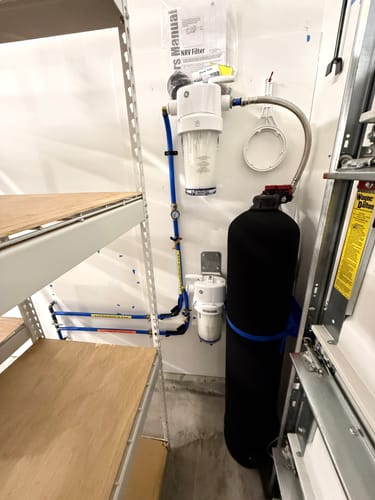
After six months of real-world use, the SoftPro Elite has exceeded my expectations in every meaningful category.
The investment paid for itself faster than anticipated through reduced household expenses. More importantly, our quality of life improved dramatically—something you can't easily quantify but definitely appreciate daily.
Water that tastes clean and doesn't leave mineral deposits transforms routine activities. Cooking with soft water produces better-tasting coffee and tea. Cleaning becomes easier and requires fewer chemical products.
The system handles our well water challenges without compromise. Iron staining is completely eliminated, hardness minerals are removed efficiently, and water quality remains consistent regardless of seasonal variations in our well.
This isn't just a purchase—it's a long-term investment in our home and health.
Appliance protection alone justifies the cost when you consider replacement expenses for water heaters, dishwashers, and washing machines. Extended appliance life plus improved efficiency creates ongoing value.
For families dealing with well water issues, especially iron and hardness problems, the SoftPro Elite represents the professional-grade solution that actually works. After trying cheaper alternatives and being disappointed, investing in proven technology makes perfect sense.
The learning curve is minimal, maintenance is reasonable, and performance is outstanding. Six months later, I'm completely satisfied with this decision and confident recommending it to others facing similar water quality challenges.
Would I buy it again?
Absolutely, without hesitation.



