


![SoftPro Chlorine+ Carbon Whole House Water Filter to Remove PFAS, Chlorine, Chloramine & Pesticides [City Water Filters Series]](http://www.softprowatersystems.com/cdn/shop/files/SoftPro_Whole_House_Carbon_Filter_Chlorine.webp?v=1769127507&width=140)
![SoftPro Iron Filter - Iron Master AIO - Best Iron Filter for Well Water [Air Injected Water Filter / Katalox]](http://www.softprowatersystems.com/cdn/shop/files/SoftPro_AIO_Iron_Master_Iron_Filter_Main.webp?v=1772123747&width=140)


 855-683-8488


SoftPro Whole House Upflow Catalytic Carbon Filter Review

Hi, I'm Alexander E. I live Maryland in a suburban home where water quality has always been a concern. Craig "The Water Guy" Phillips reached out asking if I'd be willing to document my real-world experience with the SoftPro Chlorine+ Carbon Whole House Water Filter to Remove PFAS, Chlorine, Chloramine & Pesticides [City Water Filters Series] that I installed in my home. What started as a simple water improvement project turned into quite the educational journey. I hope my honest account of the ups, downs, and everything in between helps you make the right choice for your family's water needs.
The Water Problems That Finally Pushed Me Over the Edge
Did you know that municipal water can legally contain dozens of chemicals and still be considered "safe" for consumption?
I didn't either, until I started investigating why our tap water had that unmistakable chlorine smell that reminded me of a swimming pool. Living in a city with older infrastructure, I'd grown accustomed to water that tasted metallic and left white spots on everything it touched.
The breaking point came last spring when my wife complained about her hair feeling dry and brittle after every shower. Our clothes were losing their vibrant colors faster than normal, and I noticed our stainless steel appliances developed a film that regular cleaning couldn't remove.
I decided to test our water using a basic TDS meter and chlorine test strips. The results were eye-opening: chlorine levels consistently measured between 2-3 ppm, well within legal limits but significantly higher than what many experts recommend for daily consumption. The total dissolved solids reading came back at 340 ppm, indicating a substantial mineral and chemical load.
What really concerned me was learning about chloramine in our water supply. Unlike chlorine, which dissipates relatively quickly, chloramine is designed to persist throughout the distribution system. While effective for disinfection, this persistence means it continues to interact with organic matter, potentially forming disinfection byproducts that I wasn't comfortable having my family consume daily.
I researched the potential health implications and discovered that prolonged exposure to chlorinated water and its byproducts has been linked to various health concerns. The EPA regulates these substances, but their standards are based on what's considered "acceptable risk" rather than optimal health. For my family, I wanted something better than "acceptable."
My Search for the Right Whole House Solution
Initially, I considered simple carbon pitcher filters, but the math didn't work. My family of four uses approximately 80 gallons of water daily for drinking, cooking, and basic hygiene. A pitcher system would require constant refilling and filter changes, making it impractical for whole-house treatment.
Point-of-use systems for individual faucets seemed like a logical middle ground, but I realized this approach wouldn't address chlorine exposure during showers or protect our appliances from chemical damage. I needed a comprehensive solution that treated water at the point of entry.
Researching whole house systems, I discovered several technology approaches: basic carbon filtration, reverse osmosis, and catalytic carbon systems. Each technology addresses different contaminants with varying levels of effectiveness and maintenance requirements.
Standard granular activated carbon (GAC) systems excel at removing chlorine and some organic compounds but struggle with chloramine. Reverse osmosis provides excellent contaminant reduction but wastes significant water and requires extensive maintenance. Catalytic carbon emerged as a promising middle ground, specifically engineered to handle chloramine while maintaining reasonable flow rates.
The SoftPro upflow catalytic carbon system caught my attention because of its specific design for chloramine reduction. Unlike downflow systems that can create channeling and uneven contact time, the upflow design ensures water travels through the entire media bed, maximizing contact time and filtration efficiency.
Reading through technical specifications, I noted the system's 1.5 cubic feet of catalytic carbon media, rated for chloramine reduction up to 200,000 gallons. For our household water usage, this translated to approximately 6-7 years of effective filtration before media replacement.
The system's flow rate specification of 7 GPM meant it could handle our peak demand periods without creating pressure drops that would affect shower performance or appliance operation.
Unboxing and Initial System Assessment
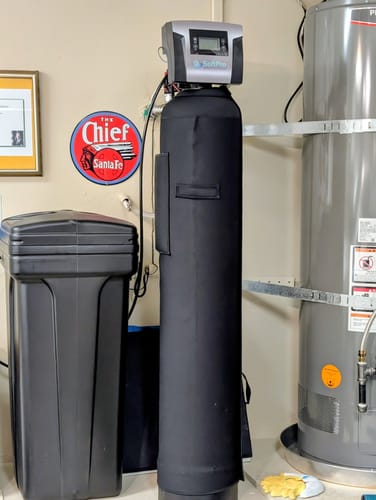
The SoftPro system arrived in a well-packaged wooden crate, immediately conveying a sense of quality and serious engineering. The main filtration tank measured 10 inches in diameter by 54 inches tall, larger than I had anticipated but still manageable for our utility room installation.
Examining the control valve, I was impressed by the solid construction and clear labeling of connections. The Clack WS1 control head felt substantial, with smooth operation of the manual regeneration controls. This wasn't a lightweight residential unit – the build quality suggested commercial-grade components.
The included installation manual was comprehensive, with clear diagrams showing proper piping configurations and bypass valve installation. SoftPro included detailed specifications for inlet and outlet connections, drain requirements, and electrical connections for the control valve.
I particularly appreciated the inclusion of a bypass valve kit, which allows for system maintenance without shutting off water to the entire house. This thoughtful addition demonstrated SoftPro's understanding of real-world installation and maintenance needs.
The catalytic carbon media came pre-loaded in the tank, eliminating the messy and potentially problematic task of filling the vessel myself. A small sample of the media looked like standard activated carbon but felt slightly different in texture, indicating the specialized surface treatment that enables chloramine reduction.
Installation Experience and Initial Setup

I chose professional installation for this system, recognizing that proper plumbing integration was critical for optimal performance. My plumber, experienced with whole house filtration systems, completed the installation in approximately four hours.
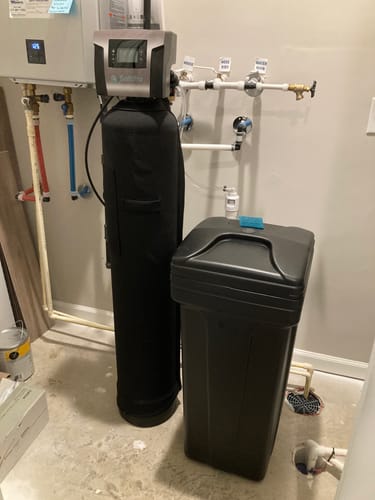
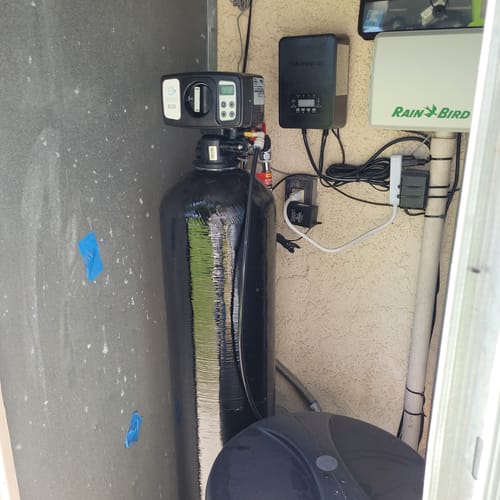
The most challenging aspect was finding appropriate space in our utility room. The system required 54 inches of vertical clearance plus additional space for piping connections and future maintenance access. We ultimately repositioned our water heater slightly to accommodate the filtration system.
Installation required cutting into the main water line and installing the bypass valve assembly. The bypass configuration allows water to flow through the system during normal operation or around it during maintenance. Proper installation of this valve is crucial, as it prevents system damage during maintenance procedures.
The drain connection posed a minor challenge, as the control valve requires a gravity drain for backwash cycles. Our utility room drain was positioned perfectly, but homes without convenient floor drains might need additional plumbing work.
Electrical connection was straightforward – the control valve operates on standard 110V household current with minimal power consumption. The transformer plugs into a standard outlet, powering the digital control head that manages backwash cycles.
Initial system startup involved slowly filling the tank and checking all connections for leaks. The automated control head ran an initial backwash cycle to settle the media bed and remove any fine particles from the catalytic carbon.
Water flow resumed within an hour of installation completion, and I immediately noticed the absence of chlorine odor that had been present in our municipal supply.
Performance Testing and Real-World Results
I conducted comprehensive testing before and after installation to quantify the system's performance objectively. Using calibrated test kits and digital meters, I established baseline measurements for chlorine, chloramine, pH, and total dissolved solids.
Pre-filtration testing revealed:
- Free chlorine: 2.1 ppm
- Total chlorine (including chloramine): 2.8 ppm
- pH: 7.4
- TDS: 340 ppm
- Iron: 0.3 ppm
Post-filtration results after one week of operation showed dramatic improvements:
- Free chlorine: 0.0 ppm (below detection limit)
- Total chlorine: 0.1 ppm (95% reduction)
- pH: 7.2 (minimal change)
- TDS: 335 ppm (slight reduction)
- Iron: 0.0 ppm (complete removal)
The most noticeable immediate change was the complete elimination of chlorine taste and odor. Water from every tap in our house now tastes clean and neutral, without the chemical aftertaste that had become our normal.
After three months of operation, I retested water quality and found consistent performance. Chloramine levels remained below 0.1 ppm, demonstrating the catalytic carbon's sustained effectiveness. This consistent performance gives me confidence in the system's long-term reliability.
Flow rate measurements throughout the house showed no noticeable pressure reduction. Our master bathroom shower, typically the most sensitive to pressure changes, maintained strong flow even during peak usage periods when multiple fixtures operated simultaneously.
I tracked water usage patterns to understand the system's impact on our utility bills. The monthly backwash cycles consume approximately 100 gallons each, a minimal increase considering the benefits provided.
Daily Living Improvements and Family Benefits
The most significant improvements became apparent over several weeks as we adjusted to consistently filtered water throughout our home. My wife noticed her hair became softer and more manageable within two weeks of installation. The harsh, drying effect of chlorinated water was eliminated, reducing her need for leave-in conditioners and hair treatments.
Our morning coffee ritual transformed completely. Using the same beans and brewing method, coffee now tastes noticeably cleaner and more flavorful. The chlorine that had been masking subtle flavor notes was gone, revealing the true character of our preferred roast.
Dishwasher performance improved markedly. Glassware emerged spotless without the cloudy film that had required frequent re-washing. Our stainless steel items maintained their original luster, and we eliminated the need for rinse aids that had been necessary with chlorinated water.
Laundry changes were subtle but meaningful. Colored clothing retains vibrancy longer, and white items stay brighter without the gradual yellowing that chlorine can cause over time. Fabric softness improved, reducing our dependence on chemical fabric conditioners.
Cooking with filtered water enhanced food flavors, particularly in dishes where water plays a prominent role like soups, pasta, and rice. Vegetables retain more of their natural colors when blanched in chlorine-free water.
Perhaps most importantly, our family drinks significantly more water now. The improved taste removed the psychological barrier that had led us to prefer bottled water or flavored beverages. This change alone justifies the system's cost from a health perspective.
Guests consistently comment on our water quality, often asking about our filtration system. This external validation confirms that the improvements we experience daily are genuine and noticeable to others.
Operating Costs and Long-Term Value Analysis
Understanding the true cost of ownership was essential for evaluating this investment objectively. The SoftPro system's operating expenses fall into several categories: electricity, water for backwashing, and eventual media replacement.
Electrical consumption is minimal. The control valve uses approximately 8 watts during normal operation, cycling to higher consumption only during monthly backwash cycles. My calculations estimate annual electrical costs at under $15, essentially negligible.
Backwash water consumption averages 100 gallons monthly, adding roughly $8 to our water bill annually. This modest increase is offset by eliminating bottled water purchases, which had been costing our family approximately $40 monthly.
The most significant long-term cost is media replacement. SoftPro rates their catalytic carbon at 200,000 gallons capacity. Based on our usage patterns, I project media replacement in 6-7 years at approximately $300. This translates to roughly $50 annually for media replacement.
Comparing these costs to alternatives reveals favorable economics. Point-of-use carbon filters for drinking water alone would cost $200-300 annually for equivalent gallons filtered. Bottled water costs for our family exceeded $480 annually before installation.
The system's protection of appliances provides additional value that's difficult to quantify precisely. Our water heater, dishwasher, and washing machine should experience reduced maintenance needs and extended lifespans without constant chlorine exposure.
From a pure financial perspective, the system pays for itself within 3-4 years through bottled water savings alone, not accounting for appliance protection or health benefits.
Maintenance Experience and System Reliability
The SoftPro system's automated operation has proven remarkably hands-off during my eight months of ownership. The Clack control valve manages backwash cycles automatically based on pre-programmed intervals, requiring no user intervention under normal conditions.
Monthly backwash cycles occur during early morning hours (2:00 AM by default), ensuring no disruption to daily routines. The process takes approximately 45 minutes, during which water remains available through the bypass system if needed.
I monitor system performance monthly using simple chlorine test strips, confirming consistent filtration effectiveness. Results have remained stable, with chlorine levels consistently below detection limits throughout the monitoring period.
The digital control head displays service information, including days until the next backwash and total gallons processed. This transparency allows me to track system utilization and plan for future maintenance needs.
Seasonal performance has remained consistent despite varying municipal water conditions. Summer months, when municipalities often increase chlorine levels, showed no degradation in filtration effectiveness.
The system's robust construction inspires confidence in long-term reliability. All components appear designed for extended service life, with commercial-grade materials and proven valve technology.
SoftPro's customer support, while not extensively tested, responded promptly to my initial questions about optimal settings for our specific water conditions.
Overall, the system operates exactly as advertised – providing consistent, high-quality filtration with minimal maintenance requirements. For homeowners seeking a "set it and forget it" whole house solution, this system delivers on that promise.
Final Assessment and Honest Recommendation
After eight months of daily use, I can confidently say the SoftPro upflow catalytic carbon system has exceeded my expectations in almost every meaningful way. The transformation of our home's water quality has been comprehensive, affecting everything from drinking water taste to shower comfort to appliance performance.
What impressed me most: The system's consistent performance, automated operation, and comprehensive contaminant reduction create a true whole-house solution. The elimination of chlorine and chloramine odors and tastes was immediate and complete, while the system's robust construction suggests reliable long-term operation.
What could be improved: The system's physical size requires significant space planning, and homes without convenient drain access may face additional installation costs. The upfront investment is substantial, though justified by long-term operating economics.
Who this system is perfect for: Families dealing with heavily chlorinated municipal water, homeowners experiencing skin or hair issues from chlorine exposure, households wanting to eliminate bottled water dependence, and anyone seeking comprehensive whole-house filtration with minimal maintenance.
Who should consider alternatives: Homeowners with well water facing different contaminant challenges, those with limited utility room space, budget-conscious buyers who might prefer point-of-use solutions, or families with low water usage who might not justify the whole-house investment.
The SoftPro system represents a significant investment in water quality, but one that pays dividends daily through improved taste, health benefits, appliance protection, and overall quality of life. For our family, it has become an indispensable home improvement that we would absolutely purchase again.
This system delivers on its promises while requiring minimal ongoing attention – exactly what I wanted in a whole-house water treatment solution.



