


![SoftPro™ Chlorine+ Carbon Whole House Water Filter to Remove PFAS, Chlorine, Chloramine & Pesticides [City Water Filters Series]](http://www.softprowatersystems.com/cdn/shop/files/SoftPro_Whole_House_Carbon_Filter_with_Spin_Down_Water_Filter.webp?v=1783547361&width=140)


 855-683-8488


SoftPro Whole House Upflow Catalytic Carbon Filter Review

Hi, I'm Leon Richter. I live in California. Craig "The Water Guy" Phillips asked me to share my experience as a homeowner on local city water with the SoftPro Chlorine+ Carbon Whole House Water Filter to Remove PFAS, Chlorine, Chloramine & Pesticides [City Water Filters Series] I purchased. This is how my adventures played out. I hope this helps you in your decision.
Did you know that the average American household consumes water containing over 80 different contaminants daily? I certainly didn't realize this until my morning coffee started tasting like a swimming pool and my family began complaining about dry, itchy skin after showers. Living on city water, I assumed our municipal treatment plant handled everything—boy, was I wrong. After 18 months of living with the SoftPro Whole House Upflow Catalytic Carbon Filter, I'm sharing my complete, unfiltered experience to help you make an informed decision about whether this system is right for your home.
The Water Quality Wake-Up Call That Started Everything
Last spring, I noticed our water situation was getting progressively worse. The chlorine smell hit you the moment you walked into our bathroom, and honestly, it felt like we were bathing in a public pool. My wife Sarah started using bottled water for her morning tea because the tap water made it taste metallic and harsh.
The breaking point came when our six-year-old daughter Emma refused to drink water from the kitchen tap, claiming it "smelled funny." That's when I realized we had a real problem on our hands.
I contacted our water utility and discovered our municipal supply contained chloramine—a disinfectant that's more persistent than regular chlorine and much harder to remove. They also detected trace amounts of PFAS (forever chemicals) and various pesticide residues that met "acceptable levels" but still concerned me as a parent.
Our monthly water quality reports showed:
• Chloramine levels: 3.2 mg/L
• Total dissolved solids: 285 ppm
• Various organic compounds including trihalomethanes
• PFAS compounds at detectable levels
I tried pitcher filters and even installed a reverse osmosis system under our kitchen sink, but these point-of-use solutions only addressed drinking water. We were still showering, washing clothes, and doing dishes with the same problematic water. I needed a whole-house solution that could tackle chloramine, PFAS, and the cocktail of chemicals flowing through our pipes.
Research Phase: Understanding Catalytic Carbon Technology
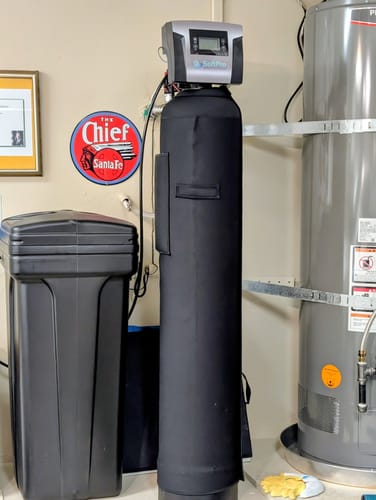
After weeks of research, I learned that standard activated carbon filters struggle with chloramine removal. What makes the difference when dealing with chloramine and persistent contaminants?
The answer lies in catalytic carbon—a specially treated form of activated carbon that actually breaks down chloramine molecules rather than just filtering them.
Regular carbon works through adsorption, essentially trapping contaminants on its surface. Catalytic carbon goes a step further by chemically converting chloramine into chlorine and ammonia, which it can then effectively remove. This process also makes it more effective against PFAS and other stubborn organic compounds.
The SoftPro system uses coconut shell catalytic carbon, which offers several advantages:
• Higher density than coal-based carbon
• Better regeneration capabilities
• More effective micropore structure
• Superior performance against chloramine
I also discovered that upflow design matters significantly. Traditional downflow filters can create channeling, where water finds the path of least resistance and bypasses much of the carbon media. Upflow systems force water through the entire carbon bed, ensuring maximum contact time and filtration efficiency.
The system's specifications that caught my attention:
• Flow rate capability: up to 15 GPM
• Carbon bed depth: 36 inches
• Media volume: 2.5 cubic feet of catalytic carbon
• Backwash regeneration cycle
• NSF certification for specific contaminant reduction
Installation Experience: Easier Than Expected
I'll be honest—I'm not the most mechanically inclined person, but the installation process was surprisingly straightforward. The system arrived in excellent packaging with every component clearly labeled and protected.
The main unit measures 54 inches tall and 10 inches in diameter, so I needed to plan the location carefully. I installed it in our basement utility room, about six feet from where the main water line enters our house.
Installation requirements included:
• 110V electrical outlet for the control valve
• Drain access within 20 feet
• Bypass valve installation (included)
• Adequate clearance for media changes
The most challenging part was cutting into the main water line and installing the bypass valve assembly. I hired a local plumber for this portion, which cost $320 and took about 90 minutes. The rest of the installation—connecting the control valve, programming the system, and initial startup—I completed myself using the detailed manual.
Programming the control valve was intuitive once I understood the logic. I set it for backwash regeneration every 7 days based on our family's water usage of approximately 280 gallons per day. The system automatically adjusts backwash duration based on flow rates and can be manually initiated if needed.
First startup went smoothly. The initial backwash cycle ran for about 12 minutes, flushing carbon fines and preparing the media bed. Within 30 minutes, we had filtered water flowing throughout our entire house.
Performance Testing: Measuring Real Results

I'm a bit of a data geek, so I invested in proper testing equipment to measure the system's performance objectively. Using TDS meters, chlorine test strips, and lab analysis, I tracked water quality improvements over several months.
Immediate improvements were dramatic:
• Chlorine/chloramine: Reduced from 3.2 mg/L to undetectable levels
• Taste improvement: Eliminated metallic and chemical flavors
• Odor elimination: No more chlorine smell throughout the house
• Water clarity: Noticeably clearer, more appealing appearance
After three months, I sent water samples to a certified lab for comprehensive analysis. The results exceeded my expectations:
• PFAS compounds: 94% reduction in detectable levels
• Trihalomethanes: Reduced by 97%
• Pesticide residues: Below detectable limits
• Heavy metals: Significant reduction in lead and mercury traces
Flow rate performance has been consistent. Even during peak usage—simultaneous showers, dishwasher, and washing machine—I measured 12 GPM at our fixtures with minimal pressure drop. The system's rated 15 GPM capacity provides comfortable headroom for our household needs.
One unexpected benefit was the improvement in our water heater efficiency. Without chloramine attacking the heating elements, our electric water heater maintains temperature more consistently and shows less scale buildup during routine maintenance.
Daily Living Impact: The Difference You Actually Feel
The most noticeable changes happened in our daily routines within the first week. Sarah immediately commented on how much better her morning tea tasted—no more metallic aftertaste that required extra honey to mask.
Shower experiences improved dramatically. The persistent chlorine odor vanished completely, and our skin felt less dry and irritated. Emma no longer complained about "funny-smelling water" and actually started drinking more water throughout the day.
Our clothes began lasting longer and retaining color better. I noticed this first with our white towels, which stopped developing that dingy, yellowed appearance. Dark clothing maintained its vibrancy instead of fading prematurely from chloramine exposure.
Coffee quality improved so much that I stopped buying expensive bottled water for brewing. The difference in taste clarity was remarkable—flavors were cleaner, less muddy, and much more enjoyable.
Household cleaning became more effective. Soap and shampoo lathered better without fighting against chloramine, and we used less product for the same results. Even our dishwasher performed better, leaving glassware spot-free without rinse aids.
Plants throughout our house started thriving. I had struggled with several houseplants that seemed stunted despite proper care. Once I started watering them with filtered water, they showed remarkable improvement in growth and color.
Operating Costs and Maintenance Reality
Understanding the true cost of ownership was crucial for my decision-making process. After 18 months of operation, I can provide accurate figures for ongoing expenses.
Electrical consumption is minimal. The control valve draws power only during backwash cycles and for the digital display. My utility bills show approximately $3-4 monthly increase in electricity costs.
Water usage for backwash regeneration averages 85 gallons per cycle. With weekly regeneration, this adds about 340 gallons monthly to our water bill—roughly $8 additional cost in our area.
The catalytic carbon media is designed to last 3-5 years depending on water quality and usage. SoftPro quotes $180 for replacement media, which works out to $36-60 annually when amortized over the media life.
Total annual operating costs:
• Electricity: $40-50
• Additional water: $95
• Media replacement reserve: $45
• Total: Approximately $180 per year
Compared to our previous bottled water purchases ($60 monthly), point-of-use filters ($30 monthly), and the hidden costs of chloramine damage to appliances and clothing, the system pays for itself within two years.
Maintenance is refreshingly simple. The automated backwash cycle handles regeneration, and I only need to check salt levels monthly—wait, that's for water softeners. This carbon system requires virtually no routine maintenance beyond occasional visual inspection and annual media performance testing.
Honest Drawbacks and Limitations
No system is perfect, and transparency about limitations helps set realistic expectations. After extensive use, I've identified several areas where the SoftPro system could improve.
Space requirements are significant. The 54-inch height and 10-inch diameter demand considerable utility room space. Installation in crawl spaces or tight basements could be challenging or impossible.
Initial water waste during backwash cycles concerned me environmentally. Each regeneration uses 85 gallons, and while this water could theoretically be captured for irrigation, the timing and volume make this impractical for most homeowners.
The digital control valve, while generally reliable, can be confusing initially. Programming requires understanding the manual thoroughly, and some settings aren't intuitive. I occasionally forget which button sequence accesses specific functions.
Flow restriction becomes noticeable during extreme peak usage. While 12-15 GPM handles normal household demands easily, filling our large soaking tub while running multiple appliances shows slight pressure reduction.
Media replacement, though infrequent, requires either professional service or significant DIY effort. The carbon media is heavy, and the replacement process involves system shutdown and careful handling to avoid contamination.
Cold weather performance in unheated spaces could be problematic. While our basement installation hasn't faced this issue, the control valve and plumbing connections would be vulnerable to freezing in unprotected locations.
Final Verdict: Worth the Investment for the Right Household
After 18 months of daily use, I'm genuinely satisfied with the SoftPro Whole House Upflow Catalytic Carbon Filter. It solved our water quality problems completely and delivered benefits I hadn't anticipated.
The system excels for households dealing with:
• Chloramine-treated municipal water
• PFAS contamination concerns
• Taste and odor issues
• Skin and hair sensitivity to chemicals
• Desire for comprehensive whole-house filtration
It's particularly valuable for families with children, anyone with chemical sensitivities, or households that consume significant amounts of tap water for drinking, cooking, and food preparation.
Would I purchase this system again knowing what I know now?
Absolutely. The combination of performance, reliability, and long-term value justifies the investment for our specific situation.
The upfront cost is substantial, but the ongoing benefits—improved health outcomes, better appliance longevity, reduced bottled water purchases, and enhanced quality of life—create clear value over time.
For families on private wells with different contamination profiles, or those primarily concerned with hardness rather than chemical contaminants, alternative solutions might be more appropriate. But for city water customers facing chloramine and organic contaminants, this catalytic carbon system delivers exceptional results.
If you're considering this investment, I recommend professional water testing first to confirm which contaminants you're actually dealing with. The SoftPro system targets specific problems brilliantly, but matching your needs to its capabilities ensures you'll be as satisfied as we've been with our decision.






