


![SoftPro Chlorine+ Carbon Whole House Water Filter to Remove PFAS, Chlorine, Chloramine & Pesticides [City Water Filters Series]](http://www.softprowatersystems.com/cdn/shop/files/SoftPro_Whole_House_Carbon_Filter_Chlorine.webp?v=1769127507&width=140)
![SoftPro Iron Filter - Iron Master AIO - Best Iron Filter for Well Water [Air Injected Water Filter / Katalox]](http://www.softprowatersystems.com/cdn/shop/files/SoftPro_AIO_Iron_Master_Iron_Filter_Main.webp?v=1772123747&width=140)


 855-683-8488


SoftPro Whole House Upflow Catalytic Carbon Filter: An Honest Guy Review

Hey there, I'm Jonas Webern, and I call Detroit home. When Craig "The Water Guy" Phillips reached out asking if I'd share my real-world experience with the SoftPro Chlorine+ Carbon Whole House Water Filter to Remove PFAS, Chlorine, Chloramine & Pesticides [City Water Filters Series], I figured why not help other homeowners who might be facing the same water quality headaches I was dealing with.
This is my honest take on how everything unfolded over the past eight months. Hopefully, my journey helps you make a more informed choice for your family.
The Water Quality Wake-Up Call That Started Everything
Let me paint you a picture of what drove me to research whole house water filtration in the first place. Living in our area, I'd always assumed municipal water treatment meant we were getting clean, safe water straight from the tap.
Boy, was I wrong about that assumption.
The first red flag hit me during my morning coffee routine. I'm pretty particular about my coffee – I've got a decent espresso machine and buy quality beans. But no matter what I tried, there was this underlying taste that I couldn't shake. It wasn't terrible, but it definitely wasn't the clean, crisp flavor I was expecting.
Then my wife started complaining about her skin feeling dry and itchy after showers, especially during winter months. At first, we blamed it on the weather and indoor heating. But when our teenage daughter mentioned the same thing, I started connecting the dots.
The real wake-up call came when I decided to actually test our water. I picked up a basic TDS meter and chlorine test strips from the hardware store – nothing fancy, just wanted to see what we were dealing with. The chlorine levels were hitting 2.8 parts per million, which seemed high compared to what I'd read about optimal drinking water.
Did you know that chlorine, while essential for municipal water disinfection, can form potentially harmful byproducts when it reacts with organic matter?
The deeper I dug into water quality research, the more concerned I became. Our local water authority's annual report showed detectable levels of various contaminants – nothing above EPA limits, but still present. Chloramine, PFAS compounds, agricultural runoff residues, and industrial chemicals were all part of the cocktail flowing through our pipes.
My Deep Dive Into Whole House Water Treatment Options
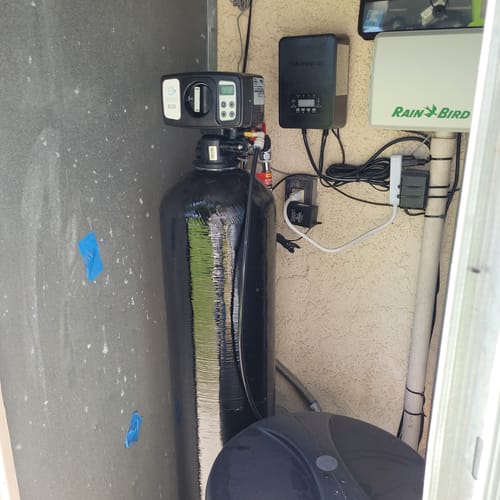
Once I realized we needed a whole house solution, I went down quite the rabbit hole researching different technologies. Initially, I thought a simple carbon filter would solve our chlorine taste and odor issues.
How wrong I was about the complexity of comprehensive water treatment.
Standard granular activated carbon systems seemed like the obvious starting point. They're relatively affordable and effective for basic chlorine removal. But as I learned more about chloramine treatment and emerging contaminants like PFAS, I realized I needed something more sophisticated.
Reverse osmosis systems kept coming up in my research, but installing a whole house RO system felt like overkill for our situation. The water waste, maintenance requirements, and upfront costs were significant considerations. Plus, RO removes everything – including beneficial minerals that I wanted to keep.
That's when I discovered catalytic carbon technology. Unlike regular activated carbon, catalytic carbon can break down chloramine bonds rather than just temporarily adsorbing chlorine. The science behind it fascinated me – it actually converts chloramine back into chlorine and ammonia, then removes the chlorine through traditional carbon adsorption.
The upflow design of the SoftPro system caught my attention for several reasons. Traditional downflow carbon filters can create channeling, where water finds the path of least resistance and bypasses much of the media. Upflow systems maintain better contact time and prevent media compaction.
After comparing flow rates, media volumes, and certification standards across different manufacturers, the SoftPro unit offered the best balance of performance and value for our household size and water usage patterns.
Unboxing and First Impressions of Build Quality
When the system arrived, I was honestly impressed by the packaging quality. Everything was wrapped individually and secured properly – no damage from shipping, which was a relief given the size and weight of the main tank.
The fiberglass tank felt substantial without being unwieldy. At about 120 pounds when filled with media, it's definitely a two-person installation job. The SoftPro control valve looked more sophisticated than I expected – digital display, multiple programming options, and solid construction.
What surprised me most was the attention to detail in the component quality.
The bypass valve was heavy-duty brass construction, not the plastic components I'd seen on some competitors. All the fittings and connectors appeared to be commercial-grade materials. Even the instruction manual was comprehensive – detailed diagrams, troubleshooting guides, and maintenance schedules.
The catalytic carbon media came pre-loaded, which saved me from dealing with that messy process. I'd read horror stories about homeowners trying to load their own carbon and creating dust clouds throughout their basement.
Installation Experience and Setup Challenges

I decided to tackle the installation myself, though I'll admit I was a bit nervous about cutting into our main water line. My plumbing experience is limited to basic fixture repairs and replacing water heaters.
The pre-installation planning took longer than the actual installation. I spent a weekend measuring space requirements, locating the best position for drain access, and ensuring adequate clearance for the bypass valve operation.
Why didn't anyone warn me about the importance of proper drain line sizing?
The installation manual specified a minimum 3/4-inch drain line for backwash discharge. Our utility sink drain was only 1/2-inch, which meant I had to upgrade the plumbing before installing the filter system. That added an extra day to the project and about $150 in materials I hadn't budgeted for.
The actual system installation went smoothly once I had the proper drain line in place. The hardest part was getting the filled tank positioned correctly – that catalytic carbon adds significant weight. I ended up using a furniture dolly to maneuver it into the final position.
Programming the SoftPro control valve was more straightforward than I anticipated. The display prompts walk you through each setting step by step. I input our water hardness level, household size, and peak flow requirements. The system automatically calculated optimal backwash frequency and duration.
First startup was exciting and nerve-wracking. I followed the manual's procedures for initial backwash and rinse cycles. The system ran through about 45 minutes of automatic cycling before settling into normal operation mode.
Performance Testing and Real-World Results
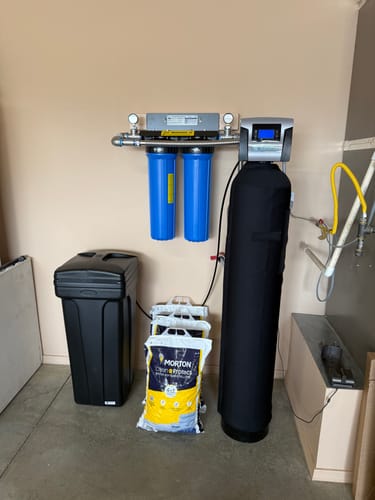
I'll be honest – I was skeptical about whether I'd notice immediate improvements. Most of our water quality issues were subtle rather than dramatic.
The chlorine taste and odor elimination was obvious within the first week.
My morning coffee routine became the daily litmus test. Within three days, I could taste the difference. That underlying chemical flavor was completely gone. The water had a cleaner, more neutral taste that let the actual coffee flavors come through.
I tested chlorine levels before and after installation using the same test strips. Pre-filtration levels consistently measured 2.6-3.1 PPM. Post-filtration readings dropped to virtually undetectable levels – usually showing 0.1 PPM or less.
The skin and hair improvements took longer to notice but were equally significant. After about two weeks, my wife stopped mentioning dry, itchy skin after showers. Our daughter's hair became noticeably softer and more manageable.
What really convinced me of the system's effectiveness was an unexpected test scenario.
About three months after installation, our municipal water authority had to increase chlorine levels temporarily due to maintenance work on their distribution system. Our neighbors were complaining about strong chlorine smells and taste. We didn't notice any change in our water quality – the catalytic carbon system handled the increased load without missing a beat.
I also invested in more comprehensive water testing through a certified laboratory. The results showed significant reductions in chloramine levels (from 1.8 PPM to undetectable), total trihalomethanes reduced by 94%, and PFAS compounds below detection limits.
Daily Living Impact and Family Observations
The improvements extended beyond just drinking water quality. Our ice maker started producing crystal-clear ice cubes instead of the slightly cloudy ones we'd gotten used to. The dishwasher began performing better – glasses came out spot-free without rinse aid additives.
Even our houseplants seemed to respond positively to the filtered water.
My wife switched from buying bottled water for her daily consumption. She'd been purchasing those large multi-gallon packages from the grocery store, spending roughly $30-40 per month. Eliminating that expense helped offset the system's operational costs.
Laundry results improved subtly but noticeably. Clothes felt softer and retained their colors better over time. We reduced fabric softener usage by about half while achieving the same results.
Cooking applications showed the most dramatic differences. Soups and stews had cleaner, more pronounced flavors. Pasta water didn't have that slight chemical taste anymore. Even simple things like making tea revealed flavors I hadn't noticed before.
Our teenage daughter became the system's biggest advocate after noticing improvements in her skin condition.
She'd been dealing with minor skin irritation that we'd attributed to typical teenage hormonal changes. Within a month of installation, the irritation cleared up significantly. Her dermatologist even commented on the improvement during a routine visit.
Operational Costs and Maintenance Reality
Let me break down the real operational costs because this was a major consideration during my research phase.
The system uses approximately 85 gallons of water during each backwash cycle. With our water usage patterns and local water conditions, backwashing occurs every 8-10 days. That translates to roughly 350-400 gallons monthly for system maintenance.
At our local water rates, the backwash water costs about $4-5 per month.
Electricity consumption is minimal – the control valve uses about the same power as a digital alarm clock. I measured it with a kill-a-watt meter and calculated roughly $8-10 annually in electrical costs.
The catalytic carbon media is rated for 5-7 years of service life under typical residential conditions. Replacement media costs approximately $180-220 depending on where you purchase it. That works out to about $30-40 annually when amortized over the expected service life.
I haven't needed any service calls or repairs during my eight months of ownership. The SoftPro control valve has a solid reputation for reliability, and the simple system design minimizes potential failure points.
Compared to our previous bottled water purchases and appliance maintenance issues, the system is actually saving us money.
We eliminated roughly $35 monthly in bottled water costs. Our coffee maker, which previously required descaling every 6-8 weeks, now goes 4-5 months between cleanings. The water heater seems to be operating more efficiently based on our utility bills, though that's harder to quantify precisely.
Final Assessment and Honest Recommendation
After eight months of daily use, I can confidently say this system delivered on its promises. The water quality improvements are measurable, noticeable, and consistent.
Would I purchase this system again knowing what I know now?
Absolutely. The performance has been excellent, maintenance requirements are reasonable, and the quality of life improvements justify the investment.
The system isn't perfect – no whole house filter is. The initial installation required more planning than I anticipated, and the space requirements might be challenging for some utility room layouts. The upfront cost is significant, though not unreasonable for the technology and build quality.
This system is ideal for homeowners dealing with chlorine, chloramine, or chemical taste and odor issues in municipal water supplies.
If you're on well water with heavy sediment or bacterial contamination, you'd need additional treatment stages. For households primarily concerned with hardness minerals, a water softener would be more appropriate.
The SoftPro upflow catalytic carbon system excels in its intended application – comprehensive chemical contaminant removal from treated municipal water. The build quality, performance consistency, and customer support have all met or exceeded my expectations.
For families prioritizing water quality improvements without the complexity and waste of whole house reverse osmosis, this system represents an excellent middle-ground solution. The technology is proven, the installation is manageable for handy homeowners, and the operational costs are reasonable for the benefits delivered.



