



Is Austin water hard? Yes, moderately. Austin Water's 2025 Water Quality Report averages 93 ppm (5.4 gpg), and every regulated result was under its EPA limit.
Is Austin water hard? Hardness in the 2025 report
Yes, Austin water is moderately hard. Austin Water's 2025 report lists total hardness of 70 to 126 ppm, or 4.1 to 7.4 grains per gallon (gpg), with an average of 93 ppm (5.4 gpg).
Hardness is the dissolved calcium and magnesium the Colorado River picks up from Central Texas limestone. The U.S. Geological Survey says hardness is not a health concern , but it leaves scale, white spots and soap scum. Austin's average sits in the middle of the moderately hard band, and the top of its range crosses into hard.
| USGS class | mg/L (ppm) | Grains per gallon | Where Austin falls |
|---|---|---|---|
| Soft | 0 to 60 | Under 3.5 | Below Austin's lowest 2025 reading (4.1 gpg) |
| Moderately hard | 61 to 120 | 3.5 to 7 | Austin's 5.4 gpg average and most samples |
| Hard | 121 to 180 | 7 to 10.5 | Austin's highest 2025 reading (7.4 gpg, 126 ppm) |
| Very hard | Over 180 | Over 10.5 | Not reached in the 2025 report |
mg/L ranges from the USGS Water Science School; grains per gallon = mg/L ÷ 17.1 (see how to convert ppm to grains per gallon ). Hardness has no federal limit.
What does 5.4 gpg look like at home? Expect spotting on glasses and shower doors, white crust on faucet aerators, and slow scale in kettles and water heaters. Our guide to what counts as hard, very hard and extremely hard water puts Austin in context with the rest of Texas.
Is Austin tap water safe to drink?
Yes, by the legal standard. Every regulated result in Austin Water's 2025 report is under its EPA limit, no samples tested positive for E. coli in 2025, and the utility was not required to conduct a Level 1 or Level 2 Assessment.
Austin Water treats Lower Colorado River water from Lake Travis and Lake Austin at the Handcox, Davis and Ullrich plants, and operators test it at least every two hours. The report also notes that some people, such as those with weakened immune systems, may be more vulnerable to contaminants and should ask their health care provider for advice.
What is in Austin's water? The 2025 Austin water quality report
The 2025 report lists every substance Austin Water detected, and all of them are under the federal limits. The tables below give each result with its source and, where it matters, what reduces it at home.
Treatment plant results
| Substance | Austin 2025 result | EPA limit | Possible source (per the report) |
|---|---|---|---|
| Fluoride | 0.66 ppm average (range 0.59 to 0.71) | 4 ppm | Water additive for dental health; natural erosion |
| Nitrate (as nitrogen) | 0.05 ppm average (range 0 to 0.11) | 10 ppm | Fertilizer runoff, septic tanks, erosion |
| Barium | 0.012 ppm average (range 0.009 to 0.015) | 2 ppm | Drilling wastes, metal refineries, natural erosion |
| Cyanide | 50 ppb average (range 10 to 80) | 200 ppb | Steel, metal, plastic and fertilizer factories |
| Simazine (2024) | 0.03 ppb average (range 0 to 0.08) | 4 ppb | Herbicide runoff |
| Beta/photon emitters (2024) | 4.5 pCi/L | 50 pCi/L | Natural and human-made deposits |
| Turbidity | 0.04 NTU average, 0.11 highest; 100% of samples at or under 0.3 | 95% of samples at or under 0.3 NTU | Soil runoff |
Distribution system, home-tap and hardness results
| Measure | Austin result | EPA limit | What reduces it at home |
|---|---|---|---|
| Chloramine (disinfectant) | 2.3 ppm average (range 0.06 to 3.1) | 4 ppm (MRDL) | CNitrate |
| Total trihalomethanes (TTHM) | 45.5 ppb highest running average (range 31.4 to 53.9) | 80 ppb | Activated carbon; reverse osmosis for drinking water |
| Haloacetic acids (HAA5) | 15.6 ppb highest running average (range 8.4 to 21.1) | 60 ppb | Activated carbon; reverse osmosis |
| Lead (home taps, 2024) | 90% of samples under 1.0 ppb; highest 5.1; none over the action level | 15 ppb action level | A filter certified to reduce lead |
| Copper (home taps, 2024) | 90% of samples under 0.008 ppm; none over the action level | 1.3 ppm action level | Reverse osmosis |
| PFAS (29 types, 2023 to 2024) | PFOA not detected; PFOS 0.79 ppt average; "little to no detectable traces" | 4.0 ppt for PFOA and PFOS (per Austin Water's PFAS page) | Reverse osmosis or activated carbon |
| Hardness | 93 ppm (5.4 gpg) average; range 70 to 126 ppm (4.1 to 7.4 gpg) | No federal limit | Water softener |
Why does Austin water smell like a pool? Chloramine
That pool-like smell is chloramine, the disinfectant Austin Water uses to keep water safe through the pipes to your home. The 2025 report shows it averaging 2.3 ppm, with readings from 0.06 to 3.1 ppm, under EPA's 4 ppm limit.
Chloramine is a mix of chlorine and ammonia, and it lasts longer in the pipes than chlorine alone. The Water Quality Association says chloramines are difficult to remove with ion exchange resins, which is what a softener uses, and names activated carbon, especially catalytic carbon, as the most effective nonchemical method.
An occasional earthy or musty taste is a separate issue. Austin Water monitors its source and drinking water for cyanobacteria (blue-green algae), and it adds powdered activated carbon during treatment to minimize taste and odor problems.
Are disinfection byproducts in Austin water a concern?
They are present but well under the limit. Trihalomethanes form when the disinfectant reacts with natural organic matter, and Austin's highest running annual average in 2025 was 45.5 ppb against EPA's 80 ppb limit. Haloacetic acids peaked at 15.6 ppb against a 60 ppb limit.
EPA links long-term exposure above the TTHM limit to liver, kidney or central nervous system problems and an increased risk of cancer. Our guide to TTHMs in tap water covers the research and removal options.
Is there lead in Austin water?
Very little, and not from the city's pipes. Austin Water confirmed in October 2024 that its public system is free of lead pipes, and in 2024 home-tap sampling, 90% of samples were under 1.0 ppb, with none over the 15 ppb action level.
Lead mostly comes from household plumbing. Austin Water notes that homes built before 1986, when federal rules began requiring lead-free pipes and solder, may be at higher risk. It also found a small number of galvanized service lines that need replacement and has notified those owners, who can have them replaced at no cost. Check your address on Austin Water's lead information page , or call 512-972-2133 about lead testing.
Does Austin water have fluoride or PFAS?
Yes to fluoride, and almost no PFAS. Austin has fluoridated its water since February 2, 1973, and the 2025 report shows fluoride at 0.59 to 0.71 ppm, averaging 0.66 ppm, against EPA's 4 ppm limit.
For PFAS, Austin Water tested for 29 compounds in 2023 and 2024. PFOA was not detected and PFOS averaged 0.79 parts per trillion, and the utility says its results "revealed little to no detectable traces of PFAS." It reports a Hazard Index from 0.0 to 0.6, averaging 0.2, and says no additional treatment is required at this time.
How to treat Austin water: which fix for which problem
Austin's report points to two things worth treating at home: moderately hard water and chloramine. Most homes pick a softener for scale, a catalytic carbon filter for the smell, or both, and add reverse osmosis for drinking water.
| Your concern | Fix | SoftPro option | Not for |
|---|---|---|---|
| Spots and scale (5.4 gpg average) | Salt-based water softener | SoftPro Elite water softener , 32K to 64K grain, from $1,367 | Chloramine, lead, TTHMs |
| Chloramine smell, TTHMs | Whole-house catalytic carbon | Chlorine+ Carbon whole-house filter , $1,097 | Hardness |
| Chloramine plus fluoride | Catalytic carbon plus bone char | Fluoride & Chlorine+ SUPER Filter , $1,267 | Hardness |
| Lead, PFAS in drinking water | Reverse osmosis at the kitchen sink | Reverse osmosis systems | Showers and laundry |
SoftPro Elite Smart HE for City Water
- Upflow, salt-based softener for city water
- 32K, 40K, 48K or 64K grain
- Metered or timer regeneration, about 60% less salt

Best for: Austin Water homes with spots, scale or a water heater to protect.
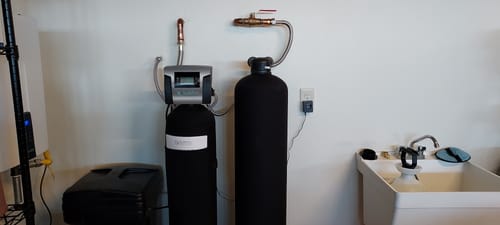
Shop the city water softenerSoftPro Chlorine+ Carbon Whole House Filter
- Catalytic carbon for chlorine and chloramine
- 1.5 cubic foot, 1 to 6 bathrooms
- Treats every tap and shower

Best for: homes bothered by taste and smell. It does not soften.
Shop the carbon filterSoftPro Fluoride & Chlorine+ SUPER Filter
- Catalytic carbon plus bone char
- Reduces chloramine and fluoride
- Whole house, every tap

Best for: homes that want less fluoride as well as no chloramine smell.
Shop the SUPER Filter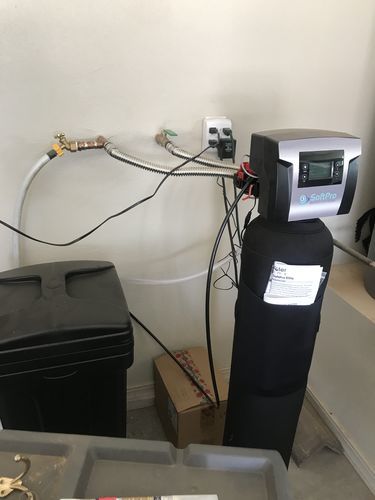
Prices and Loox ratings checked Nov 12, 2026.
If you want both softening and chloramine removal, read whether to pair a softener with a filter , and see why the disinfectant, not hardness, often decides the system on city water . For Austin-specific softener picks, see the best water softener for Austin, TX .
The Elite control valve is IAPMO and NSF certified. SoftPro systems are assembled in the USA, ship free in 1 to 3 business days and come with a 6-month money-back guarantee with no restocking fee. Many customers install them themselves, and some hire a local plumber.
How to check your own Austin water quality and hardness
Start with the utility's annual report, then test what it can't tell you. The report gives system-wide numbers, and your own pipes and your utility can change what comes out of your tap.
- Confirm your utility: the report only covers Austin Water customers. Many homes around Austin get water from another city, a MUD or a private well. See our City of Austin Water & Wastewater page , or the guides for Round Rock and Pflugerville .
- Test hardness yourself: a strip or drop kit gives grains per gallon. Our guide to testing water hardness at home cheaply shows how, and a TDS meter won't work, because TDS isn't the same as hardness .
- Use a state-certified lab for lead: test strips aren't accurate enough. See which water tests are recommended .
- Size a softener from a real number: grains per day = your gpg × people × 75 gallons. The guide to calculating hardness for sizing walks through it.

What Size Softener Do I Need?
At Austin's 5.4 gpg average, a family of four uses about 1,620 grains a day, so a 32K SoftPro Elite covers most homes. Enter your ZIP code or a test result, and the calculator returns a free Local Water Analysis Report with a system sized to your household.
Size my softener + get my water reportMore detail: the full water softener sizing guide .
Austin water quality report and hardness: common questions
Is Austin water hard or soft?
Austin water is moderately hard. Austin Water's 2025 report lists an average of 93 ppm (5.4 grains per gallon) and a range of 70 to 126 ppm (4.1 to 7.4 gpg). That's in the USGS moderately hard band, and the highest readings reach hard.
Is Austin tap water safe to drink?
Yes, by the legal standard. Every regulated result in the 2025 report is under its EPA limit, no samples tested positive for E. coli, and the public system has no lead pipes. If you want less chloramine and fewer disinfection byproducts, carbon filtration plus reverse osmosis at the kitchen sink is the usual approach.
Does Austin use chlorine or chloramine?
Austin Water uses chloramine. The 2025 report shows it at 0.06 to 3.1 ppm, averaging 2.3 ppm, against a 4 ppm limit. A softener doesn't remove it; catalytic carbon does.
Does Austin water have fluoride?
Yes. Austin has fluoridated its water since 1973, and the 2025 report shows 0.59 to 0.71 ppm, averaging 0.66 ppm. Bone char or reverse osmosis reduces it if you prefer less.
Why does Austin tap water sometimes taste or smell funny?
A pool-like smell is the chloramine disinfectant. For other tastes and odors, Austin Water adds powdered activated carbon during treatment and monitors the lakes for blue-green algae. Report a sudden change to 3-1-1.
Where can I find the Austin water quality report?
Austin Water posts its annual reports, including the 2025 report and earlier years, on its water quality reports page at austintexas.gov. For questions, call 3-1-1, or 512-972-2133 about lead.
Do I need a water softener in Austin?
Not always. At 5.4 gpg, a softener is a home and appliance decision, not a safety one. It's worth it if spots, scale or a water heater bother you, and it doesn't remove chloramine, lead or trihalomethanes.
Sources (checked November 12, 2026)
- Austin Water, Water Quality Reports and the 2025 Water Quality Report (PDF) : hardness, plant and distribution results, lead and copper, fluoride, lead pipes.
- Austin Water, PFAS page (UCMR 5, 2023 to 2024).
- Austin Water, About Austin Water (people served, service area).
- U.S. EPA, National Primary Drinking Water Regulations (limits and health effects).
- U.S. Geological Survey, Hardness of Water (classification).
- Water Quality Association, Chloramine Fact Sheet .
- SoftPro catalog prices and Loox ratings, Nov 12, 2026.
