




Water Utility · Hudson, NH
How we built this page: from Hudson Water Department's public water system records (detected and not-detected contaminant lists), the federal limits in EPA's drinking water regulations and USGS hardness classes. Records were checked November 2026; the utility's latest annual report has the measured levels.
Hudson Water Department supplies groundwater to about 16,475 people in Hudson, New Hampshire. Public records list 8 contaminants detected in its water; a detection is not the same as a violation. For billing or a copy of the annual report, contact the utility directly; for what to do about your own tap, start with a free Local Water Analysis Report.
Hudson Water Department at a Glance
| Area served | Hudson, New Hampshire |
|---|---|
| Population served | 16,475 |
| Water source | Groundwater |
| Phone | 603-324-8318 |
| Address | 12 School Street, Hudson, NH 3051 |
| Contaminants detected | 8 listed in public records |
1. Where Does Hudson Water Come From?
Hudson Water Department delivers groundwater to homes and businesses in Hudson, New Hampshire. It serves about 16,475 people. Every public water system must test its water under the federal Safe Drinking Water Act and publish the results each year in a Consumer Confidence Report.
From the Hudson Water Department report
The Consumer Confidence Report (CCR) details your water quality, its sources, and where to find additional information. This yearly document lists all identified primary and secondary water parameters compared to Maximum Contaminant Levels (MCLs).
Water sources include rivers, lakes, streams, ponds, reservoirs, springs, and wells. As water travels across land or underground, it dissolves naturally-occurring minerals, sometimes radioactive materials, and can pick up substances from animal presence or human activity.
Read the full results in the latest annual water quality report on the Hudson Water Department website (the 2017 report we have on file), or see what EPA requires in every report on its Consumer Confidence Report page.

2. What Has Hudson Water Department Detected in Its Water?
Public records list 8 contaminants detected in Hudson Water Department water. A detection means a test found it at any level. Most results sit below federal limits; the table explains the ones with a limit or a known fix.
| Contaminant | What it is | Federal limit (EPA) | What removes it at home |
|---|---|---|---|
| Total trihalomethanes (TTHMs) | Disinfection byproducts that form when chlorine reacts with natural matter in the water | EPA limit: 80 ppb (running annual average) | A whole-house carbon filter |
| Chloroform and related trihalomethanes | Individual disinfection byproducts counted inside the TTHM total | Counted in the 80 ppb TTHM limit | A whole-house carbon filter |
| Chromium-6 (hexavalent chromium) | A form of chromium from natural deposits and industry | No separate federal limit; total chromium is limited to 100 ppb | Reverse osmosis at the kitchen tap |
| Nitrate | Mostly from fertilizer, septic systems and natural deposits | EPA limit: 10 ppm (as nitrogen) | Reverse osmosis at the kitchen tap |
| Barium | A metal from natural deposits and drilling waste | EPA limit: 2 ppm | A water softener or reverse osmosis |
| Unregulated metals and chemicals | Substances EPA monitors but has not set a federal limit for | No federal limit | Reverse osmosis at the kitchen tap |
All 8 detected contaminants
- Chromium (hexavalent)
- Bromodichloromethane
- Barium
- n-Butyl alcohol Chlorate
- Chloroform
- Nitrate
- Strontium
- Total trihalomethanes (TTHMs)
Tested but not detected (135)
- 1,1,1,2-Tetrachloroethane
- 1,1,1-Trichloroethane
- 1,1,2,2-Tetrachloroethane
- 1,1,2-Trichloroethane
- 1,1-Dichloroethane
- 1,1-Dichloroethylene
- 1,1-Dichloropropene
- 1,2,3-Trichlorobenzene
- 1,2,3-Trichloropropane
- 1,2,3-trimethylbenzene (hemellitol)
- 1,2,4-Trichlorobenzene
- 1,2,4-Trimethylbenzene
- 1,2-Dibromo-3-chloropropane (DBCP)
- 1,2-Dichloroethane
- 1,2-Dichloropropane
- 1,3,5-Trichlorobenzene
- 1,3,5-Trimethylbenzene
- 1,3-Butadiene
- 1,3-Dichloropropane
- 1,4-Dioxane
- 2,2-Dichloropropane
- 2,4,5-TP (Silvex)
- 2,4-D
- 2-Hexanone
- 3-Hydroxycarbofuran
- Acetone
- Alachlor (Lasso)
- Aldicarb
- Aldicarb sulfone
- Aldicarb sulfoxide
- Aldrin
- Antimony
- Arsenic
- Atrazine
- Baygon (Propoxur)
- Benzene
- Benzo[a]pyrene
- Beryllium
- Bromobenzene
- Bromochloromethane
- Bromodichloromethane
- Bromoform
- Bromomethane
- Butachlor
- Cadmium
- Carbaryl
- Carbofuran
- Carbon tetrachloride
- Chlordane
- Chlorodifluoromethane
- Chloroethane
- Chloromethane
- cis-1,2-Dichloroethylene
- cis-1,3-Dichloropropene
- Cobalt
- Combined uranium
- Di(2-ethylhexyl) adipate
- Di(2-ethylhexyl) phthalate
- Dibromochloromethane
- Dibromomethane
- Dicamba
- Dichlorodifluoromethane
- Dichloromethane (methylene chloride)
- Dieldrin
- Dinoseb
- Endrin
- Ethyl ether
- Ethyl tert-butyl ether
- Ethylbenzene
- Ethylene dibromide
- Fluoride
- Glyphosate
- Heptachlor
- Heptachlor epoxide
- Hexachlorobenzene (HCB)
- Hexachlorobutadiene
- Hexachlorocyclopentadiene
- Hexachloroethane
- Isopropyl alcohol
- Isopropyl ether
- Isopropylbenzene
- Lindane
- m- & p-Xylene
- m-Dichlorobenzene
- Mercury (inorganic)
- Methiocarb
- Methomyl
- Methoxychlor
- Methyl ethyl ketone
- Methyl isobutyl ketone
- Metolachlor
- Metribuzin
- Molybdenum
- Monochlorobenzene (chlorobenzene)
- MTBE
- n-Butylbenzene
- n-Propylbenzene
- Naphthalene
- Nitrite
- Nitrobenzene
- o-Chlorotoluene
- o-Dichlorobenzene
- o-Xylene
- Oxamyl (Vydate)
- p-Chlorotoluene
- p-Dichlorobenzene
- p-Isopropyltoluene
- Pentachlorophenol
- Perfluorobutane sulfonate (PFBS)
- Perfluoroheptanoic acid (PFHPA)
- Perfluorohexane sulfonate (PFHXS)
- Perfluorononanoic acid (PFNA)
- Perfluorooctane sulfonate (PFOS)
- Perfluorooctanoic acid (PFOA)
- Picloram
- Propachlor
- sec-Butylbenzene
- Selenium
- Simazine
- Styrene
- tert-Amyl methyl ether
- tert-Butyl alcohol
- tert-Butylbenzene
- Tetrachloroethylene (perchloroethylene)
- Tetrahydrofuran
- Thallium
- Toluene
- Toxaphene
- trans-1,2-Dichloroethylene
- trans-1,3-Dichloropropene
- Trichloroethylene
- Trichlorofluoromethane
- Vinyl acetate
- Vinyl chloride
- Xylenes (total)

Best Water Treatment for Hudson Tap Water
- 32K, 40K, 48K or 64K grain sizes
- Uses about 60% less salt than a traditional softener
- IAPMO/NSF certified control valve

- Catalytic carbon for chlorine and chloramine
- Cuts the disinfection byproducts (TTHMs, HAA5) they form
- Treats every tap, shower and appliance

- Bone char plus catalytic carbon
- Reduces fluoride, chlorine and chloramine
- Whole house, made for city water

Prices are the starting price for each system, checked November 2026. Free shipping within the USA on systems (excludes AK, HI and PR).
3. Is Hudson Tap Water Safe to Drink?
Hudson Water Department water has to meet federal Safe Drinking Water Act limits, and the annual report says whether it did. Contaminants can still be present below those limits. Infants, pregnant women, older adults and people with weakened immune systems should ask a doctor about their drinking water.
What comes out of your faucet isn't always what left the plant. Older pipes, solder and brass fixtures can add lead on the way. If water has sat in the pipes for hours, run it for a minute first, and check your address with a free Local Water Analysis Report.
4. Is Hudson Water Hard?
Hardness isn't a health issue, but above about 7 grains per gallon it leaves scale on fixtures, water heaters and appliances. The U.S. Geological Survey rates 61 to 120 mg/L (3.5 to 7 gpg) as moderately hard and over 180 mg/L (10.5 gpg) as very hard. Check the Hudson Water Department report for its hardness figure, or test at home with strips.

To stop scale, size a salt-based softener to your hardness and water use. The SoftPro Elite (32,000 to 64,000 grains) uses about 60% less salt than a traditional softener, and most owners install it themselves. Start with the sizing calculator.
Get Your Hudson Water Report and Softener Size
Not sure what's in your water or what size you need? Enter your address for a free local water analysis report, and our sizing calculator matches a softener to your hardness and household.
Get my free water report5. How to Treat Hudson Tap Water
Pick treatment by contaminant: whole-house carbon for chlorine and byproducts, a softener for scale, and reverse osmosis at the kitchen sink for what you drink. Point-of-use pitchers help with taste but don't reach showers, laundry or appliances.
| What you want to fix | What works | SoftPro option |
|---|---|---|
| Hard water scale and spots | Salt-based ion exchange softener | SoftPro Elite water softener |
| Chlorine taste, TTHMs and HAA5 | Whole-house catalytic carbon | Chlorine+ whole-house filter |
| Fluoride | Bone char plus carbon | Fluoride & Chlorine+ SUPER filter |
| Arsenic, nitrate, chromium-6, lead and PFAS in drinking water | Reverse osmosis at the kitchen tap | Reverse osmosis systems |
6. What SoftPro Customers Say
SoftPro has 10,000+ reviews from more than 100,000 customers. Most install the system themselves, and every system comes with a 6-MONTH money-back guarantee with no restocking fee.
"The soft water is lovely. It has only had to regenerate twice in 30 days unlike my older unit... I like the display showing the usage, flow rate and remaining charge in gallons."
Michael C., verified Loox review, March 2026"No more ugly calcium deposits in bath/shower and around fixtures! I love all the advanced features around regeneration and less salt use, too!"
Jeffrey S., verified Loox review, May 2026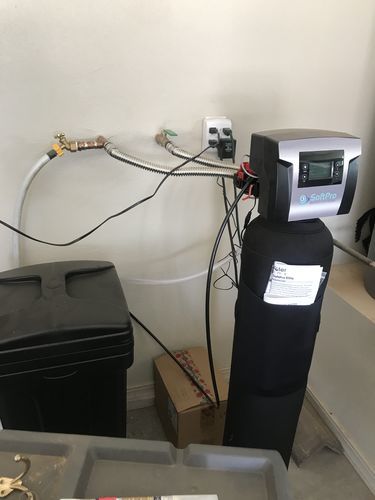

7. How to Contact Hudson Water Department
For billing, outages or a copy of the annual report, contact Hudson Water Department directly. You can call 603-324-8318, visit 12 School Street, Hudson, NH 3051 or go to the utility's website.
Frequently Asked Questions
Where does Hudson Water Department water come from?
Hudson Water Department supplies groundwater to Hudson, New Hampshire.
Does Hudson Water Department test its tap water?
Yes. Like every public water system, Hudson Water Department must test its water under the federal Safe Drinking Water Act and publish an annual water quality report (Consumer Confidence Report). Ask the utility for the latest report or look for it on its website.
Does Hudson Water Department water contain lead?
Water usually leaves the treatment plant without lead. Lead can enter tap water from older service lines, solder and brass fixtures inside homes, especially when water sits in the pipes. Run the tap before drinking if water has been sitting, and ask the utility about lead testing and service line records.
Is Hudson Water Department water hard?
Hardness depends on the source and changes over time. The annual water quality report lists hardness, or you can test it at home. If it is above about 7 grains per gallon, a water softener sized to your measured hardness will stop scale and spotting.
How do I get a water report for my Hudson address?
Use SoftPro's free Local Water Analysis Report, or ask the utility for its latest annual Consumer Confidence Report.
Know Your Hudson Water. Then Pick Your System.
Get your free local water analysis report first, then match the treatment to what is actually in your water.
Get my free water reportSources (checked November 2026)
- Public water system records for the utilities listed on this page (detected and not-detected contaminant lists)
- EPA National Primary Drinking Water Regulations and Consumer Confidence Reports
- USGS: Hardness of Water
- SoftPro product pages for specs, prices and Loox review counts
