




Water Quality Report · Vancouver, WA
How we built this report: from the public water system records for 1 utility serving Vancouver, the federal limits in EPA's drinking water regulations and USGS hardness classes. We sell water treatment, so every claim about your water links to its public source. Records were checked November 2026; your utility's latest annual report has the measured levels.
Shopping for a softener? See our best water softener for Vancouver guide.
Public water in Vancouver, Washington must meet federal Safe Drinking Water Act limits. Public records list 6 contaminants detected in Vancouver water, and a detection is not the same as a violation. The usual fixes are a softener for hard water, whole-house carbon for chlorine and its byproducts, and reverse osmosis for drinking water. Start with a free Local Water Analysis Report for your address.
1. Is Vancouver Tap Water Safe to Drink?
The Safe Drinking Water Act sets the legal limits for Vancouver tap water, and the utility reports its results every year. Low levels of some contaminants can still be in water that passes. Families with babies, older relatives or anyone with a weak immune system may want to ask a doctor about extra filtering.
What comes out of your faucet isn't always what left the plant. Older pipes, solder and brass fixtures can add lead on the way. If water has sat in the pipes for hours, run it for a minute first, and check your address with a free Local Water Analysis Report.

2. What's in Vancouver Water?
Public water system records list 6 contaminants in Vancouver water. Most detections sit below federal limits; the table explains the ones with a limit or a known fix.
| Contaminant | What it is | Federal limit (EPA) | What removes it at home |
|---|---|---|---|
| Total trihalomethanes (TTHMs) | Disinfection byproducts that form when chlorine reacts with natural matter in the water | EPA limit: 80 ppb (running annual average) | A whole-house carbon filter |
| Chloroform and related trihalomethanes | Individual disinfection byproducts counted inside the TTHM total | Counted in the 80 ppb TTHM limit | A whole-house carbon filter |
| Chromium-6 (hexavalent chromium) | A form of chromium from natural deposits and industry | No separate federal limit; total chromium is limited to 100 ppb | Reverse osmosis at the kitchen tap |
| Barium | A metal from natural deposits and drilling waste | EPA limit: 2 ppm | A water softener or reverse osmosis |
All 6 contaminants listed for Vancouver
- Bromodichloromethane
- Chloroform
- Chromium (hexavalent)
- Dibromochloromethane
- Total trihalomethanes (TTHMs)
- Barium

Best Water Treatment for Vancouver Tap Water
- 32K, 40K, 48K or 64K grain sizes
- Uses about 60% less salt than a traditional softener
- IAPMO/NSF certified control valve

- Catalytic carbon for chlorine and chloramine
- Cuts the disinfection byproducts (TTHMs, HAA5) they form
- Treats every tap, shower and appliance

- Bone char plus catalytic carbon
- Reduces fluoride, chlorine and chloramine
- Whole house, made for city water

Prices are the starting price for each system, checked November 2026. Free shipping within the USA on systems (excludes AK, HI and PR).
3. Where Does Vancouver Water Come From?
Vancouver is served by 1 public water system. Each tests its water and publishes the results once a year in a Consumer Confidence Report.
City of Vancouver Water Company
Serves about 231,140 people with groundwater.
6 contaminants detected in public records
4. Is Vancouver Water Hard?
Hardness isn't a health issue, but above about 7 grains per gallon it leaves scale on fixtures, water heaters and appliances. The U.S. Geological Survey rates 61 to 120 mg/L (3.5 to 7 gpg) as moderately hard and over 180 mg/L (10.5 gpg) as very hard. Check the annual report for the hardness figure, or test at home with strips.

A salt-based ion exchange softener is the fix that actually removes hardness. The SoftPro Elite is sized at 32,000, 40,000, 48,000 or 64,000 grains and uses about 60% less salt than older softeners; enter your hardness and household size in the sizing calculator to choose. Our Vancouver water softener guide covers local hardness and installation.
Get Your Vancouver Water Report and Softener Size
Not sure what's in your water or what size you need? Enter your address for a free local water analysis report, and our sizing calculator matches a softener to your hardness and household.
Get my free water report5. How to Treat Vancouver Tap Water
Match the fix to what you want gone: a softener for hardness, carbon for chlorine taste and disinfection byproducts, and reverse osmosis for drinking water. Refrigerator and pitcher filters only treat the water you drink, not your shower, laundry or water heater.
| What you want to fix | What works | SoftPro option |
|---|---|---|
| Hard water scale and spots | Salt-based ion exchange softener | SoftPro Elite water softener |
| Chlorine taste, TTHMs and HAA5 | Whole-house catalytic carbon | Chlorine+ whole-house filter |
| Fluoride | Bone char plus carbon | Fluoride & Chlorine+ SUPER filter |
| Arsenic, nitrate, chromium-6, lead and PFAS in drinking water | Reverse osmosis at the kitchen tap | Reverse osmosis systems |
6. What SoftPro Customers Say
SoftPro has 10,000+ reviews from more than 100,000 customers. Most install the system themselves, and every system comes with a 6-MONTH money-back guarantee with no restocking fee.
"No more ugly calcium deposits in bath/shower and around fixtures! I love all the advanced features around regeneration and less salt use, too!"
Jeffrey S., verified Loox review, May 2026"The soft water is lovely. It has only had to regenerate twice in 30 days unlike my older unit... I like the display showing the usage, flow rate and remaining charge in gallons."
Michael C., verified Loox review, March 2026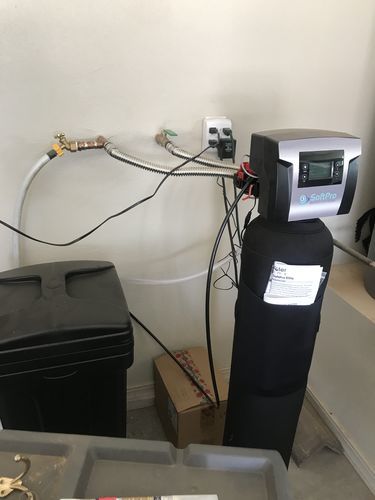

Frequently Asked Questions
Is Vancouver water hard or soft?
Moderately hard. City of Vancouver Water's report gives 3.2 to 7.6 gpg, which the USGS scale calls moderately hard.
Is Vancouver tap water safe to drink?
Yes, by the legal standard. City of Vancouver Water's 2025 report shows every regulated result under its legal limit with no violations. If you want less chlorine and fewer disinfection byproducts, carbon filtration plus reverse osmosis at the kitchen sink is the usual approach.
Does Vancouver water have chlorine or chloramine?
The 2025 report lists chlorine as the disinfectant: 0.4 to 1.3 ppm against a 4 ppm limit. Catalytic carbon reduces its taste and smell at every tap.
Is there fluoride in Vancouver water?
The 2025 report shows 0.22 to 0.67 ppm, against a limit of 4 ppm. Bone char or reverse osmosis reduces it if you prefer less.
Where can I find the Vancouver water quality report?
City of Vancouver Water posts its 2025 Annual Water Quality Report online; the Sources list below links to it. Lead and copper sampling may come from an earlier year than the rest of the report.
Do I need a water softener in Vancouver?
Only if a test shows hard water, roughly 7 grains per gallon or more, or you're fighting scale and spots. A softener removes calcium and magnesium; it doesn't remove chlorine, lead, nitrate or trihalomethanes.
How do I get a water report for my Vancouver address?
Use SoftPro's free Local Water Analysis Report, or ask your utility for its latest annual Consumer Confidence Report.
Know Your Vancouver Water. Then Pick Your System.
Get your free local water analysis report first, then match the treatment to what is actually in your water.
Get my free water reportSources (checked November 2026)
- Public water system records for the utilities listed on this page (detected and not-detected contaminant lists)
- EPA National Primary Drinking Water Regulations and Consumer Confidence Reports
- USGS: Hardness of Water
- SoftPro product pages for specs, prices and Loox review counts
