




Water Utility · Camp Pendleton, CA
How we built this page: from Camp Pendleton (South) Water Company's public water system records (detected and not-detected contaminant lists), the federal limits in EPA's drinking water regulations and USGS hardness classes. Records were checked November 2026; the utility's latest annual report has the measured levels.
Camp Pendleton (South) Water Company supplies groundwater to about 39,940 people in Camp Pendleton, California. Public records list 7 contaminants detected in its water; a detection is not the same as a violation. For billing or a copy of the annual report, contact the utility directly; for what to do about your own tap, start with a free Local Water Analysis Report.
Camp Pendleton (South) Water Company at a Glance
| Area served | Camp Pendleton, California |
|---|---|
| Population served | 39,940 |
| Water source | Groundwater |
| Phone | 800-350-7873 |
| Address | 928 North Coast Hwy, Oceanside, CA 92054 |
| Contaminants detected | 7 listed in public records |
1. Where Does Camp Pendleton Water Come From?
Camp Pendleton (South) Water Company delivers groundwater to homes and businesses in Camp Pendleton, California. It serves about 39,940 people. Every public water system must test its water under the federal Safe Drinking Water Act and publish the results each year in a Consumer Confidence Report.
From the Camp Pendleton (South) Water Company report
Unlike most of Southern California that relies on imported water, MCB Camp Pendleton's municipal water primarily comes from local groundwater resources. The base's wells supply water to all areas except San Mateo Point Housing, which receives water from South Coast Water District.
MCB Camp Pendleton maintains rigorous water quality monitoring protocols. The base conducts over 20,000 annual water tests to check for more than 200 different potential contaminants. This comprehensive testing helps ensure compliance with EPA and California State Water Resources Control Board standards. While most substances test below detectable limits, some occasional variations occur. The official water quality reports detail these findings.
Read the full results in the latest annual water quality report on the Camp Pendleton (South) Water Company website (the 2017 report we have on file), or see what EPA requires in every report on its Consumer Confidence Report page.

2. What Has Camp Pendleton (South) Water Company Detected in Its Water?
Public records list 7 contaminants detected in Camp Pendleton (South) Water Company water. A detection means a test found it at any level. Most results sit below federal limits; the table explains the ones with a limit or a known fix.
| Contaminant | What it is | Federal limit (EPA) | What removes it at home |
|---|---|---|---|
| Total trihalomethanes (TTHMs) | Disinfection byproducts that form when chlorine reacts with natural matter in the water | EPA limit: 80 ppb (running annual average) | A whole-house carbon filter |
| Haloacetic acids (HAA5) | A second group of chlorine disinfection byproducts | EPA limit: 60 ppb for the five combined | A whole-house carbon filter |
| Chloroform and related trihalomethanes | Individual disinfection byproducts counted inside the TTHM total | Counted in the 80 ppb TTHM limit | A whole-house carbon filter |
| Chromium-6 (hexavalent chromium) | A form of chromium from natural deposits and industry | No separate federal limit; total chromium is limited to 100 ppb | Reverse osmosis at the kitchen tap |
| Arsenic | A metal that occurs naturally in rock and soil | EPA limit: 10 ppb | Reverse osmosis at the kitchen tap |
| Unregulated metals and chemicals | Substances EPA monitors but has not set a federal limit for | No federal limit | Reverse osmosis at the kitchen tap |
All 7 detected contaminants
- Arsenic
- Bromodichloromethane
- Chlorate
- Chromium (hexavalent)
- Dibromochloromethane
- Dichloroacetic acid
- Total trihalomethanes (TTHMs)
Tested but not detected (139)
- 1,1,1,2-Tetrachloroethane
- 1,1,1-Trichloroethane
- 1,1,2,2-Tetrachloroethane
- 1,1,2-Trichloroethane
- 1,1-Dichloroethane
- 1,1-Dichloroethylene
- 1,1-Dichloropropene
- 1,2,3-Trichlorobenzene
- 1,2,3-Trichloropropane
- 1,2,4-Trichlorobenzene
- 1,2,4-Trimethylbenzene
- 1,2-Dichloroethane
- 1,2-Dichloropropane
- 1,3,5-Trimethylbenzene
- 1,3-Butadiene
- 1,3-Dichloropropane
- 1,3-Dichloropropene
- 2,2-Dichloropropane
- 2,3,7,8-TCDD (Dioxin)
- 2,4,5-TP (Silvex)
- 2,4-D
- 2,4-Dinitrotoluene
- 3-Hydroxycarbofuran
- Alachlor (Lasso)
- Aldicarb
- Aldicarb sulfone
- Aldicarb sulfoxide
- Aldrin
- Aluminum
- Antimony
- Asbestos
- Atrazine
- Baygon (Propoxur)
- Bentazon (Basagran)
- Benzene
- Benzo[a]pyrene
- Beryllium
- Bromacil
- Bromobenzene
- Bromochloromethane
- Bromomethane
- Butachlor
- Cadmium
- Caffeine
- Carbaryl
- Carbofuran
- Carbon tetrachloride
- Chlordane
- Chlorodifluoromethane
- Chloroethane
- Chloromethane
- cis-1,2-Dichloroethylene
- cis-1,3-Dichloropropene
- Cobalt
- Cyanide
- Dalapon
- DCPA mono- and di-acid degradates
- Di(2-ethylhexyl) adipate
- Di(2-ethylhexyl) phthalate
- Diazinon (Spectracide)
- Dibromomethane
- Dicamba
- Dichlorodifluoromethane
- Dichloromethane (methylene chloride)
- Dieldrin
- Dimethoate
- Dinoseb
- Diquat
- Endothall
- Endrin
- Ethyl tert-butyl ether
- Ethylbenzene
- Ethylene dibromide
- Glyphosate
- Heptachlor
- Heptachlor epoxide
- Hexachlorobenzene (HCB)
- Hexachlorobutadiene
- Hexachlorocyclopentadiene
- Isopropyl ether
- Isopropylbenzene
- Lindane
- m- & p-Xylene
- m-Dichlorobenzene
- Mercury (inorganic)
- Methiocarb
- Methomyl
- Methoxychlor
- Methyl ethyl ketone
- Methyl isobutyl ketone
- Metolachlor
- Metribuzin
- Molinate
- Monochloroacetic acid
- Monochlorobenzene (chlorobenzene)
- MTBE
- n-Butylbenzene
- n-Propylbenzene
- Naphthalene
- Nitrate & nitrite
- Nitrite
- o-Chlorotoluene
- o-Dichlorobenzene
- o-Xylene
- Oxamyl (Vydate)
- p-Chlorotoluene
- p-Dichlorobenzene
- p-Isopropyltoluene
- Pentachlorophenol
- Perchlorate
- Perfluorobutane sulfonate (PFBS)
- Perfluoroheptanoic acid (PFHPA)
- Perfluorononanoic acid (PFNA)
- Perfluorooctane sulfonate (PFOS)
- Picloram
- Polychlorinated biphenyls (PCBs)
- Propachlor
- Radium-226
- sec-Butylbenzene
- Selenium
- Silver
- Simazine
- Strontium-90
- Styrene
- tert-Amyl methyl ether
- tert-Butylbenzene
- Tetrachloroethylene (perchloroethylene)
- Thallium
- Thiobencarb
- Toluene
- Toxaphene
- trans-1,2-Dichloroethylene
- trans-1,3-Dichloropropene
- Trichloroethylene
- Trichlorofluoromethane
- Trichlorotrifluoroethane
- Tritium
- Vinyl chloride
- Xylenes (total)

Best Water Treatment for Camp Pendleton Tap Water
- 32K, 40K, 48K or 64K grain sizes
- Uses about 60% less salt than a traditional softener
- IAPMO/NSF certified control valve

- Catalytic carbon for chlorine and chloramine
- Cuts the disinfection byproducts (TTHMs, HAA5) they form
- Treats every tap, shower and appliance

- Bone char plus catalytic carbon
- Reduces fluoride, chlorine and chloramine
- Whole house, made for city water

Prices are the starting price for each system, checked November 2026. Free shipping within the USA on systems (excludes AK, HI and PR).
3. Is Camp Pendleton Tap Water Safe to Drink?
The Safe Drinking Water Act sets the legal limits for Camp Pendleton (South) Water Company water, and the utility reports its results every year. Low levels of some contaminants can still be in water that passes. Families with babies, older relatives or anyone with a weak immune system may want to ask a doctor about extra filtering.
What comes out of your faucet isn't always what left the plant. Older pipes, solder and brass fixtures can add lead on the way. If water has sat in the pipes for hours, run it for a minute first, and check your address with a free Local Water Analysis Report.
4. Is Camp Pendleton Water Hard?
Hardness isn't a health issue, but above about 7 grains per gallon it leaves scale on fixtures, water heaters and appliances. The U.S. Geological Survey rates 61 to 120 mg/L (3.5 to 7 gpg) as moderately hard and over 180 mg/L (10.5 gpg) as very hard. Check the Camp Pendleton (South) Water Company report for its hardness figure, or test at home with strips.

To stop scale, size a salt-based softener to your hardness and water use. The SoftPro Elite (32,000 to 64,000 grains) uses about 60% less salt than a traditional softener, and most owners install it themselves. Start with the sizing calculator.
Get Your Camp Pendleton Water Report and Softener Size
Not sure what's in your water or what size you need? Enter your address for a free local water analysis report, and our sizing calculator matches a softener to your hardness and household.
Get my free water report5. How to Treat Camp Pendleton Tap Water
There's no single filter for everything, so start from the problem. Hardness needs a softener, chlorine and its byproducts need carbon, and dissolved metals and nitrate in drinking water need reverse osmosis. A pitcher or fridge filter covers one glass at a time, not the whole house.
| What you want to fix | What works | SoftPro option |
|---|---|---|
| Hard water scale and spots | Salt-based ion exchange softener | SoftPro Elite water softener |
| Chlorine taste, TTHMs and HAA5 | Whole-house catalytic carbon | Chlorine+ whole-house filter |
| Fluoride | Bone char plus carbon | Fluoride & Chlorine+ SUPER filter |
| Arsenic, nitrate, chromium-6, lead and PFAS in drinking water | Reverse osmosis at the kitchen tap | Reverse osmosis systems |
6. What SoftPro Customers Say
SoftPro has 10,000+ reviews from more than 100,000 customers. Most install the system themselves, and every system comes with a 6-MONTH money-back guarantee with no restocking fee.
"The soft water is lovely. It has only had to regenerate twice in 30 days unlike my older unit... I like the display showing the usage, flow rate and remaining charge in gallons."
Michael C., verified Loox review, March 2026"No more ugly calcium deposits in bath/shower and around fixtures! I love all the advanced features around regeneration and less salt use, too!"
Jeffrey S., verified Loox review, May 2026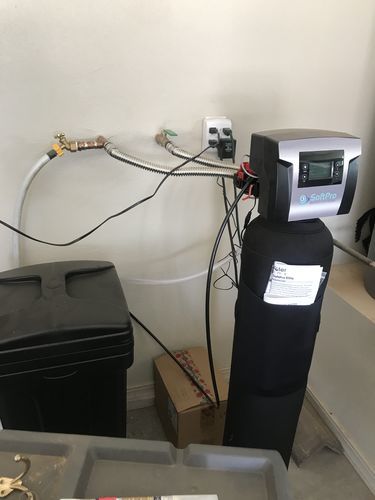

7. How to Contact Camp Pendleton (South) Water Company
For billing, outages or a copy of the annual report, contact Camp Pendleton (South) Water Company directly. You can call 800-350-7873, visit 928 North Coast Hwy, Oceanside, CA 92054 or go to the utility's website.
Frequently Asked Questions
Where does Camp Pendleton (South) water come from?
Camp Pendleton (South) supplies groundwater to Camp Pendleton, California.
Does Camp Pendleton (South) test its tap water?
Yes. Like every public water system, Camp Pendleton (South) must test its water under the federal Safe Drinking Water Act and publish an annual water quality report (Consumer Confidence Report). Ask the utility for the latest report or look for it on its website.
Does Camp Pendleton (South) water contain lead?
Water usually leaves the treatment plant without lead. Lead can enter tap water from older service lines, solder and brass fixtures inside homes, especially when water sits in the pipes. Run the tap before drinking if water has been sitting, and ask the utility about lead testing and service line records.
Is Camp Pendleton (South) water hard?
Hardness depends on the source and changes over time. The annual water quality report lists hardness, or you can test it at home. If it is above about 7 grains per gallon, a water softener sized to your measured hardness will stop scale and spotting.
How do I get a water report for my Camp Pendleton address?
Use SoftPro's free Local Water Analysis Report, or ask the utility for its latest annual Consumer Confidence Report.
Know Your Camp Pendleton Water. Then Pick Your System.
Get your free local water analysis report first, then match the treatment to what is actually in your water.
Get my free water reportSources (checked November 2026)
- Public water system records for the utilities listed on this page (detected and not-detected contaminant lists)
- EPA National Primary Drinking Water Regulations and Consumer Confidence Reports
- USGS: Hardness of Water
- SoftPro product pages for specs, prices and Loox review counts
