



Water Utility · Sarasota, FL
How we built this page: from Sarasota County Special Utility District's public water system records (detected and not-detected contaminant lists), the federal limits in EPA's drinking water regulations and USGS hardness classes. Records were checked November 2026; the utility's latest annual report has the measured levels.
Want the whole picture for Sarasota, including other local utilities? See the Sarasota water quality report.
Sarasota County Special Utility District supplies purchased surface water to about 171,533 people in Sarasota, Florida. Public records list 8 contaminants detected in its water; a detection is not the same as a violation. For billing or a copy of the annual report, contact the utility directly; for what to do about your own tap, start with a free Local Water Analysis Report.
Sarasota County Special Utility District at a Glance
| Area served | Sarasota, Florida |
|---|---|
| Population served | 171,533 |
| Water source | Purchased surface water |
| Phone | 941-861-6790 |
| Address | 1001 Sarasota Center Blvd., Sarasota, FL 34240 |
| Contaminants detected | 8 listed in public records |
1. Where Does Sarasota Water Come From?
Sarasota County Special Utility District delivers purchased surface water to homes and businesses in Sarasota, Florida. It serves about 171,533 people. Every public water system must test its water under the federal Safe Drinking Water Act and publish the results each year in a Consumer Confidence Report.
From the Sarasota County Special Utility District report
Quality Assurance Program • The district conducts daily water sampling throughout the distribution system, analyzing over 120 monthly samples for bacterial content. • Specialized samples from treatment facilities and distribution networks undergo daily testing for process control, exceeding all regulatory requirements.
Key Terms Explained • MRDLG: Maximum residual disinfectant level goal - Safe level with no known health risks • MRDL: Maximum residual disinfectant level - Highest allowed disinfectant level • ND: Not detected in laboratory analysis • TT: Treatment technique required to reduce contaminant levels • AL: Action level triggering treatment requirements • MCL: Maximum contaminant level allowed in municipal water • MCLG: Maximum contaminant level goal below which no health risks exist • NTU: Nephelometric turbidity unit measuring water clarity • PCI/l: Picocuries per liter measuring radioactivity
Read the full results in the Sarasota County Special Utility District annual water quality report, or see what EPA requires in every report on its Consumer Confidence Report page.

2. What Has Sarasota County Special Utility District Detected in Its Water?
Public records list 8 contaminants detected in Sarasota County Special Utility District water. A detection means a test found it at any level. Most results sit below federal limits; the table explains the ones with a limit or a known fix.
| Contaminant | What it is | Federal limit (EPA) | What removes it at home |
|---|---|---|---|
| Total trihalomethanes (TTHMs) | Disinfection byproducts that form when chlorine reacts with natural matter in the water | EPA limit: 80 ppb (running annual average) | A whole-house carbon filter |
| Chromium-6 (hexavalent chromium) | A form of chromium from natural deposits and industry | No separate federal limit; total chromium is limited to 100 ppb | Reverse osmosis at the kitchen tap |
| Nitrate | Mostly from fertilizer, septic systems and natural deposits | EPA limit: 10 ppm (as nitrogen) | Reverse osmosis at the kitchen tap |
| Barium | A metal from natural deposits and drilling waste | EPA limit: 2 ppm | A water softener or reverse osmosis |
| Nitrite | From fertilizer runoff, septic systems and sewage | EPA limit: 1 ppm (as nitrogen) | Reverse osmosis at the kitchen tap |
| Unregulated metals and chemicals | Substances EPA monitors but has not set a federal limit for | No federal limit | Reverse osmosis at the kitchen tap |
All 8 detected contaminants
- Chlorate
- Chromium (hexavalent)
- Strontium
- Total trihalomethanes (TTHMs)
- Nitrite
- Barium
- Molybdenum
- Nitrate
Tested but not detected (84)
- 1,1,1-Trichloroethane
- 1,1,2-Trichloroethane
- 1,1-Dichloroethane
- 1,1-Dichloroethylene
- 1,2,3-Trichloropropane
- 1,2,4-Trichlorobenzene
- 1,2-Dibromo-3-chloropropane (DBCP)
- 1,2-Dichloroethane
- 1,2-Dichloropropane
- 1,3-Butadiene
- 1,4-Dioxane
- 17-beta-Estradiol
- 2,3,7,8-TCDD (Dioxin)
- 2,4,5-TP (Silvex)
- 2,4-D
- 4-Androstene-3,17-dione
- Alachlor (Lasso)
- Aluminum
- Antimony
- Arsenic
- Asbestos
- Atrazine
- Benzene
- Benzo[a]pyrene
- Beryllium
- Bromochloromethane
- Bromomethane
- Cadmium
- Carbofuran
- Carbon tetrachloride
- Chlordane
- Chlorodifluoromethane
- Chloromethane
- cis-1,2-Dichloroethylene
- Cobalt
- Dalapon
- Di(2-ethylhexyl) adipate
- Di(2-ethylhexyl) phthalate
- Dichloromethane (methylene chloride)
- Dinoseb
- Diquat
- Endothall
- Endrin
- Equilin
- Estriol
- Estrone
- Ethinyl estradiol
- Ethylbenzene
- Ethylene dibromide
- Glyphosate
- Heptachlor
- Heptachlor epoxide
- Hexachlorobenzene (HCB)
- Hexachlorocyclopentadiene
- Lindane
- Manganese
- Mercury (inorganic)
- Methoxychlor
- Monochlorobenzene (chlorobenzene)
- o-Dichlorobenzene
- Oxamyl (Vydate)
- p-Dichlorobenzene
- Pentachlorophenol
- Perfluorobutane sulfonate (PFBS)
- Perfluoroheptanoic acid (PFHPA)
- Perfluorohexane sulfonate (PFHXS)
- Perfluorononanoic acid (PFNA)
- Perfluorooctane sulfonate (PFOS)
- Perfluorooctanoic acid (PFOA)
- Picloram
- Polychlorinated biphenyls (PCBs)
- Selenium
- Silver
- Simazine
- Styrene
- Testosterone
- Tetrachloroethylene (perchloroethylene)
- Thallium
- Toluene
- Toxaphene
- trans-1,2-Dichloroethylene
- Trichloroethylene
- Vinyl chloride
- Xylenes (total)

Best Water Treatment for Sarasota Tap Water
- 32K, 40K, 48K or 64K grain sizes
- Uses about 60% less salt than a traditional softener
- IAPMO/NSF certified control valve

- Catalytic carbon for chlorine and chloramine
- Cuts the disinfection byproducts (TTHMs, HAA5) they form
- Treats every tap, shower and appliance

- Bone char plus catalytic carbon
- Reduces fluoride, chlorine and chloramine
- Whole house, made for city water

Prices are the starting price for each system, checked November 2026. Free shipping within the USA on systems (excludes AK, HI and PR).
3. Is Sarasota Tap Water Safe to Drink?
Sarasota County Special Utility District water has to meet federal Safe Drinking Water Act limits, and the annual report says whether it did. Contaminants can still be present below those limits. Infants, pregnant women, older adults and people with weakened immune systems should ask a doctor about their drinking water.
What comes out of your faucet isn't always what left the plant. Older pipes, solder and brass fixtures can add lead on the way. If water has sat in the pipes for hours, run it for a minute first, and check your address with a free Local Water Analysis Report.
4. Is Sarasota Water Hard?
Hard water won't hurt you, but it costs money: scale builds up in water heaters, dishwashers and shower heads once hardness passes about 7 grains per gallon. The USGS calls 3.5 to 7 gpg (61 to 120 mg/L) moderately hard and anything over 10.5 gpg (180 mg/L) very hard. Check the Sarasota County Special Utility District report for its hardness figure, or test at home with strips.

To stop scale, size a salt-based softener to your hardness and water use. The SoftPro Elite (32,000 to 64,000 grains) uses about 60% less salt than a traditional softener, and most owners install it themselves. Start with the sizing calculator.
Get Your Sarasota Water Report and Softener Size
Not sure what's in your water or what size you need? Enter your address for a free local water analysis report, and our sizing calculator matches a softener to your hardness and household.
Get my free water report5. How to Treat Sarasota Tap Water
Pick treatment by contaminant: whole-house carbon for chlorine and byproducts, a softener for scale, and reverse osmosis at the kitchen sink for what you drink. Point-of-use pitchers help with taste but don't reach showers, laundry or appliances.
| What you want to fix | What works | SoftPro option |
|---|---|---|
| Hard water scale and spots | Salt-based ion exchange softener | SoftPro Elite water softener |
| Chlorine taste, TTHMs and HAA5 | Whole-house catalytic carbon | Chlorine+ whole-house filter |
| Fluoride | Bone char plus carbon | Fluoride & Chlorine+ SUPER filter |
| Arsenic, nitrate, chromium-6, lead and PFAS in drinking water | Reverse osmosis at the kitchen tap | Reverse osmosis systems |
6. What SoftPro Customers Say
SoftPro has 10,000+ reviews from more than 100,000 customers. Most install the system themselves, and every system comes with a 6-MONTH money-back guarantee with no restocking fee.
"No more ugly calcium deposits in bath/shower and around fixtures! I love all the advanced features around regeneration and less salt use, too!"
Jeffrey S., verified Loox review, May 2026"The soft water is lovely. It has only had to regenerate twice in 30 days unlike my older unit... I like the display showing the usage, flow rate and remaining charge in gallons."
Michael C., verified Loox review, March 2026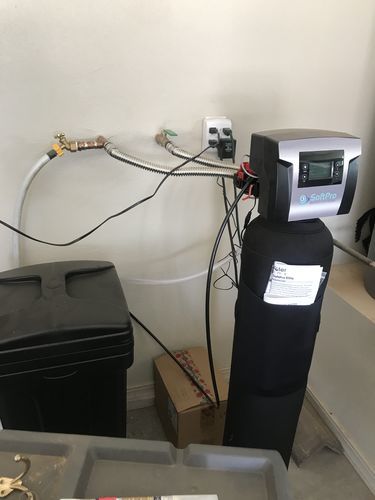

7. How to Contact Sarasota County Special Utility District
For billing, outages or a copy of the annual report, contact Sarasota County Special Utility District directly. You can call 941-861-6790, visit 1001 Sarasota Center Blvd., Sarasota, FL 34240 or go to the utility's website.
Frequently Asked Questions
Where does Sarasota County Special Utility District water come from?
Sarasota County Special Utility District supplies purchased surface water to Sarasota, Florida.
Does Sarasota County Special Utility District test its tap water?
Yes. Like every public water system, Sarasota County Special Utility District must test its water under the federal Safe Drinking Water Act and publish an annual water quality report (Consumer Confidence Report). Ask the utility for the latest report or look for it on its website.
Does Sarasota County Special Utility District water contain lead?
Water usually leaves the treatment plant without lead. Lead can enter tap water from older service lines, solder and brass fixtures inside homes, especially when water sits in the pipes. Run the tap before drinking if water has been sitting, and ask the utility about lead testing and service line records.
Is Sarasota County Special Utility District water hard?
Hardness depends on the source and changes over time. The annual water quality report lists hardness, or you can test it at home. If it is above about 7 grains per gallon, a water softener sized to your measured hardness will stop scale and spotting.
How do I get a water report for my Sarasota address?
Use SoftPro's free Local Water Analysis Report, or ask the utility for its latest annual Consumer Confidence Report.
Know Your Sarasota Water. Then Pick Your System.
Get your free local water analysis report first, then match the treatment to what is actually in your water.
Get my free water reportSources (checked November 2026)
- Public water system records for the utilities listed on this page (detected and not-detected contaminant lists)
- EPA National Primary Drinking Water Regulations and Consumer Confidence Reports
- USGS: Hardness of Water
- SoftPro product pages for specs, prices and Loox review counts
